
If you were lucky enough to be invited to Sir Lawrence Alma-Tadema’s home in St John’s Wood, you would eventually find yourself facing a small puzzle.
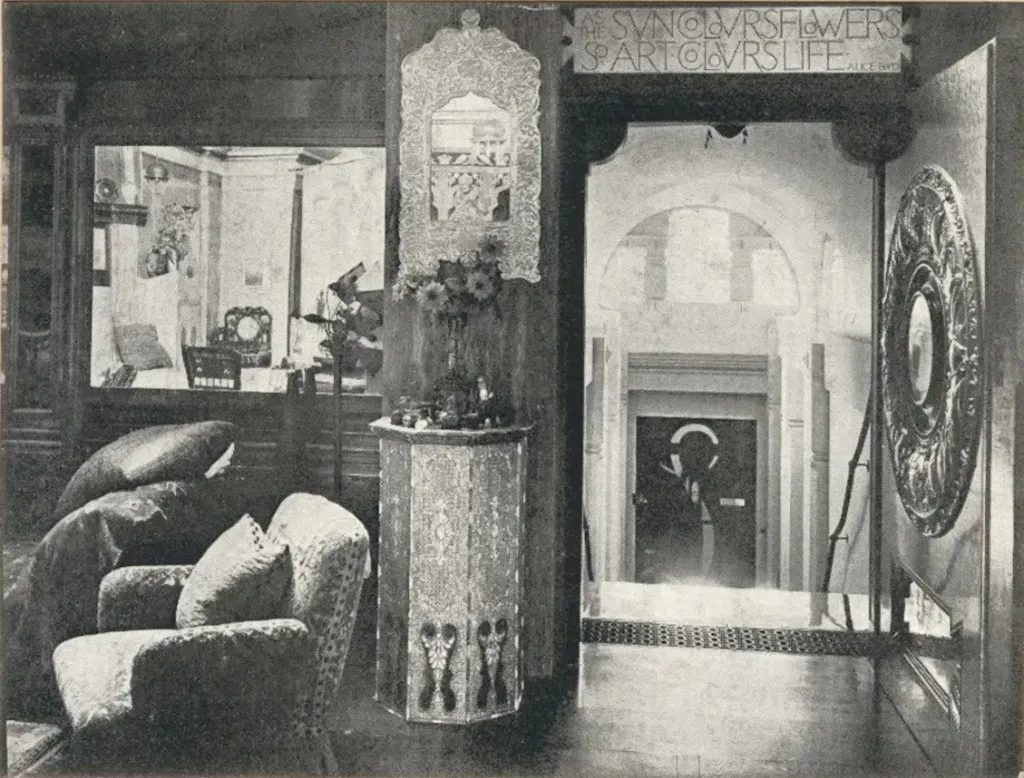
Having ascended the famous "Gold Staircase"—a flight of steps made of solid, polished brass, flanked by handrails of yellow and black silk rope—you would find yourself in a space of transition. The ascent was ritualistic; models were required to remove their street shoes and slide into soft felt slippers before treading upon the burnished metal, ensuring that the silence of the sanctuary remained unbroken. Standing before the heavy door, a motto above the lintel proclaimed the artist’s creed: "The sun colours flowers, and Art colours the world."
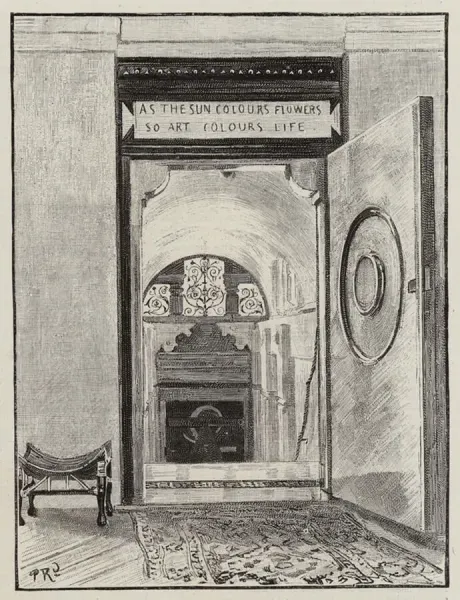
But beneath this poetic welcome, the door itself presented a challenge. You couldn’t simply walk in. There was no handle to turn, no latch to lift—nothing to disrupt the smooth, metallic surface. Instead, your path was blocked by a massive, four-foot disk of beaten brass that looked more like a shield from a mythological battle than a piece of domestic decor.
To enter the room, you had to know the secret. In place of a knob, Alma-Tadema had placed a beautiful flower, either painted or wrought into the metal. It appeared as a delicate ornament, yet it held a mechanical secret: at its center lay a hidden spring. To the uninitiated, the door was an impenetrable wall; to a friend, a gentle touch of the flower’s heart caused the catch to release, and the door would swing open to reveal the artist within.
This wasn't just a theatrical trick. It was a masterpiece of engineering and art, created by one of the most interesting (and overlooked) figures in Alma-Tadema’s circle: his neighbor, George Blackall Simonds.
The Scion of Reading
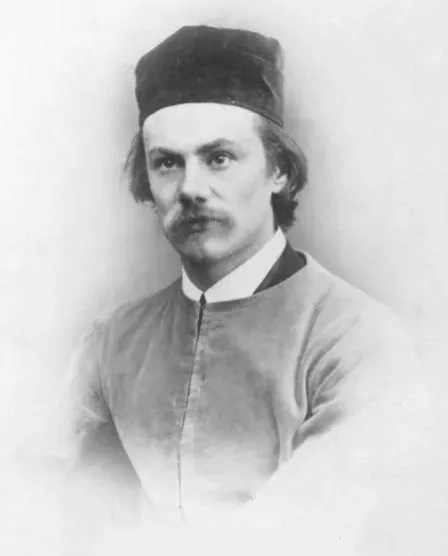
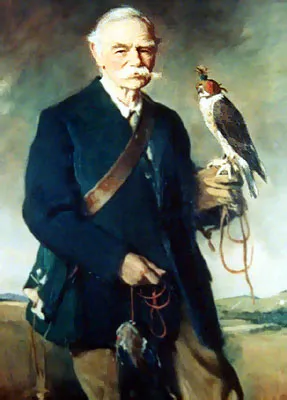
George Simonds was a man of two worlds, though at the time of this story, he was still firmly planted in one. Born into the wealthy dynasty behind the H & G Simonds Brewery in Reading, he had turned his back on the family business to pursue art, studying in Dresden and Rome to become a highly respected sculptor.
In the 1890s, he was still a dedicated artist and the first Master of the Art Workers Guild. It was only later, in 1905, that he would inherit the family empire and trade his chisel for a boardroom chair. But even as a sculptor, he possessed the systematic, engineering mind of an industrialist—and the passion of a master falconer—traits that would prove essential for the difficult task Alma-Tadema was about to set him.
He lived just a few streets away from Alma-Tadema, at "The Priory" on North Bank. The two men were both members of the Art Workers Guild, a group that believed there should be no division between "high art" (like painting) and "craft" (like metalwork). For them, a door handle deserved as much artistic attention as a portrait.
The "Blank Cheque" Commission
The story of the door began as a friendly offer. Simonds had often told Alma-Tadema that he wanted to contribute something to the magnificent house he was building at 17 Grove End Road.
For months, the offer remained just a polite conversation. Then, one day, a letter arrived at Simonds’ studio.
Alma-Tadema hadn't sent a detailed blueprint. He hadn't asked for a specific scene from mythology. Instead, he had cut out a simple circle of plain white paper. He wrote the required dimensions on it and added a single instruction:
"This is what I want for the door of my studio... but it must be repoussé and in brass."
He was effectively giving Simonds a blank canvas and total creative freedom. The only requirement was the material.
A Crash Course in Repoussé
So, what exactly is repoussé?
It is a metalworking technique that is as exhausting as it is delicate. The word comes from the French for "pushed back." Instead of carving into the metal (which would be engraving), the artist takes a sheet of metal and hammers it from the reverse side. This pushes the metal outward, creating a raised design on the front.
It sounds simple, but try to imagine doing it on a brass disk nearly four feet wide.
As you hammer brass, the metal gets stressed. It becomes hard and brittle, liable to crack if you hit it one too many times. To fix this, you have to "anneal" it—heat it up until it glows red, which relaxes the metal structure, and then let it cool.
Simonds faced a major engineering problem: he didn't have a furnace big enough for the door shield. If he heated one part of the disk while the other was cool, the whole thing would warp and twist like a potato chip.
His solution was to become an inventor. He built a custom iron table—essentially a giant tray on legs—and filled it with charcoal. He laid the massive brass shield on top, creating a bed of even heat that kept the metal soft and workable. He then used gas blow-pipes to do the fine soldering work. It was a massive industrial effort for a "decorative" object. The project was so complex that it remained "in hand" for a full year, though Simonds likely worked on it intermittently between his other duties.
His perfectionism was absolute. Before hammering the final shield for the door, Simonds actually made a complete duplicate model in brass first, "beating it out as carefully as the other," just to ensure the technique was flawless. This duplicate model was likely the piece exhibited years later at the Walker Art Gallery in Liverpool (1898) under the title Central Decoration for the Studio Door of L. Alma Tadema, Esq., RA (Item 1443), listed as "not for sale."
The Head of Invention
The final design was split into four sections, intricately mapping the cycle of the day. On the top right, Dawn appears as a female figure beneath the morning star, with a lark rising at her feet. Opposite her is Daylight, a man crowned with the sun, holding a trumpet to summon the world to work. Below Dawn sits Evening, depicted as a laborer resting with food and drink after his toil, while Night is represented by a sleeping woman watched over by a crescent moon.
But the most touching detail was placed at the very top, crowning the entire cycle.
Simonds hammered out a head with butterfly wings, which he called "The Head of Invention."
It was a graceful nod to the people living behind the door. Simonds knew that the Alma-Tadema household was a factory of imagination. There was Lawrence, the master painter; his wife Laura, a gifted artist in her own right; his daughter Anna, who painted delicate watercolors; and his daughter Laurence, a novelist and poet.
By placing the "Head of Invention" at the top of the shield, Simonds was saying that the most important thing happening in that room wasn't the mixing of paints or the selling of canvases—it was the invention of new worlds.
The Secret Button
Finally, there was the matter of the lock. A standard brass door handle would have ruined the "ancient shield" aesthetic.
Simonds solved this by hiding the mechanism in plain sight. The outer rim of the shield was decorated with a repeating pattern of Greek honeysuckle flowers (a classic motif in architecture).
One of these manufacturing bosses was "live." It was connected to a spring-loaded catch. When a visitor pressed their thumb against that specific honeysuckle, the catch released.
It acted as a subtle gatekeeper. If you were a stranger, you were stuck on the landing. If you were a friend—if you belonged—you knew where to press. It transformed the simple act of opening a door into a secret handshake, a tactile reminder that you were entering a private sanctuary of art.
A Contribution to the Temple of Friendship
This door wasn't an isolated gesture. It was a key piece in the "artistic economy" that thrived at 17 Grove End Road.
Just as John Singer Sargent, Lord Leighton, and Val Prinsep had gifted paintings to fill the famous "Hall of Panels" in the antechamber, Simonds—the sculptor—offered his contribution in brass. As Rudolph de Cordova noted in his 1911 chronicle of the house, Simonds' shield stood as a "third artistic adjunct" to the hall, equal in significance to the paintings that lined the walls.
While the painters covered the surfaces with color, Simonds ensured that the very act of entering the studio was a tactile experience of craftsmanship. Hanging there until the house’s dismantling in 1913, the brass shield was a physical testament to the ideal that Alma-Tadema and Simonds shared: that a house should not just contain art, but be art, built by the hands of friends.
Despite the grandeur of his surroundings and the mechanical wonders he commissioned, Alma-Tadema remained remarkably humble. Amidst the marble and the brass, he was known to remark to his visitors with genuine sincerity: "Ah! I have a lot to learn yet." Even behind a door of gold and secrets, the master still considered himself a student of the light.
Leave a Visiting Card
Consulting the visiting cards...