The year is 1874. It is 4:00 AM on a Friday morning in October.
In the bedroom of Townshend House, North Gate, Regent’s Park, Lawrence Tadema (as he was then known) is asleep beside his young wife, Laura Epps. Down the hall, his two small daughters, Laurense and Anna, are sleeping in their nursery.
Suddenly, the world ends.
A deafening roar tears through the silence. The entire house lifts off its foundations and slams back down. Every window in the building shatters instantly, sending a blizzard of razor-sharp glass flying through the dark rooms. The heavy front door is blown off its hinges.
It feels like an earthquake. It sounds like the apocalypse.
But it was neither. It was a barge named the Tilbury, carrying five tons of gunpowder and petroleum, which had just exploded on the Regent’s Canal, directly behind Lawrence Tadema's garden.
The Survival
Miraculously, no one in the Lawrence Tadema household was killed.
Lawrence Tadema leaped from bed, his feet crunching on broken glass, and rushed to the nursery. He found the window frames blown inward, lying across the beds where his daughters slept. By a stroke of impossible luck, the heavy frames had formed a tent over the girls, shielding them from the debris.
They emerged from the house into a scene of devastation. The blast had flattened the bridge. Dead birds fell from the sky. The trees in Regents Park were stripped bare of their leaves in a second.
For a man who had fled the continent to escape the chaos of war, the war seemed to have followed him to London.
The Ruin of the First Studio
When the sun rose, the true scale of the damage became clear. Townshend House—the home Tadema had spent three years carefully decorating—was a wreck.
His studio was destroyed. Unfinished canvases were slashed by glass. His collection of antique photographs, his carefully curated props, his "Golden Room"—all lay in ruins covered in soot and black dust.
Lawrence Tadema was a man obsessed with order and beauty. To see his sanctuary reduced to chaos could have broken him. Critics and rivals might have expected the "foreign painter" to pack his bags and leave the dangerous city of London.
Instead, Lawrence Tadema did something characteristic. He looked at the ruins, lit a cigar, and decided to negotiate.
The Phoenix of Townshend House
He sued the canal company. And more importantly, he used the insurance payout not just to repair the house, but to reinvent it.
The destruction of Townshend House gave Lawrence Tadema a blank slate. He realized he didn't just want a home; he wanted a stage set.
He began a renovation that would make him famous among the London elite. He didn't rebuild a Victorian house; he built a Roman villa inside a London shell.
- The Dutch Room: He installed heavy oak paneling and antique cabinets, recreating the 17th-century interiors of his childhood.
- The Gold Room: He used real gold leaf on the walls, creating a shimmering, windowless space that glowed like a Byzantine shrine.
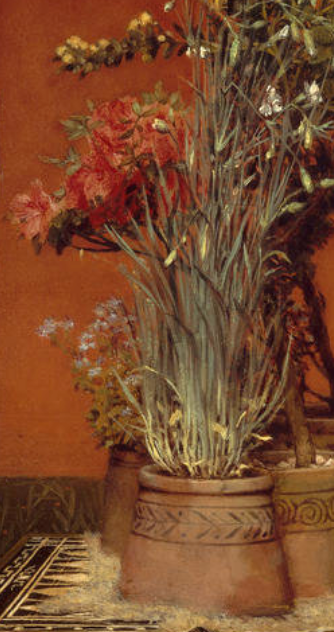
- The Pompeian Drawing Room: He ignored Victorian fashion and painted the walls in bold Roman reds and blacks.
It was bold. It was eccentric. And it was brilliant marketing.
The House as a Showroom
Townshend House became the talk of London. Visitors didn't just come to see the paintings; they came to see the house.
It was here that Tadema perfected his unique lifestyle. He treated his home as a living portfolio. If a client liked the marble bench they were sitting on, they would see it appearing in his next painting. If they admired the Silk curtains, they would find them draped over a model in The Vintage Festival.
The explosion of 1874 didn't stop him. It accelerated him. It forced him to build a "Palace of Art" far earlier than he might have otherwise.
The Lesson of the Blast
There is a psychological resilience in this story that defines Tadema’s character. He was a man who converted trauma into beauty. He lost his first wife; he painted his way through the grief. His house blew up; he turned the rubble into a masterpiece of interior design.
The Rehearsal for Greatness
While the dust settled and the builders began their work, the family took refuge with Laura's parents, the Epps family, in Bloomsbury.
It is important to remember that Townshend House—as spectacular as it became—was not the final "Casa Tadema." It was the prototype.
The famous villa with the silver ceiling, the huge atrium, and the legendary Tuesday evening parties was a different house entirely (built ten years later on Grove End Road). But Townshend House was where the dream began. It was where Lawrence Tadema proved that with enough imagination (and insurance money), you could build a Roman palace in the middle of a London disaster.