
Geography is destiny. Or at least, it should be. But for the Alma Tadema artist who would become one of Victorian England's most celebrated painters, destiny meant defying geography entirely.
If you are born in the Netherlands, you are born into a world of water. The light is diffused, filtered through layers of cloud and mist. The colors are subtle: slate gray, moss green, brick red. For centuries, Dutch artists like Rembrandt and Vermeer mastered this specific, quiet light. They painted interiors. They painted shadows.
Lawrence Alma-Tadema was born into this tradition. He should have been a painter of windmills and brown canals.
But inside the soul of this young Alma Tadema artist, there was a glitch. He didn't dream of gray. He dreamed of a blue so bright it burned.
The Training Ground: Antwerp
At sixteen, having survived his brush with death, Lawrence left home for the Royal Academy of Antwerp.
It was a step up from his village, but it was still the North. The Academy was a fortress of tradition. Under the guidance of Baron Hendrik Leys, Lawrence learned the "proper" way to paint.
Leys was a master of medieval history. He taught Lawrence that art was not about splashing paint around; it was about accuracy. You didn't just paint a knight; you painted the specific rust on his chainmail. You researched the heraldry. You got the buttons right.
This period was crucial. It turned Lawrence into a technician. He learned the patience of a watchmaker. He learned to paint textures—wood, velvet, iron—so realistically that you wanted to touch them.
But the subject matter? It was gloomy. He painted Merovingian Franks hacking each other to bits in dark forests. He painted brooding interiors. He was a master technician looking for a subject that made his heart sing.
The Professor of Time Travel
It was also in Antwerp that he met Louis Jan de Taeye, a professor of archaeology.
De Taeye was not an artist, but a historian. He took the young student under his wing and taught him a radical idea: The past is not a fairy tale. It was a real place, with real dimensions, real clothes, and real architecture.
De Taeye made him read. He made him study the Merovingian legends until he knew them by heart. He taught the young Alma Tadema artist that a painting should be a window into history.
"If you are going to paint a table," De Taeye might have said, "make sure it is a table that actually existed in 500 AD."
Lawrence absorbed this. He became a history geek. He started building his massive library of reference books. The "Archaeologist Painter" was being born, but he was still stuck in the Dark Ages.
The Crossing
Then came 1863. The year everything changed.
Newly married to his first wife, Marie-Pauline, Lawrence planned a honeymoon to Italy. Today, we hop on a plane and arrive in Rome in two hours. In 1863, the journey was a pilgrimage.
They traveled by carriage and train, slowly winding their way down through Europe. As they crossed the Alps, the world shifted.
Imagine the sensory shock for a man who had lived his entire life under the heavy wool blanket of Dutch skies. Suddenly, the ceiling of the world lifted. The light became sharp, hard, and blindingly clear. The colors shifted from brown and green to azure, ochre, and white.
He later said that entering Italy was like "waking up."
The Epiphany at Pompeii
The climax of the trip was Pompeii.
The city had been excavated for over a century, but it was still a raw, open wound in the earth. Lawrence walked the stone streets. He saw the ruts left by chariot wheels. He saw the fast-food counters (thermopolia) where Romans had bought hot wine.
He entered the ruined houses and saw the walls. They weren't white. They were covered in frescoes of deep, vibrant red—a color so intense it felt like blood.
This was the moment the Alma Tadema artist found his true north (by going south).
He realized that the Romans were not the stiff, white-marble statues in museums. They were people. They loved color. They loved luxury. They lived in houses that were designed to catch the sun.
He spent days measuring the ruins. He sketched the floor mosaics. He sketched the door frames. He wasn't just a tourist; he was a spy stealing the secrets of a lost civilization.
Bringing the Sun Home
When he returned to the north, he couldn't go back to painting dark medieval forests. He had seen the light.
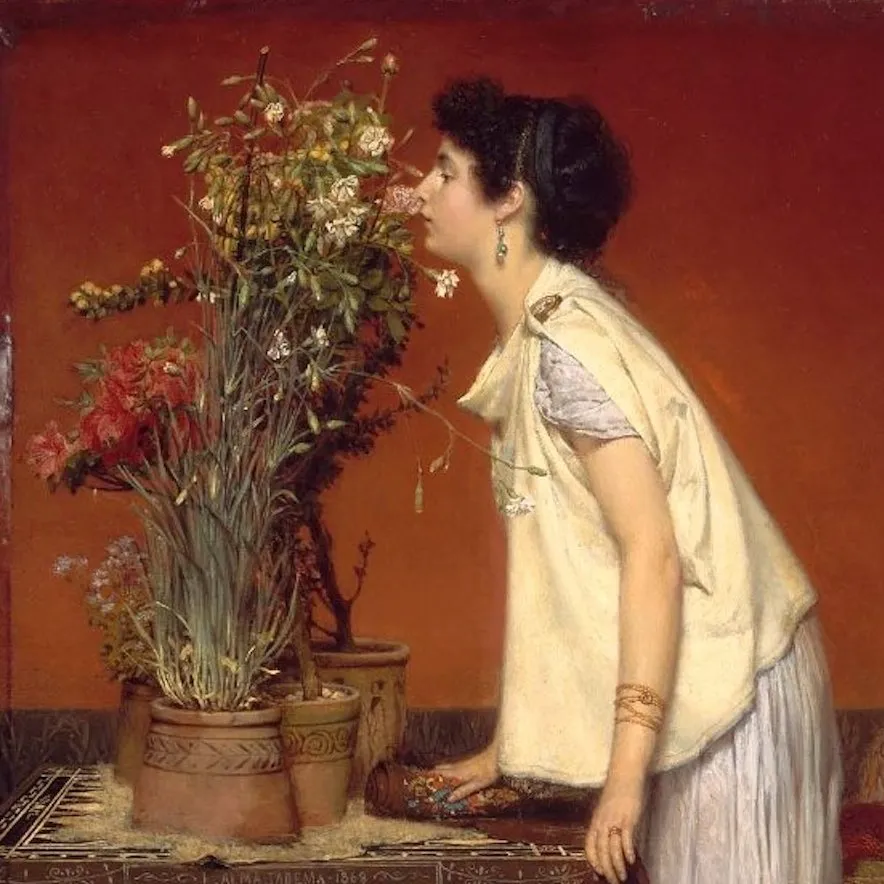
He began to paint Rome. But not the tragic Rome of burning cities or dying gladiators. He painted the Rome he had felt in Pompeii: the Rome of ordinary, sunny afternoons. He painted women smelling flowers. He painted men reading poetry. He painted the sun hitting a marble bench.
It was a revolution. He used the rigorous Dutch technique he had learned in Antwerp—the obsession with texture and detail—but he applied it to the Mediterranean world.
He created a hybrid: Dutch realism meets Roman fantasy.
Critically, he never lost his accent, but his paintbrush became fluent in Latin. He spent the rest of his life in London, a city famous for its fog, painting a world where it was always high noon in Pompeii.
The journey south never really ended for him. Every time he stepped into his studio, every time he mixed that specific shade of cobalt blue for the Mediterranean sea, the Alma Tadema artist was traveling back over the Alps, back to the moment the clouds broke and the sun came out.
Leave a Visiting Card
Consulting the visiting cards...