It is not easy to be the child of a giant.
When your father is Sir Lawrence Alma-Tadema—the most famous, most expensive, most knighted painter in London—where do you find your own light? How do you pick up a brush without your hand shaking?
Anna Alma Tadema found her answer in the silence.
Born in 1867, she was the older of Lawrence's two daughters from his first marriage to Marie-Pauline. She lost her mother when she was barely two years old. Perhaps this early loss gave her the quiet, introspective quality that would later define her art.
While her father painted grand, sweeping scenes of Roman festivals with hundreds of figures, Anna Alma Tadema painted empty rooms.
The Girl in the Watercolor
She grew up in Casa Tadema, the legendary house her father built. But she didn't just live there; she recorded it.
Her medium was not the heavy, historical oil paint of her father. It was watercolor. But not the wishy-washy watercolor of Victorian amateurs. She used the medium with a terrifying precision.
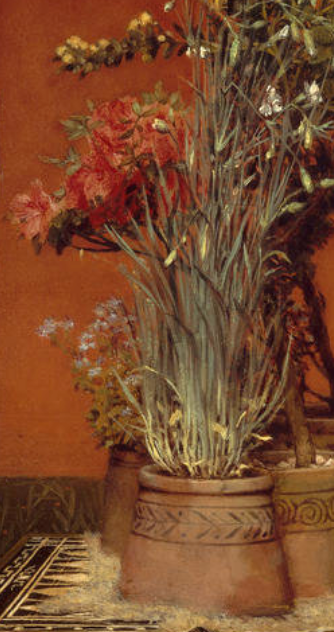
Her most famous work, The Garden Studio (1886), painted when she was just nineteen, is a masterpiece of observation. It captures a corner of their home. But look at the details.
Look at the way the light hits the dusty glass of the window. Look at the texture of the textile thrown over the chair. Look at the specific, botanical accuracy of the flowers. It is a painting about stillness. It is a painting about the feeling of being alone in a beautiful room on a Tuesday afternoon.
Critics noticed. They praised her "power of detail," noting that she shared her father's obsession with texture but possessed a gentler, more feminine touch. She wasn't trying to impress the Royal Academy with epic history; she was trying to capture the soul of a house.
A Career of Her Own
It would have been easy for her to disappear into the role of "artist's daughter." But Anna Alma Tadema fought for her own space.
She exhibited at the Royal Academy alongside her father and stepmother (Laura). She won a medal at the World's Columbian Exposition in Chicago in 1893. She was a respected professional in a world that often dismissed women painters as hobbyists.
She was also a woman of quiet conviction. In 1889, she signed the Declaration in favor of Women's Suffrage. In the shadow of a colossal Victorian patriarch, she quietly asserted that she, too, was a citizen.
The Golden Cage
But her life was inextricably bound to the house.
She and her younger sister, Laurence (who became a writer), never married. They lived in Casa Tadema as the keepers of the flame. After their stepmother Laura died in 1909, the house began to feel less like a palace and more like a mausoleum.
Then came 1912. Sir Lawrence died.
The fall was swift and brutal. The Great War was approaching. The art market collapsed. The sisters, who had lived like princesses in a fairy tale, were suddenly faced with the cold reality of economics.
The Fall from Grace
Why did this golden life end so darkly?
The lease on the massive, expensive "Casa Tadema" was unsustainable without their father's income. Worse, the world had changed. Modernism was rising; Victorian art was suddenly despised. The critics who had praised Anna Alma Tadema now mocked her family as "sentimentalists."
In 1913, the contents of the house—the silver, the costumes, the marble, even the paintings—were auctioned off. It was a fire sale. Masterpieces sold for fractions of their value.
Evicted from their sanctuary, the sisters retreated into a smaller, quieter life in London. They watched as their father's name became a joke. They watched as the world forgot them.
Anna Alma Tadema died in 1943, in the middle of another World War, almost penniless. She died in a world of concrete and bombs, a long way from the gold and marble of her youth.
But today, we are looking closer. We are rediscovering her watercolors. We are seeing that she was not just a footnote. She was a brilliant observer who captured the soul of the Victorian age from the inside out. She reminds us that sometimes, the quietest voice in the room has the most interesting story to tell.