There are turning points in history, and then there are turning points in a soul. For Lawrence Alma-Tadema, that point was 1863.
It was the year he got married. It was the year he left the Netherlands. And it was the year he discovered that he was not, in fact, a painter of medieval gloom, but a painter of eternal sunshine.
The Marriage
He married Marie-Pauline Gressin Dumoulin in Antwerp. She was French, the daughter of a journalist living in Belgium. We know less about her than we do about his second wife, Laura, but the portraits he painted of her show a woman of quiet intelligence and delicate features.
She was the partner of his "young" years—the years of struggle, of budget-counting, and of ambition. And in 1863, they embarked on the traditional Grand Tour honeymoon to Italy.
The Problem with 1863 Travel
We have to remember that travel in the 1860s was an ordeal. There were no direct express trains through the Alps (the Gotthard Tunnel wouldn't open until 1882). You had to cross the passes by carriage.
For Lawrence and Marie-Pauline, this journey was physically exhausting. But for Lawrence, it was a revelation.
As they descended into the Italian peninsula, he saw things that simply didn't exist in Dronryp or Antwerp. He saw lizards sunning themselves on rocks. He saw cypress trees that looked like black flames against a turquoise sky. He saw ancient walls that had been baking in the sun for two thousand years.
He filled sketchbook after sketchbook. He wasn't just drawing specific buildings; he was trying to capture the feeling of heat.
The Visit to Pompeii
But the true explosion happened in Pompeii.
He had read about it. He had seen prints. But standing there was different.
What shocked Lawrence Alma-Tadema was how lived-in it felt. This wasn't a dead monument. It was a frozen city. He saw the graffiti on the walls. He saw the ruts in the road. He realized that the Romans were not abstract figures from a Latin textbook; they were people who ate, drank, laughed, and complained about the weather.
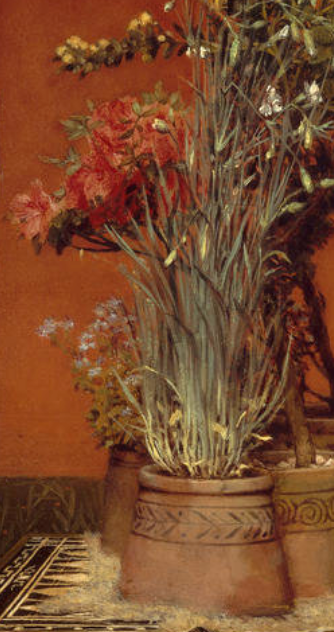
He became obsessed. While Marie-Pauline likely rested (she had fragile health), Lawrence was measuring the atrium of the House of Glaucus. He was noting the exact shade of red used in the wall paintings.
The Shift
Before 1863, his paintings were dark. They were "Merovingian"—full of bearded barbarians and gloomy forests. They were technically skilled but emotionally heavy.
After 1863, the lights came on.
He began to paint the series that would make him famous. The Entrance to a Roman Theatre (1866). A Roman Art Lover (1868). These paintings were revolutionary because they were so... normal.
They didn't show Caesar being stabbed. They showed everyday people doing everyday things in a beautiful, sun-drenched setting. He took the "genre painting" style of the Dutch masters (people peeling potatoes, reading letters) and transported it to Ancient Rome.
It was a stroke of genius. He humanized history. And it all started in that carriage ride over the Alps in 1863.
If he had never taken that trip, if he had stayed in Antwerp, Lawrence Alma-Tadema might be remembered today as a minor painter of Belgian history. Instead, he found the sun, and he spent the next fifty years trying to bottle it.