In the 1960s, the reputation of Sir Lawrence Alma-Tadema was effectively dead. The Modernists had won, and Victorian art was being tossed into the trash. The only man standing in the way of this destruction was an unlikely hero: Allen Funt, the creator of Candid Camera.
The art establishment dismissed Victorian painting as "sentimental kitsch." Museums were taking his massive canvases down and unceremoniously shoving them into damp basements.
At this low point in history, the savior of the genre emerged. His story remains one of the strangest twists in art history.
He was the smiling, prank-playing host of a hit TV show.

The Unlikely Collector
The TV host was famous for catching people in unguarded, embarrassing moments of reality. He made his fortune by revealing the clumsy, funny truth of human nature.
Yet, in his private life, he became obsessed with the most carefully scripted, unrealistic art in history.
The obsession began by accidental discovery. In the early 1960s, Allen Funt wandered into a London gallery and saw a painting. It was love at first sight. He was thunderstruck by the technical perfection.
He asked the price. The dealer, likely suppressing a smirk, named a figure that was shockingly low. He bought it on the spot.
The Buying Spree: A Hands-On Hunt
It wasn't a passive collection. This was a personal mission. He hunted.
He would personally fly to London and walk into the stuffy galleries of Bond Street or the dusty antique shops of Kensington. He developed a reputation. Dealers, who were embarrassed to display "unfashionable" Victorian art, would see him coming and rush to the back rooms to drag out their hidden stock.
They often treated him like a naive American tourist with more money than taste. They were happy to unload these "white elephants"—massive canvases that no modern buyer wanted—for pennies.
The prankster enjoyed the irony. He knew they were laughing at him as he wrote the checks, but he also knew he was walking out with masterpieces. He famously tracked down paintings that were being sold for the value of their frames, rescuing works that were minutes away from being stripped or destroyed.
His accountant was horrified. He reportedly told the collector, "Allen, you are throwing your money away. These frames are worth more than the paintings. Why are you buying this junk?"
He ignored him. He saw something the critics missed. "I think he is the greatest painter who ever lived," he said.
Perhaps, as a man who studied human behavior through a hidden lens, he appreciated Alma-Tadema's ability to capture the "candid" moments of ancient life—a gossip on a bench, a shared glance, a bored stare.
Inside the Collection
At the height of his collecting, Allen Funt owned 35 of the artist's finest works. It was arguably the greatest collection of Victorian art ever assembled by a single individual. It included works that define the artist's career:
- The Roses of Heliogabalus: The infamous scene of the Emperor smothering his guests in petals. The collector famously hung this massive canvas in his living room.
- Spring: The 7-foot tall depiction of the Roman festival procession.
- The Finding of Moses: The painting commissioned by the Aswan Dam engineer, which later broke the $35 million record.
- A Coign of Vantage: The heavy marble balcony scene that inspired Hollywood.
- The Baths of Caracalla: A massive architectural tour-de-force showing the scale of Rome.
- Silver Favourites: Three women feeding fish in a marble pool, a masterpiece of water reflection.
- Unconscious Rivals: Two women waiting for a lover, oblivious to their competition.
- Comparing Notes: Two women chatting on a marble bench (he loved the casual humanity of this).
He lived inside a 360-degree panorama of ancient Rome.
The Controversy at The Met
The collector didn't just hoard the paintings; he wanted the world to see them. In March 1973, he convinced The Metropolitan Museum of Art to host an exhibition of his collection.
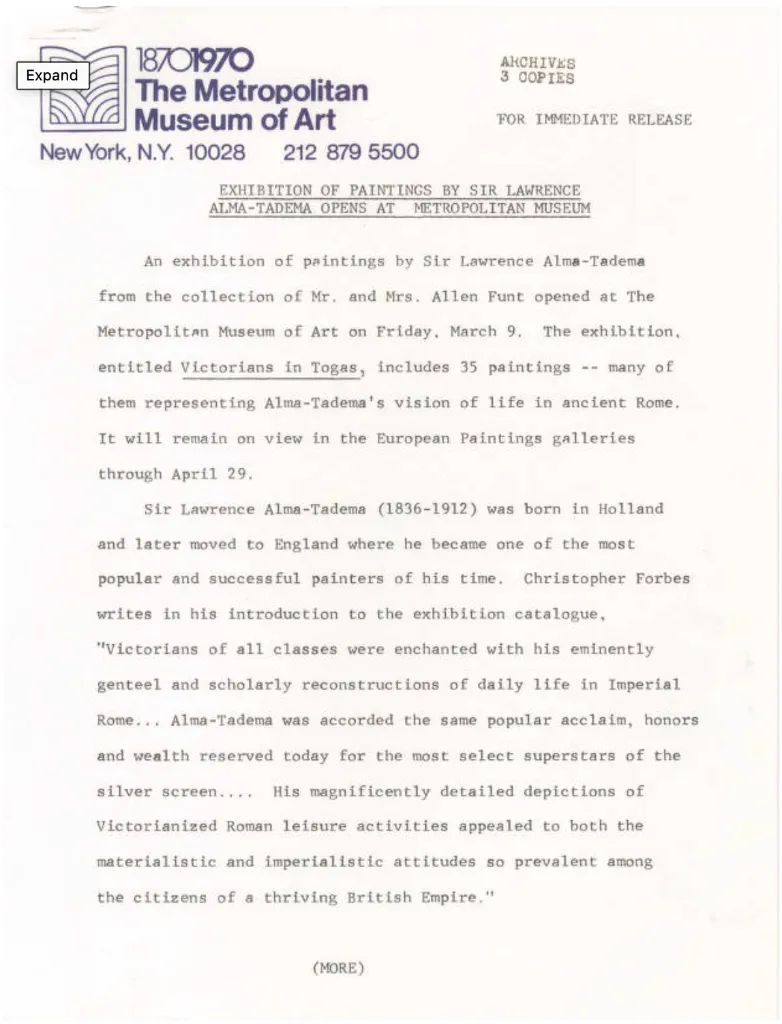
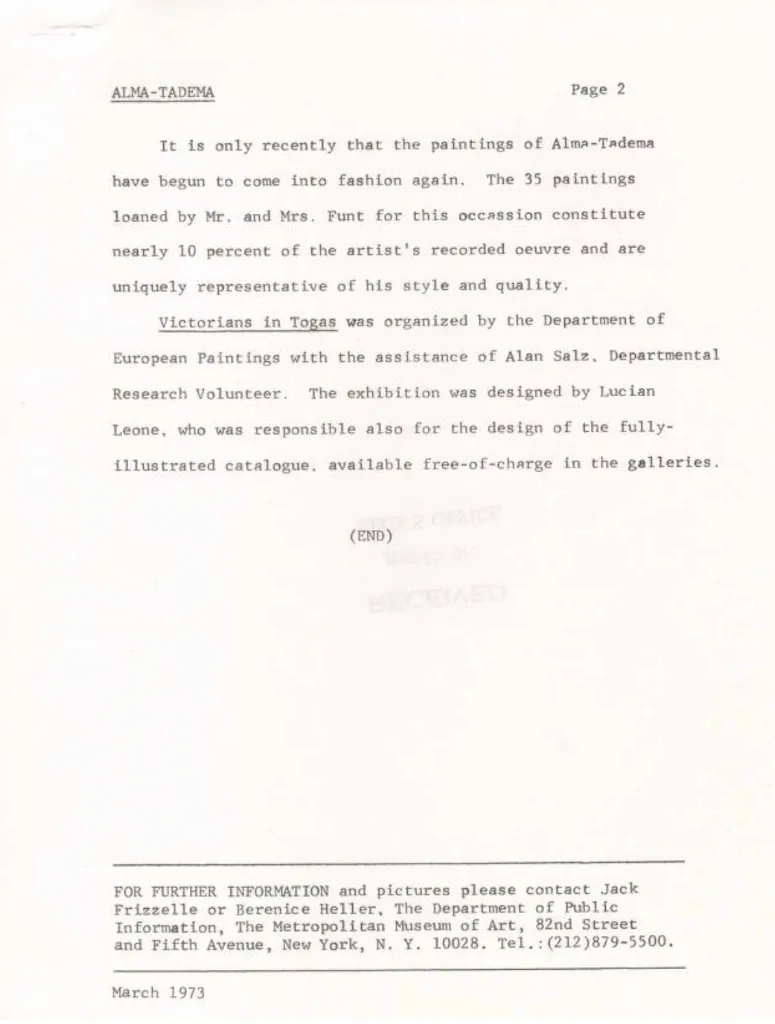
The show, titled Victorians in Togas, was a lightning rod for controversy. The Modernist critics, who believed in Abstract Expressionism, were appalled.
John Canaday, the powerful critic for The New York Times, savaged the show. He wrote that the exhibition was "for people who want to be amused by the bad taste of their grandfathers." He dismissed the painstakingly painted marble as empty trickery.
But the criticism didn't stop the crowds. The public didn't read the reviews; they looked at the art. The lines stretched down Fifth Avenue. Visitors were mesmerized by the technique that Modernism had abandoned—the way the light hit the water, the texture of the silk, the humanity of the figures.
They didn't see "bad taste"; they saw a lost world brought to life.
It was the first crack in the ice of Modernism. It proved that despite what the critics said, people still craved beauty.
The Betrayal and The Sale
The story has a tragic twist. Just as the exhibition was proving him right, Allen Funt discovered a devastating truth: his accountant—the very man who had mocked the collection—had embezzled millions of dollars from him.
He was ruined. To avoid bankruptcy, he had to liquidate his assets. The most valuable thing he owned was not his TV show, but the collection he had lovingly built piece by piece.
He was heartbroken. He viewed the auction not as a sale, but as a funeral. He feared the critics were right, that he would get pennies on the dollar.
The Auction That Changed History
On November 6, 1973, the collection went under the hammer at Sotheby's Belgravia.
The atmosphere was tense. But as the first lot came up, something shifted. The room was packed. People had not come to mock; they had come to buy.
The sale was a sensation. Prices shattered expectations, proving the investment genius of Allen Funt:
- The Finding of Moses sold for £30,000. He had purchased it years earlier for mere thousands. (In 2010, this same painting would sell for $35.9 million).
- The Roses of Heliogabalus sparked a bidding war, selling for £28,000, a record for the artist at the time.
- Spring wasn't even in the auction; he had sold it privately to the J. Paul Getty Museum a year earlier for $55,000 (having bought it for roughly $3,000).
The total sale realized over £500,000 in one night. It revitalized the entire market for Victorian art, turning "junk" into gold.
The Last Laugh
Allen Funt died in 1999, missing the final explosion of the market in 2010. But he died knowing he was right.
The man who made his career pranking the public had played the ultimate joke on the art establishment. He had seen genius where they saw trash. He had saved the legacy of Lawrence Alma-Tadema from oblivion.
The story of the Allen Funt collection serves as a reminder: trust your own eyes, not the critics. Beauty is always worth saving.
Leave a Visiting Card
Consulting the visiting cards...