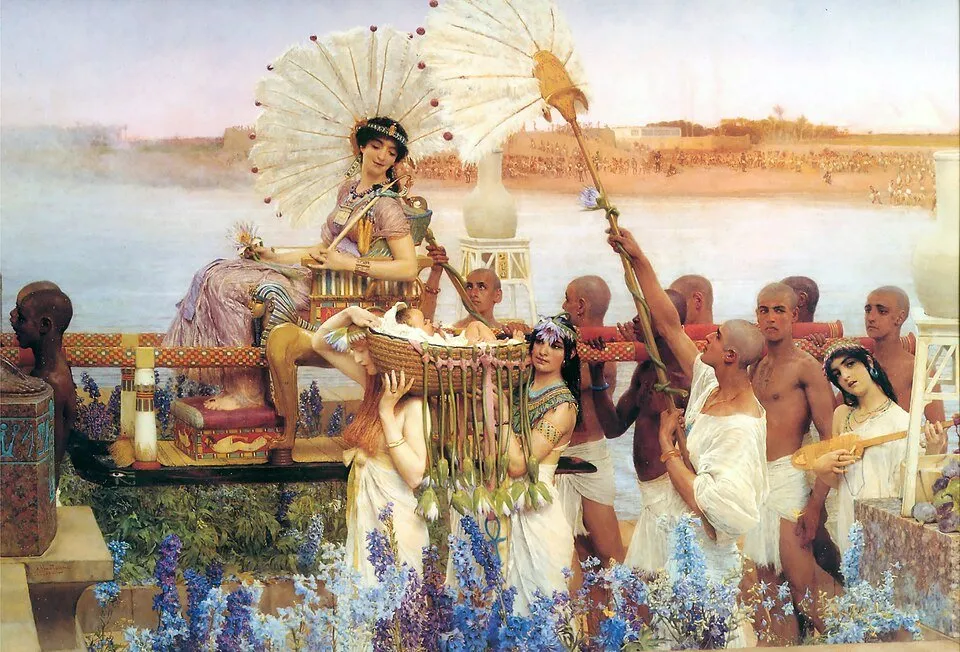
It is a grey Tuesday in London, 1960. In the back rooms of the Newman Gallery, a painting of colossal proportions—seven feet of shimmering Nile water, lotus blossoms, and Egyptian royalty—is being cut from its stretcher. The canvas is rolled like a common rug and relegated to a dusty corner. Its frame, a magnificent construction of gilded wood, is deemed more valuable than the masterpiece it once held.
This was The Finding of Moses. Its price tag? A mere £252. And yet, there were no takers.
The Era of the "Used Sofa"
To walk through the galleries of the mid-20th century was to walk through a desert of minimalism. The lush, marble-lit worlds of Sir Lawrence Alma-Tadema had been cast out, dismissed by the high priests of Modernism as the "quintessence of the bad." The very name had become shorthand for Victorian excess, a sentimental relic to be buried beneath the white-washed walls of progress.
During this long winter, masterpieces that once commanded the wealth of nations were found leaning against the damp walls of London junk shops. It was here that Allen Funt, the creator of television’s Candid Camera, began his lonely pilgrimage.
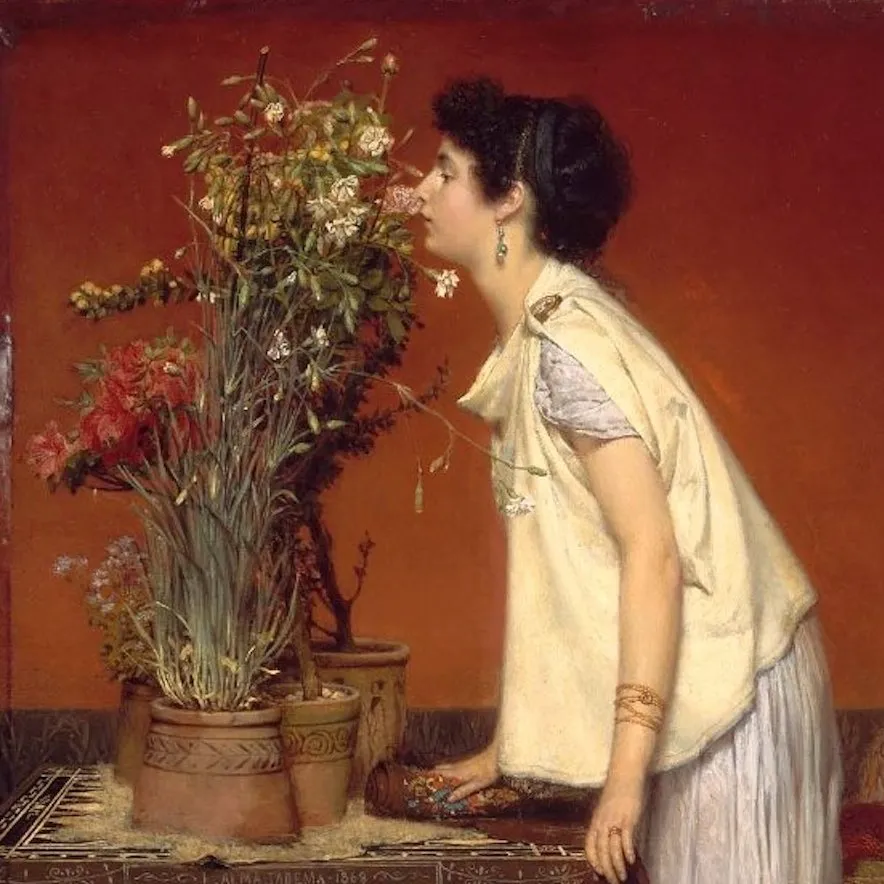
Funt saw what the critics chose to ignore: the impossible texture of the marble, the scent of the roses, and the unhurried grace of a vanished world. He began acquiring Alma-Tademas for what he famously described as "less than the price of a used sofa." For a few hundred dollars, he rescued works that would later be valued in the millions. To the London dealers, he was the "naive American tourist"—the only man in the world who would pay for Victorian "junk."
A Hallucinogenic Detail
While the art establishment sneered, a different revolution was brewing in the streets of Soho and the boutiques of Kensington. The 1960s were a decade of sensory expansion, of "bruised purples" and Art Nouveau swirls. At the Biba boutique, Barbara Hulanicki was reviving the Victorian silhouette; in the posters of the counter-culture, the "maximalism" of the 19th century was being rediscovered through a psychedelic lens.
To a generation fueled by music and sensory exploration, Alma-Tadema’s work felt strangely contemporary. His hyper-realism was not seen as stuffy, but as "trippy"—a hallucinogenic attention to detail that made a single petal of a poppy feel as vast as a galaxy. The public did not want the austerity of the "white box." They wanted to feel beautiful again.
The Accountant’s Shadow
By the early 1970s, Funt had amassed nearly 35 works—nearly 10% of the artist's entire output. His New York office had become a sanctuary of cool stone and sun-drenched terraces, a sharp contrast to the frantic pace of the television industry.
But the "man who watched others" was himself being watched. In a tragedy that reads like a Victorian melodrama, Funt discovered that his accountant had embezzled millions of his earnings—estimates range from $1.2 million to a staggering $12 million. The betrayal ended in the accountant's suicide and Funt’s near-bankruptcy.
The sanctuary had to be sold.
Victorians in Togas
The liquidation of Funt’s collection coincided with a landmark event in 1973: the Metropolitan Museum of Art’s exhibition, Victorians in Togas. Curated with the support of Mario Amaya—who had recently argued that Alma-Tadema was the unacknowledged grandfather of Hollywood’s cinematic epics—the show was a provocation.
The critics sharpened their knives, but the public voted with their feet. They lined up around the block, drawn by the echo of a beauty they were told they shouldn't desire. When Funt’s collection finally went to auction at Sotheby’s Belgravia in November 1973, the market "fixed" itself in a single afternoon. The prices did not merely rise; they exploded.
The "junk" had become blue-chip. The winter was over.
The Echo
And so, the marble remains cool.
We look back at the 1960s not as a momentary lapse in taste, but as the moment the spell was broken. It took the television pioneer, the psychedelic rebel, and even the tragic betrayal of a thief to remind us that beauty is not a fashion, but a resonance.
The petals of The Roses of Heliogabalus continue to fall, forever suspended in that vibrant, rescued springtime.
Explore Further:
Leave a Visiting Card
Consulting the visiting cards...