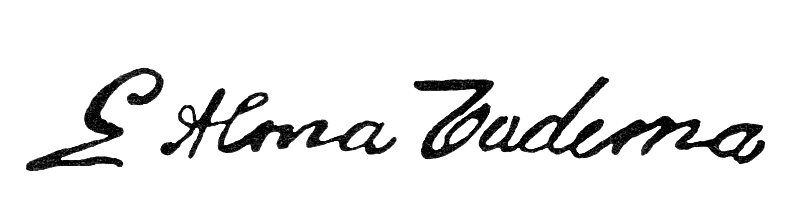
At first glance, The Roses of Heliogabalus looks like the ultimate celebration of high summer.
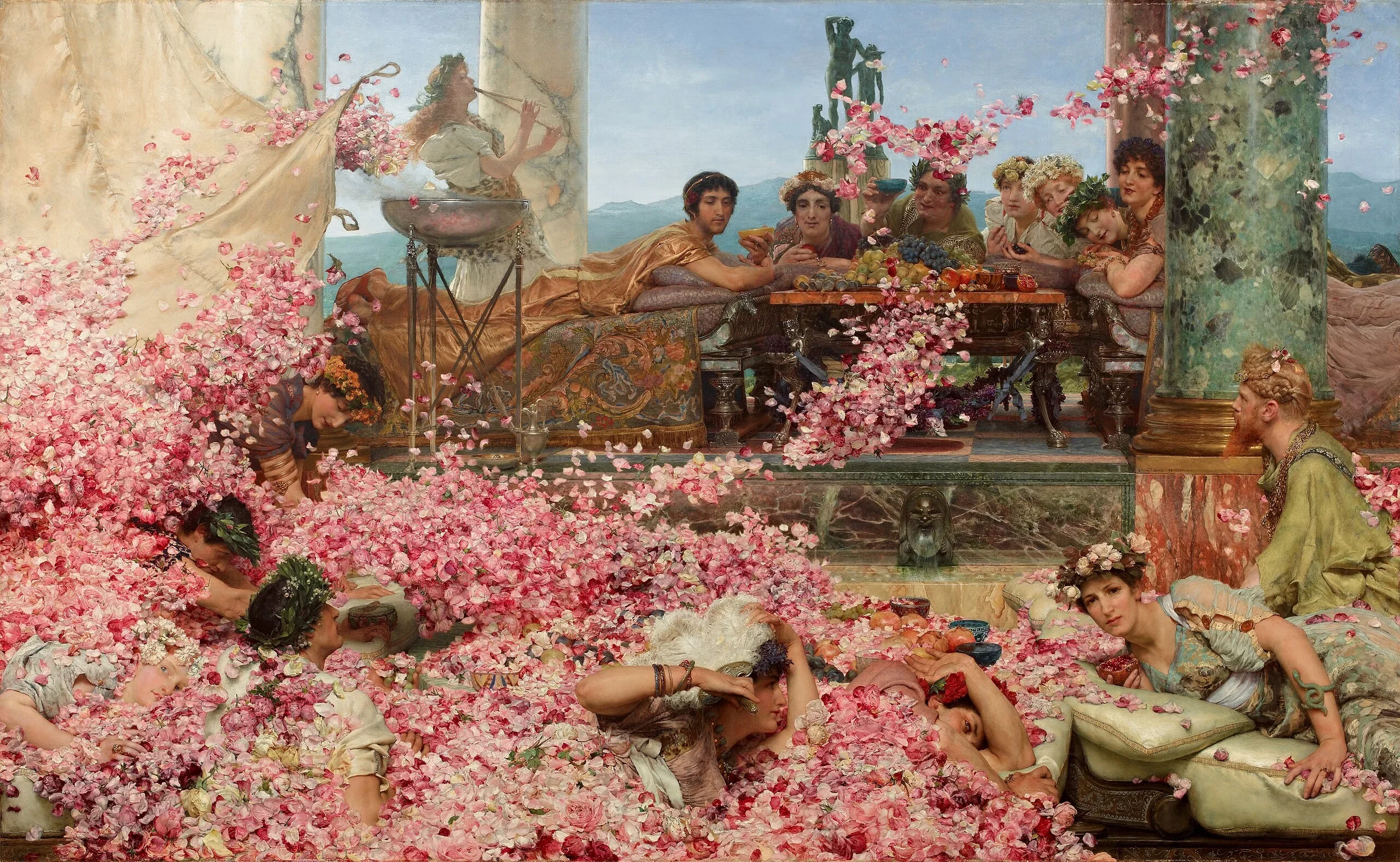
You are hit with a landslide of pink. A swirling, shimmering storm of petals fills the frame, burying the guests in a soft, fragrant cloud. Above them, in the cool shade of a silk awning, beautiful young people sip wine. It is a vision of pure, unadulterated pleasure.
But look closer at the faces in the flowers.
Are they laughing? Are they struggling? It is terrifyingly ambiguous. One woman seems to be smiling, perhaps thinking this is just a playful game. Another looks dazed, as if the scent is already overpowering her senses. A feather fan lies half-buried in the drift, a symbol of luxury being swallowed whole.
This is the genius of the painting: it freezes the split-second between delight and death. The guests think it is a party. The Emperor knows it is an execution.
The Tyrant in Gold
To understand the horror of The Roses of Heliogabalus, you have to look at the young man lounging at the top of the table.
This is Emperor Heliogabalus (Marcus Aurelius Antoninus). Even by the debauched standards of Rome, he was a shock. Taking the throne at just 14, he was not a soldier or a statesman; he was a high priest of the Syrian sun god Elagabal.
He brought a strange, oriental mysticism to Rome. He paraded a sacred black meteorite through the streets. He married a Vestal Virgin (a sacrilege). He reportedly wore makeup, silk, and diadems, blurring the lines of gender and decorum. He turned the imperial palace into a theatre of cruelty and caprice.
The painting depicts a story from the Augustan History, a collection of Roman biographies. The text claims that Heliogabalus loved practical jokes. During one banquet, he arranged for a reversible ceiling to be installed, loaded with tons of flowers.
"In a banqueting-room with a reversible ceiling he once buried his parasites in violets and other flowers, so that some were actually smothered to death, being unable to crawl out to the top."
In the painting, Heliogabalus is the figure in the golden robes and tiara. He holds a wine cup with languid indifference, leaning on his elbow. He watches his "parasites" gasp for air with the mild curiosity of a child poking an anthill. It is the ultimate display of power: I can kill you with something soft.
The Obsession: Winter Roses
If the story is dark, the story of the painting's creation is almost as absurd as the banquet itself.
Alma-Tadema decided to paint this masterpiece in the middle of a London winter in 1888. Obviously, there were no roses blooming in the smoggy, freezing gardens of St John's Wood. And Tadema, a perfectionist, refused to paint from memory or use silk fakes.
He commissioned a nursery in the French Riviera—likely in Nice—to send him weekly shipments of fresh petals.
For four months, crates of roses traveled by steam train across France, across the Channel, and into London. As soon as they arrived in the studio, Tadema and his assistants would have to work frantically. A rose petal changes color as it wilts; it loses its translucency. He had to capture the specific "pink" of a living flower before it turned brown.
He also made a critical artistic choice. The history books mentioned violets. Tadema swapped them for roses. Visual impact was key; dark violets would have looked like a bruise on the canvas. Pink roses, however, popped against the marble and carried a Victorian double-meaning: the rose symbolized love, but a falling petal symbolized death.
It is estimated he spent thousands of flowers to complete The Roses of Heliogabalus. In a way, he was acting just like the Emperor—expending a fortune in natural beauty just to create a moment of spectacle.
The "Machine" and the Money
This was not a modest painting for a hallway. It was what the Victorians called a "Salon Machine"—a massive, complex canvas designed to dominate an exhibition wall and prove the artist's technical supremacy. Measuring over 4 feet by 7 feet (52 x 84 inches), it was a widescreen epic.
The painting was commissioned by Sir John Aird, the civil engineering tycoon who built the first Aswan Dam. Aird was the archetype of "New Money." He wasn't an aristocrat with a dusty ancestor gallery; he was a man of concrete and steel.
For men like Aird, owning a Tadema was the ultimate status symbol. It proved that the man who tamed the Nile also understood the soul of Rome. Ideally, the man of industry wanted to own the ultimate image of idleness.
The Composition: A Tilted World
Artistically, the painting is a risk. It violates the "Rule of Thirds." In The Roses of Heliogabalus, he basically splits the canvas in half horizontally.
- The Top Half (The Power): Horizontal, stable lines. The table, the Emperor, the guests. They are calm, cool, and detached.
- The Bottom Half (The Victims): Chaotic, swirling, diagonal lines. A mess of limbs and petals.
But look at the perspective. Tadema cheats the eye. He tilts the floor up towards us. This creates a sensation of vertigo, as if the avalanche of petals is about to spill out of the frame and bury the viewer, too. We are not just watching the suffocation; we are sliding into it.
To the left of the Emperor stands a woman playing the double flute (aulos). She wears the leopard skin of a Maenad—a follower of Dionysus. She is absorbed in her music, seemingly indifferent to the chaos unfolding beneath her. She provides the soundtrack to the murder. Behind her looms the bronze statue of Dionysus himself, the god of wine and madness, presiding over the deadly feast.
The Aesthetic Warning
When The Roses of Heliogabalus was unveiled at the Royal Academy in 1888, it caused a physical reaction.
Critics joked that the painting was so realistic it had an odor. The density of the thousands of painted petals created a claustrophobic sensation. One reviewer noted that the "scent" of the picture was enough to make one faint.
This was the height of the Aesthetic Movement—the era of "Art for Art's Sake." Led by figures like Oscar Wilde, this movement argued that art did not need to teach a moral lesson. Its only duty was to be beautiful.
Tadema took this to its dangerous extreme. He took a murder scene and made it exquisite. He tempts us to enjoy the scene, even though we know it is wrong. In doing so, he forces us to confront a dangerous question: Do we care about morality, or are we just seduced by beauty?
The Survivor: The Allen Funt Connection
The story of the painting has a final twist.
After the Victorian era ended and Modernism arrived, Tadema's work fell out of fashion. His paintings, once worth thousands, became worthless. The Roses of Heliogabalus disappeared into obscurity.
It resurfaced in the 1960s in the most unlikely place: the collection of Allen Funt, the creator of the TV show Candid Camera. Funt was the only man buying Tademas when the rest of the world laughed at them. He saw the cinematic quality in them. He owned The Roses until the 1970s, when the market finally realized what it had lost.
Today, it is one of the most valuable Victorian paintings in existence.
The Legacy
For decades, this painting was dismissed as "kitsch." But today, it is recognized as a technical marvel.
The real magic is in the petals. They are not just pink blobs; each one is distinct. You can see the curl of the leaves, the variation in the light, the specific botanical species. It is a landslide of nature, rendered with an obsessiveness that borders on madness.
The Roses of Heliogabalus remains the most deceptive image in British art: a candy-colored nightmare that seduces you, right before it kills you.
Leave a Visiting Card
Consulting the visiting cards...