
The world outside is loud. Far from the sanctuary of Lawrence Alma-Tadema, life is made of gray concrete and glowing screens. It demands your attention every second of every day, vibrating with notifications, deadlines, and the ceaseless friction of modern life.
But here, it is always afternoon.
Here, the light is different. It is the golden, syrupy light of a Mediterranean sun that never sets. It warms the white marble beneath your feet, which is cool and smooth to the touch. The air smells faintly of oleander, rose water, and salt. There is no ticking clock. There is no steam engine, no combustion engine, no algorithm. There is only the rhythmic lap of the Tyrrhenian Sea against a limestone quay, and the rustle of silk against stone.
Welcome to the world of Sir Lawrence Alma-Tadema. And more importantly: Welcome to your Sanctuary.
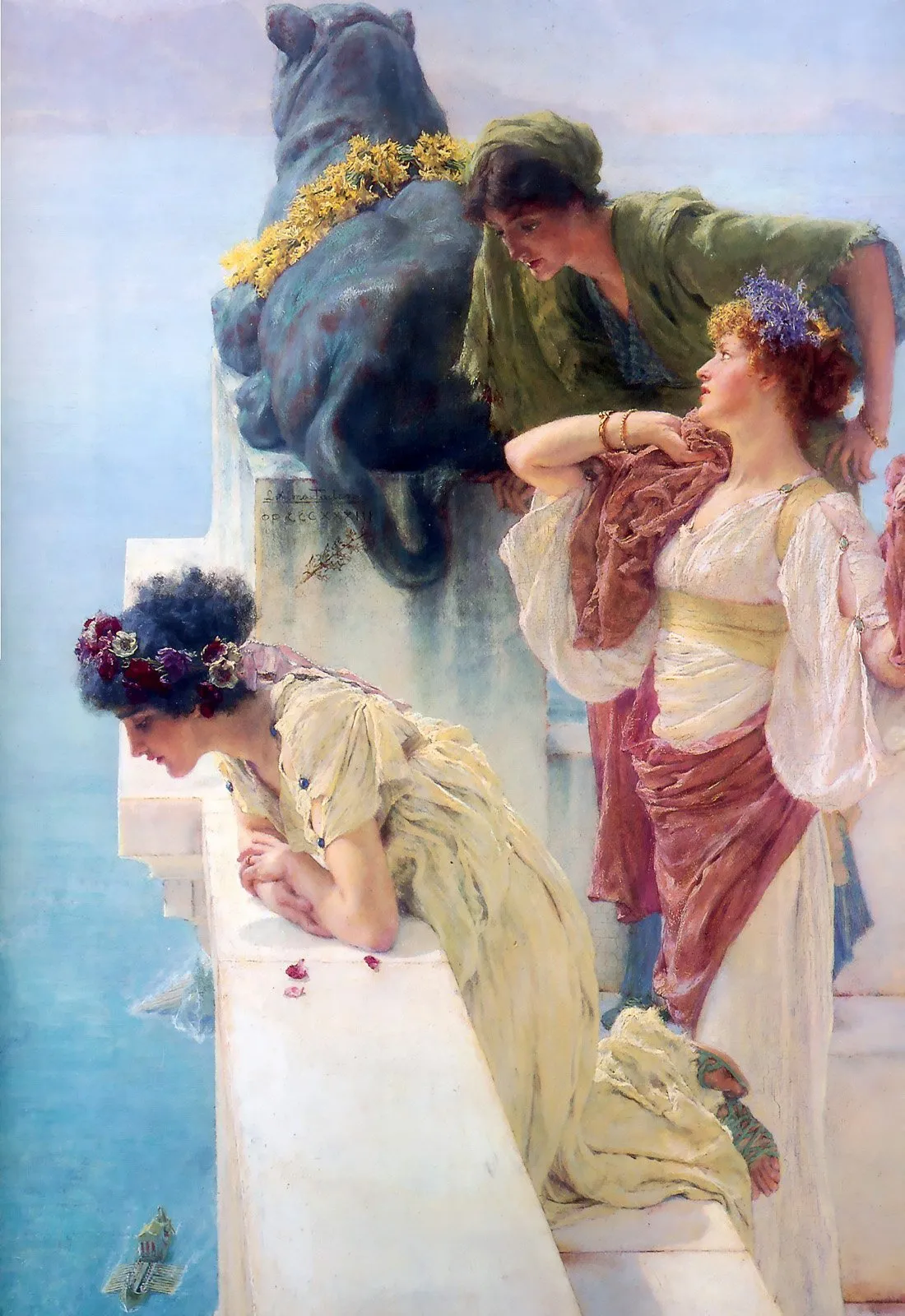
This website is not merely a digital archive. It is not just a catalog of dates, dimensions, and provenance. It is built to be a utility for the soul—a place where you can step out of the rushing current of time and rest, for a moment, on a marble bench in the sun. This is the "Sanctuary" he built for himself, and now, it is yours.
The Necessity of Escape
For nearly a century, the art world has treated "escapism" as a dirty word.
Critics in the 20th century—obsessed with the shock of the new—looked at Alma-Tadema’s paintings and scoffed. They dismissed them as "Victorian Kitsch" for the nouveau riche. They argued that art should confront the harsh realities of the industrial age, not offer a reprieve from them.
But consider the reality Lawrence Alma-Tadema lived in.
He worked in London during the peak of the Industrial Revolution. Outside the studio of Lawrence Alma-Tadema at 17 Grove End Road, the city was choking. The "Great Smog" was turning the marble buildings of London black with coal soot. The new Underground Railway was rumbling beneath the streets. The world was becoming louder, faster, and dirtier than ever before—a 19th-century version of our own relentless, noisy present.
In response, he didn't just paint a sanctuary; he built one.
Inside his famous home, he constructed a "Hall of Panels" lined with polished brass and aluminum to reflect maximum light—a technique he borrowed from Roman atriums but updated with industrial materials. He shut out the gray London fog and engineered a permanent Mediterranean afternoon.
He didn't paint Rome because he was a historian; he painted Rome because he needed to survive London. He offered the Victorians a window to climb through. Today, we offer you that same window.
The Architecture of Calm
Why does the art of Lawrence Alma-Tadema work so well as a sanctuary? Why not Impressionism, or Abstract Expressionism?
It comes down to Sensory Precision.
Lawrence Alma-Tadema was a master of the tactile. His studio was filled with actual Roman artifacts, marble fragments, and fresh flowers delivered daily from the French Riviera. He studied these objects with the rigor of a scientist.
When you look at his work, your brain doesn't just register visual data; it registers texture. You know exactly what that cool marble bench feels like against the back of your leg. You know the weight of that heavy wool toga. You know the temperature of that sun-warmed leopard skin.
This is the "Marble Whisperer" effect (which we explore in our Technique section). His obsession with material reality anchors the viewer. Unlike the blurry, fleeting impressions of Monet—which require active cognitive work to resolve—the world of Lawrence Alma-Tadema is solid. They are safe. You can lean on them.
In a modern digital environment that feels increasingly ephemeral and fake, the solidity of Lawrence Alma-Tadema is grounding. It acts as a counter-weight to the virtual. It reminds us that we are physical beings who crave physical beauty—sunlight, stone, water, skin.
Lawrence Alma-Tadema’s Eternal Afternoon
You will notice a theme as you wander through our Gallery: Time stands still.
In A Reading from Homer, the listener is lying face-down, totally absorbed. In The Tepidarium, the bather is simply lying there, holding a strigil, doing absolutely nothing. In Silver Favourites, the women are just watching fish swim.
There is no urgency. No one is rushing to a meeting. No one is checking a watch.
This is the philosophy of the Eternal Afternoon. It is a rejection of the productivity cult that has plagued the West since the industrial revolution. The Romans painted by Lawrence Alma-Tadema are not lazy; they are present. They are engaged in the radical act of simply being.
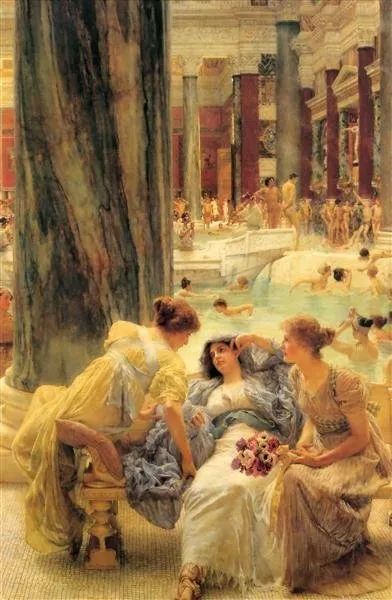
When you visit this site, we invite you to adopt that same posture. Do not "doom scroll" through these paintings. Do not click through them looking for data to memorize.
Instead, linger.
Open The Roses of Heliogabalus. Zoom in. Look at the individual petals. Look at the shadows casting on the marble floor. Let your eyes adjust to the light. Treat a five-minute visit to this site as a five-minute meditation.
How to Use This Site
We have structured the Sanctuary to help you find the specific type of rest you need.
- If you need to understand the man: Visit The Life. Learn how a sickly Dutch boy defied death to become the most successful painter of his age. It is a story of resilience.
- If you need to be overwhelmed by beauty: Visit The Work and specifically the Major Masterworks. Let the sheer scale of The Finding of Moses or Spring wash over you.
- If you need to think: Visit The Reflections. These essays explore the deeper meanings of beauty, the definition of art, and why we look at the past.
- If you just need to breathe: Go to the Gallery. Turn off your notifications. Pick one painting. Stare at it until you can feel the heat of the sun.
Welcome Home
In 1912, when Lawrence Alma-Tadema died, the critics cheered. They tore down his reputation and threw his paintings into basements. They wanted to move on to the jagged, anxious world of Modernism.
But the wheel of time has turned. The Modernist experiment—with its concrete, its irony, and its rejection of beauty—has left us starving. We are tired of the ugly. We are tired of the loud.
We are ready to go back to the Mediterranean.
So, please. Come in. The door is open. The marble is cool. The sun is warm.
You are safe here.
Leave a Visiting Card
Consulting the visiting cards...