
In the late 19th century, a joke circulated among London art critics. They said that if you broke a painting by the Dutch master into pieces, the shards would not be made of canvas and wood—they would be made of marble. This was the power of the Alma-Tadema marble technique.
It was a compliment wrapped in a criticism. While his peers were obsessed with emotion and narrative, Alma-Tadema was obsessed with geology. He didn't just paint stone; he seemed to transmute oil paint into calcite.
Today, he is remembered as the "Marble Whisperer." But how did he do it? How did a Dutch artist, working in a rainy London studio, create the illusion of Mediterranean stone so perfect that you can almost feel its temperature?
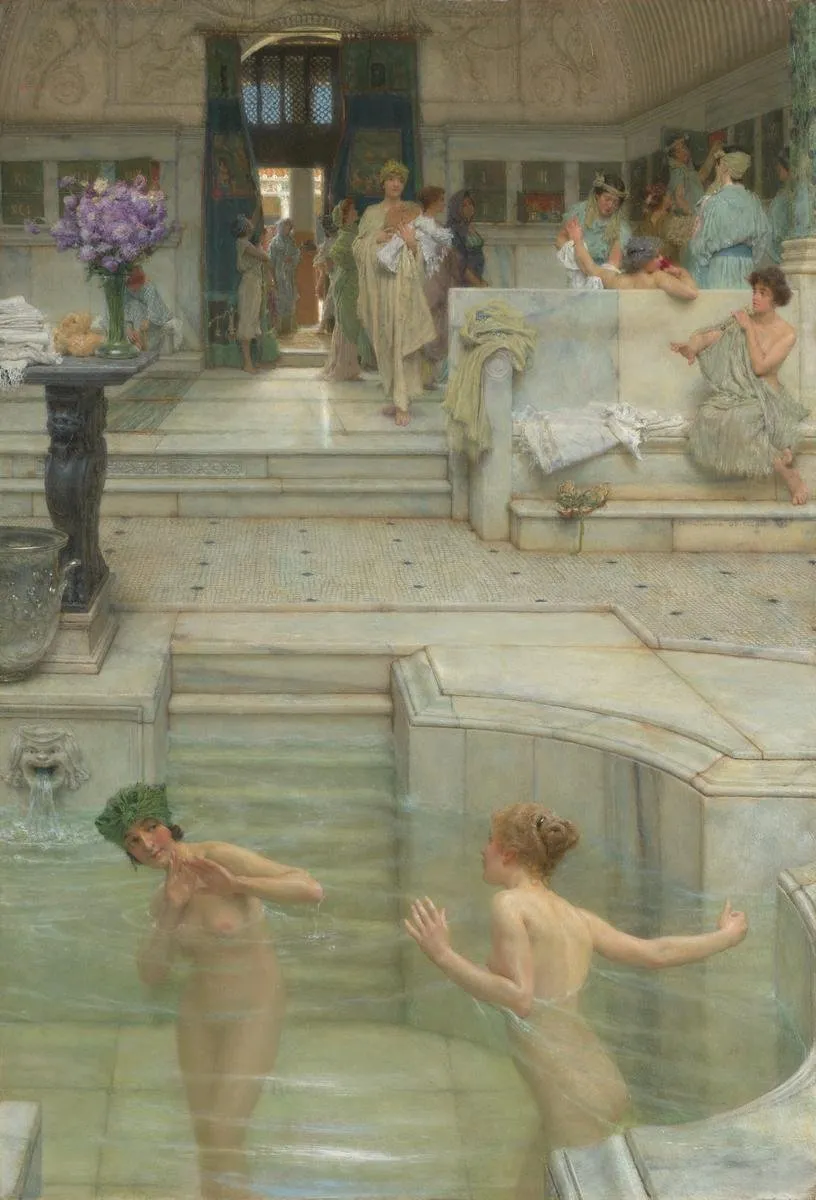
The answer lies in a combination of scientific observation, technical wizardry, and a specific lighting phenomenon known as sub-surface scattering.
The Obsession: Why Alma-Tadema Loved the Marble
"I have always loved the marble," Alma-Tadema once told a biographer. "It is living matter."
To him, stone was not a dead background element. It was a character. He treated a slab of Carrara marble with the same tenderness that other artists treated human skin.
This obsession began early. During his honeymoon in Italy in 1863, while other tourists were sketching the Colosseum's arches, Tadema was measuring its floors. He carried a tape measure everywhere. He famously measured the exact height of the steps at the Capitol in Rome to ensure his figures captured the specific muscular tension required to climb them.
But geometry was the easy part. The hard part was the light.
Alma-Tadema’s Secret: Painted Light
The reason most painted stone looks like gray plastic is that artists treat it as an opaque surface. They paint the light hitting it and bouncing off.
But marble is translucent. It is a metamorphic rock composed of recrystallized carbonate minerals. When sunlight hits white marble, it doesn't just bounce off the surface; it penetrates into the stone, scatters among the crystals, and then glows back out.
This is the same phenomenon that makes human skin look alive (and why wax figures look dead). The Alma-Tadema marble technique relied on mastering this effect before CGI artists even had a name for it. He achieved it through a rigorous layering process:
- The Base: He would start with a brilliant white lead ground—much brighter than the standard canvas prep of his day.
- The Glow: He laid down thin, semi-transparent glazes of blue and violet (reflecting the sky) and warm ochres (reflecting the sun).
- The Scattering: Instead of blending these colors perfectly, he allowed the brushstrokes to remain slightly distinct, mimicking the granular crystal structure of the stone.
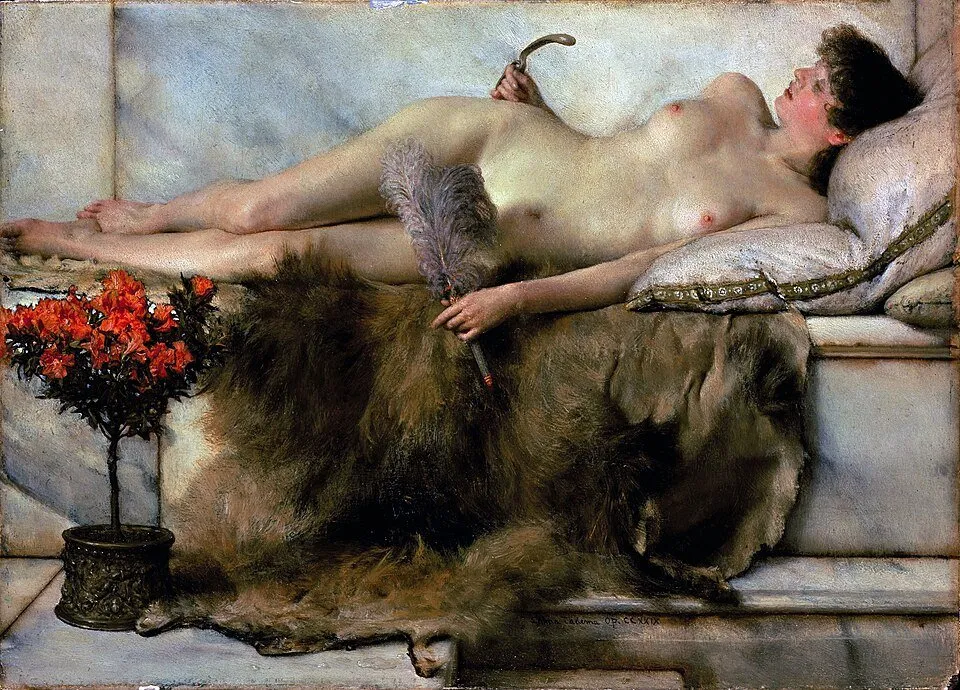
The result is a surface that seems to trap light. In famous works like The Frigidarium (or its predecessor In the Tepidarium), the marble bench doesn't just sit there; it glows with an inner luminosity. You can practically gauge how cool it would feel to the touch.
The Mirror Effect
The second pillar of the Alma-Tadema marble technique was reflection.
Alma-Tadema realized that in the bright Mediterranean sun, polished marble acts like a mirror. It reflects the colors of the clothes, the skin, and the sky around it.
In A Reading from Homer (1885), look closely at the famous curved bench. It isn't just white. It contains smears of pink (from the listener's skin), dashes of blue (from the sky), and deep browns (from the shadows). He painted the environment into the stone.
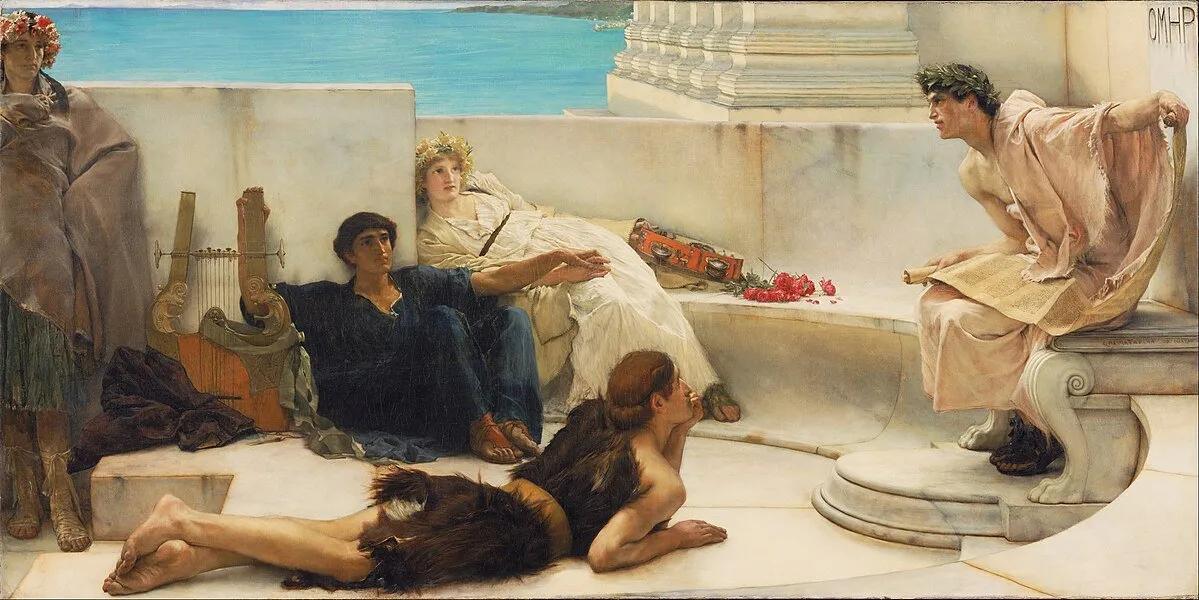
This created a sense of extreme physical unity. The figures in his paintings are not pasted onto a background; they are optically merged with it. The light that hits the woman’s arm is the same light that reflects off the marble wall behind her.
The "Marbousier"
Eventually, this skill became a double-edged sword.
As the 19th century turned into the 20th, art became more abstract. The Impressionists and Post-Impressionists didn't care about rendering perfect stone; they cared about capturing fleeting moments of light.
To them, Alma-Tadema's perfectionism seemed pedantic. One harsh critic disparagingly called him a "marbousier"—a French pun meaning "marble-maker" rather than artist. They argued he was a craftsman, not a poet.
But this criticism misses the point. For Tadema, the craftsmanship was the poetry. He believed that by rendering the physical world with absolute fidelity, he could transport the viewer across time. If the stone felt real, then the Romans standing on it felt real. He wasn't trying to make a painting; he was trying to build a time machine.
The Living Stone
The brilliance of the Alma-Tadema marble technique is that it preserved a vision of the ancient world that feels touchable. The next time you view an Alma-Tadema, don't just look at the faces. Look at the floor. Look at the benches. Look at the columns.
Notice the blue veins running through the white calcite. Notice the sharp, hard reflection of a bronze pot on a polished step. Notice how the light seems to sink a millimeter into the surface before bouncing back.
You are witnessing the work of a man who loved the world so much he tried to preserve it in oil—one grain of stone at a time.
Leave a Visiting Card
Consulting the visiting cards...