Names have power. And Alma Tadema knew it.
His birth name was distinctively Dutch: Lourens Tadema. "Tadema" is a common Frisian surname (meaning "son of Ade"). "Lourens" is the Dutch version of Lawrence.
But if you look at the catalogs of the Royal Academy exhibitions in the 19th century, you won't find a "Lourens Tadema" listed under purely 'T'. You will find Alma-Tadema listed right at the top, under 'A'.
This wasn't an accident. It was one of the smartest marketing moves in art history.
The Alphabet Game
In the 19th century, art exhibitions like the Paris Salon or the Royal Academy Summer Exhibition were massive. Thousands of paintings were hung on the walls, floor to ceiling. The accompanying catalog was the visitor's Bible.
Crucially, the catalog was organized alphabetically.
If your name was "Tadema," you were listed near the end, possibly on page 40, after the visitor was already tired and bored.
Lawrence realized this problem early in his career. He had a godfather named Tadema Sans, but "Alma" was also a family name (from his godfather / uncle). He decided to incorporate it.
But he didn't just make it a middle name. He made it part of his surname. By hyphenating it (either officially or unofficially in usage), he jumped from the 'T's to the 'A's.
Suddenly, he was on page 1 of the catalog. He was the first name critics saw.
Not a Title
Many British people assumed the double-barrel name was a sign of aristocracy. In England, hyphenated names usually meant you had inherited two estates.
People whispered, "Is he a Count? Is he a Baron?"
He wasn't. He was the son of a village notary. But the name Alma Tadema sounded exotic, rhythmical, and slightly mysterious. It fit perfectly with the luxurious, foreign scenes he painted.
The "Alma" Mystery
What does "Alma" actually mean?
In Latin, Alma means "nourishing" or "kind" (as in Alma Mater). In Spanish, it means "Soul." In Arabic, it can mean "Learned."
Lawrence liked the ambiguity. He enjoyed the fact that his name sounded like ancient Latin. It connected him to the Roman world he painted.
The Brand
By the 1880s, the name had become a global brand. You didn't even need to say "Lawrence." You just said "a Tadema" or "an Alma-Tadema," and everyone from New York to St. Petersburg knew exactly what you meant: blue skies, white marble, and expensive beauty.
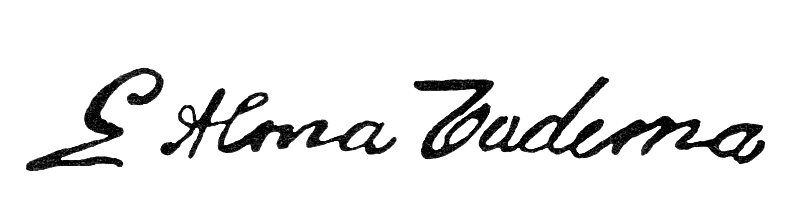
He protected this brand fiercely. He signed his paintings with a distinctive, block-capital signature that looked like it was carved into stone: L. ALMA TADEMA.
He also Anglicized his first name. "Lourens" became "Lawrence" when he moved to London. He wanted to be easy for his customers to address.
In the end, the name change tells us that he wasn't just a dreamy artist. He was a practical man. He understood that talent is not enough; you also need to be seen. And the best way to be seen is to be first in the book.
Leave a Visiting Card
Consulting the visiting cards...