
Lawrence Alma-Tadema knew tragedy early. Death had stalked him as a boy, and it visited him again as a young man. But the story of Laura Alma Tadema—his second wife, his muse, and his salvation—is a testament to how love can resurrect even the most broken heart.
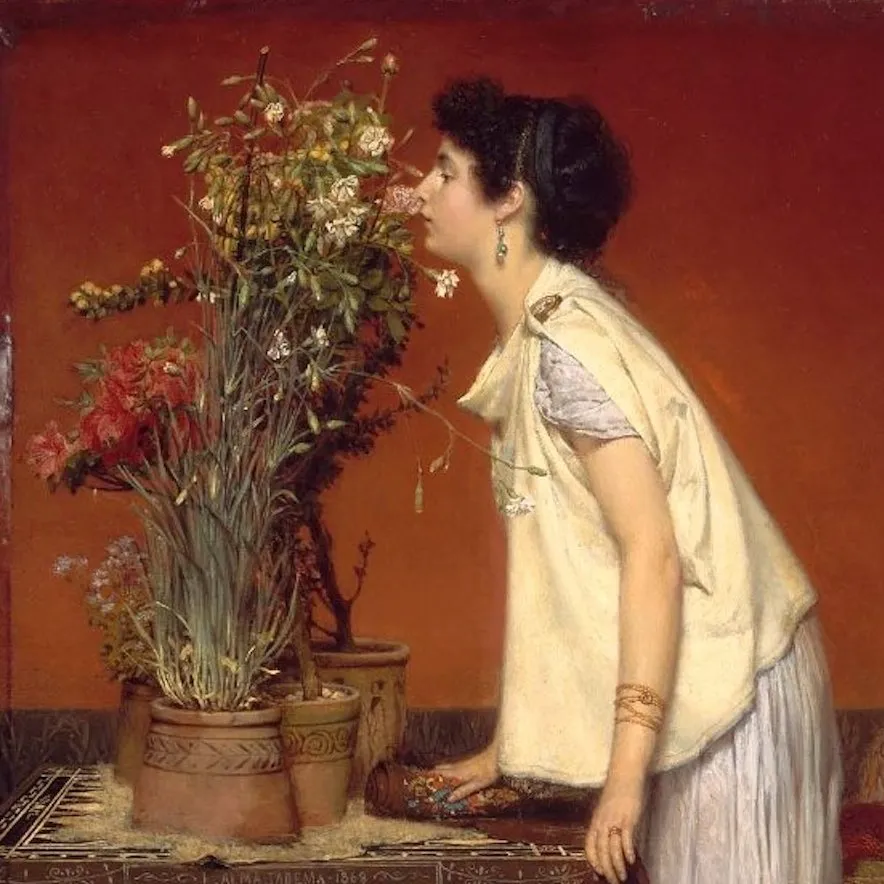
His first wife, Marie-Pauline Gressin Dumoulin, was the companion of his early struggles. She was the one who crossed the Alps with him on that fateful honeymoon in 1863. She stood beside him in the ruins of Pompeii when the great inspiration struck.
But their time was cruel. She died in 1869, leaving Lawrence a widower at thirty-three. He was left alone in a foreign city (Brussels at the time) with two infant daughters and a broken heart.
The house was quiet again. The gloom threatened to return. The "boy who was supposed to die" felt like he was dying again, not from consumption, but from grief.
But then, he met Laura Alma Tadema (then Laura Epps). The woman who would become his salvation, his partner, and the light that would guide him through his greatest years.
The Second Act
He met her at a dance in London in December 1869, at the home of the painter Ford Madox Brown.
Lawrence had just arrived in London, seeking medical advice for his mysterious ailments (which were mostly psychosomatic manifestations of stress). He saw Laura. She was barely seventeen—half his age. She had a striking mane of red-gold hair and a spirit that matched his own.
He later said it was love at first sight. He reportedly turned to a friend and said, "There is my wife."
But it wasn't that simple. Her father, Dr. George Napoleon Epps, was a formidable man. He looked at this foreign painter—older, widowed, with two sick children and a thick Dutch accent—and was less than impressed. He argued that Laura was too young.
Lawrence was persistent. He didn't give up. He offered to give her painting lessons as a way to "get to know the family."
It was a Trojan Horse strategy. During those lessons, amidst the smell of turpentine and oil paint, they fell in love. With every brushstroke, the bond grew. Lawrence wasn't just teaching a student; he was courting a partner.
They married in 1871, and Laura Alma Tadema became not just a wife, but the anchor of his new life in England.
A Creative Partnership
Laura was not content to simply be a muse (though she appears in many of his paintings, her distinctive hair unmistakable in works like The Women of Amphissa). She was an artist in her own right.
This is what made their marriage so modern. It wasn't a case of the Genius and the Housewife. It was two painters working side by side.
In their famous house, Casa Tadema, they had separate studios. But they were always connected. They would visit each other's spaces to critique work throughout the day.
While Lawrence painted the grand marble palaces of Rome and the blinding Mediterranean sun, Laura Alma Tadema painted the quiet, intimate interiors of the 17th century. She focused on Dutch domestic scenes—mothers reading to children, women looking out windows. Her work was celebrated; she exhibited at the Royal Academy and the Paris Salon.
They were London's artistic power couple. They hosted legendary parties where sticking a stamp on an envelope might mean meeting Tchaikovsky or Caruso. Their home was a swirl of music, laughter, and art.
She brought the light back into his life. The dark "medieval" period of his art ended, and the "golden" Roman period truly bloomed. You can see her influence in the warmth of his colors.
The Muse and the Maker
For thirty-eight years, they were inseparable.
She raised his daughters (Anna and Laurence) as her own. She designed the interiors of their homes. She sat for him when he needed a model. She defended him against critics.
When she died in 1909, after a short illness, the light went out for good.
Lawrence was devastated. He was knighted, famous, and wealthy, but without Laura, the "Sanctuary" he had built was empty. He painted very little of consequence after her death. He spent his final three years wandering the empty halls of the palace they had built together.
To know Lawrence, you must know Laura Alma Tadema. She was the warmth in his marble. She was the red-gold thread that ran through the tapestry of his greatest years. She was the reason the boy who was supposed to die lived such a glorious, full life.
Leave a Visiting Card
Consulting the visiting cards...