
In 1895, the world was on the verge of learning to see in a new way. In Paris, the Lumière brothers were preparing to project the first moving pictures to a stunned audience. But in a quiet studio in London, Lawrence Alma-Tadema had already invented the wide-screen epic. His painting, A Coign of Vantage, is not just a static image of three women on a balcony; it is a direction to the eye. It is a camera angle.
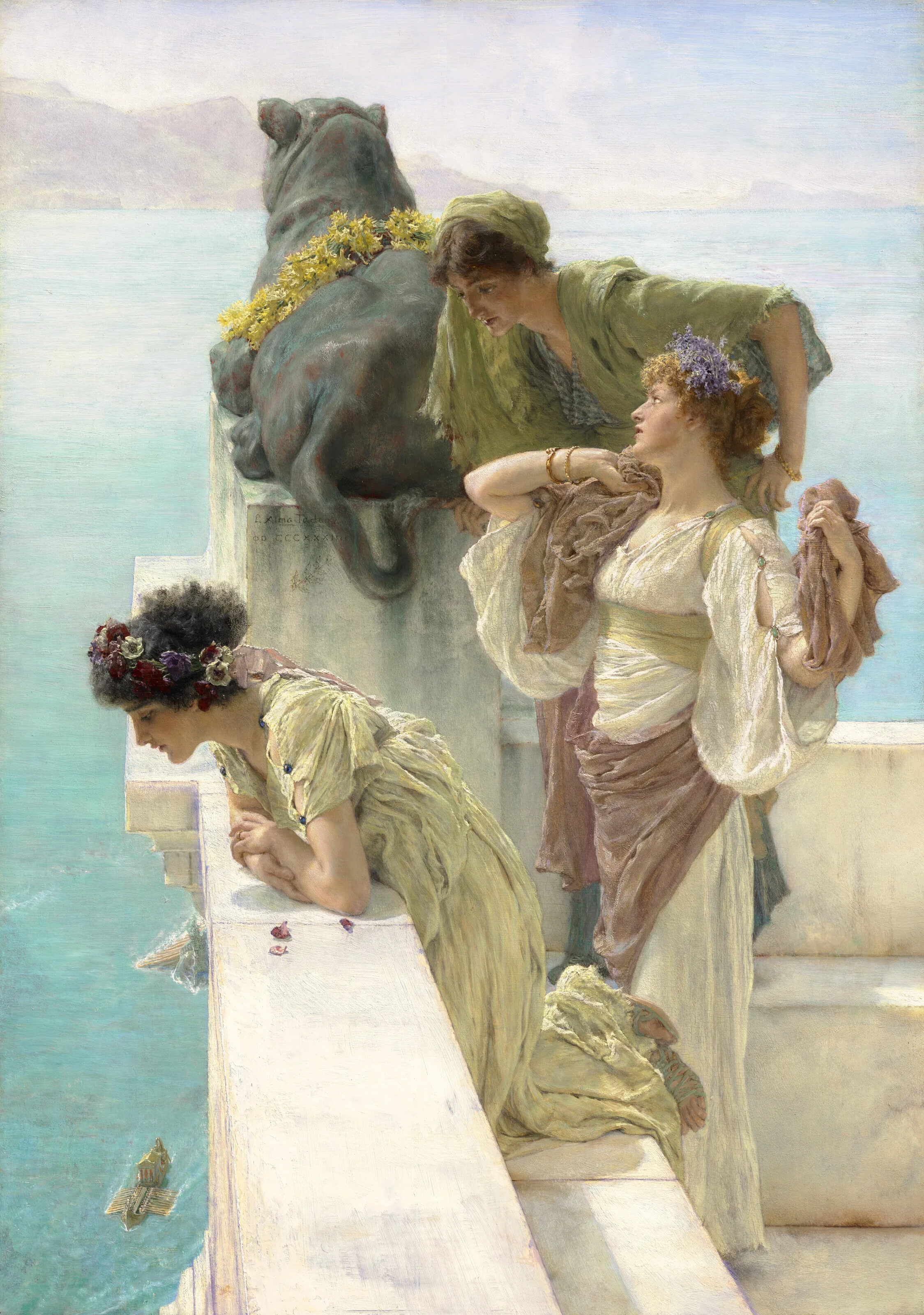
Depending on who you ask, A Coign of Vantage is either the most expensive view in Victorian art or the first true "establishing shot" in history. It depicts three women in classical dress, lounging on a high marble precipice, looking down—way down—at a fleet of galleys returning to a sun-drenched harbor. The horizon is high, the drop is sheer, and the sense of vertigo is intentional.
When this painting sold in 2010 for $9.7 million, setting a new world record for the artist, the price tag shocked the art world. But for those who understand the lineage of visual storytelling, the value was obvious. This canvas is the missing link between the gallery wall and the cinema screen.
The Architecture of Vertigo
The title itself gives the first clue to the painting's power. The phrase is lifted directly from Shakespeare’s Macbeth. In Act 1, Banquo observes the castle and notes: "No jutty, frieze, / Buttress, nor coign of vantage, but this bird / Hath made his pendent bed."
A "coign of vantage" is a projecting corner, a high point of observation. Alma-Tadema took this literary concept and translated it into pure architecture. He places the viewer not on the ground, looking up at the subjects, but suspended in the air beside them. We are hovering.
This was a radical departure from the "fourth wall" theatricality of most Victorian art. In traditional history painting, the action unfolds on a stage, and the viewer sits in the audience. In A Coign of Vantage, the viewer is dangling over the abyss. By cutting off the foreground with a sharp, diagonal marble balustrade, Alma-Tadema forces our eye to plunge downward. We don't see the city below, but we feel it. We feel the height, the wind, and the terrifying drop to the water. It is a masterclass in suggesting scale without showing it—a technique that Hollywood set designers would study continuously for the next century.
The Color of Heat
If the composition creates the vertigo, the color provides the atmosphere. Art historians and critics have long struggled to define the specific quality of "Tadema Blue," but this painting is its definitive manifesto.
The Mediterranean Sea in the background is not the grey, churned water of the English Channel. It is a flat, opaque sheet of turquoise-lapis that radiates heat. Alma-Tadema understood that under the relentless mid-day sun of the Bay of Naples, the sea does not sparkle; it solidifies. It becomes a heavy, saturated plane of color.
To achieve this, he utilized the new synthetic pigments of the industrial age, layering glazes to create a luminosity that seems backlit. Against this blinding blue, the white marble of the balcony acts as a reflector, bouncing light onto the faces of the women and the bronze surface of the Sphinx.
The Sphinx crouching in the corner is not merely decoration. It is a counterweight. The women are animated, alive, pointing and whispering about the returning fleet. The Sphinx is stone-still, gazing into eternity. This contrast—between the fleeting excitement of a human moment and the indifferent permanence of history—is the philosophical engine of the painting. The heat of the day will fade; the ships will dock; the women will age. The Sphinx and the sea will remain.
The New Woman on the Balcony
There is a subtle social narrative hidden in this dizzying height. The women in A Coign of Vantage are distinct from the passive, fainting damsels of earlier Victorian art.
Crowned with wreaths of ivy—a symbol sacred to Bacchus, the god of wine and celebration—they are seemingly waiting for a festival or a returning conqueror. But notice their agency. They are not being looked at; they are doing the looking. They possess the "high ground." They own the view.
In 1895, the "New Woman" movement was gaining momentum in London. Women were demanding space, visibility, and autonomy. By placing these three figures at the very top of the world, looking down on the toy ships of men, Alma-Tadema grants them a position of supreme power. They are the audience for whom the fleet sails. They are the critics on the balcony.
From Canvas to California
The cinematic quality of A Coign of Vantage was not lost on the pioneers of early Hollywood. When directors like D.W. Griffith and Cecil B. DeMille began to construct their bibical epics in the California desert, they did not look to real Rome for inspiration—real Rome was a mess of brick and ruin. They looked to Alma-Tadema.
They wanted his white marble, his blinding light, and yes, his camera angles. The high, sweeping shots of Babylon in Griffith's Intolerance are direct descendants of this balcony. The use of foreground figures to frame a massive distant spectacle is a technique Alma-Tadema perfected here. He taught the camera how to see the ancient world.
The 9.7 Million Dollar Coign of Vantage
The journey of the painting itself is a testament to the fluctuating tastes of the art market. Commissioned by the wealthy New York banker John Stewart Kennedy, this coign of vantage was the jewel of the American Gilded Age. But as modernism swept the 20th century, the painting fell out of favor, dismissed as "kitsch."
It was rescued from obscurity by Allen Funt, the creator of Candid Camera, who recognized its genius when the critics did not. He held it in his collection, preserving it through the decades when Victorian art was considered worthless.
When it finally came to auction at Sotheby's in 2010, the world had caught up to Funt's vision. A Coign of Vantage sold for nearly $10 million, shattering expectations. The price confirmed what the eye already knew: this is not just a painting of three women on a ledge. It is one of the most sophisticated visual devices of the 19th century—a machine for seeing, a blueprint for cinema, and a permanent window into a dream of the Mediterranean that never truly existed, except in the mind of a Dutch painter in London.
Leave a Visiting Card
Consulting the visiting cards...