The smell is not of varnish and turpentine, but of hot oil and steam.
While Leopold Lowenstam worked in the quiet intimacy of the studio, and Auguste Blanchard labored over cold steel plates for weeks, W. Biscombe Gardner lived in the roar of the deadline.
He was the conduit to the crowd.
If Blanchard was the cinema screen and Lowenstam was the signed photograph, Gardner was the broadcast signal. He was the master of Wood Engraving, the "pixel" of the Victorian age, and the man who put Alma-Tadema’s Rome into the hands of the commuter, the clerk, and the masses.
The Tyranny of the Steam Press
In the late 19th century, art had a distribution problem.
You could print text by the millions using relief type—raised letters inked and pressed onto paper. But you couldn't print a copper etching that way. Etching requires the ink to be inside the grooves (intaglio), needing a completely different, slower press. You couldn't run an etching alongside the morning news.
Enter the Wood Engraver.
Working on blocks of end-grain boxwood—hard as bone—Gardner cut away the white to leave the black standing in relief. This meant his block could be locked into the same chase as the lead type of The Illustrated London News. Text and Image, married in speed.
But Gardner was no factory hack. He was a celebrity in a world of anonymous cutters.
The High-Definition Cut
Most wood engravings of the era were functional—rough sketches meant to convey information. W. Biscombe Gardner (1847–1919) was different. He was an artist who fought for his medium to be recognized by the Royal Academy.
He didn't just cut lines; he cut tone.
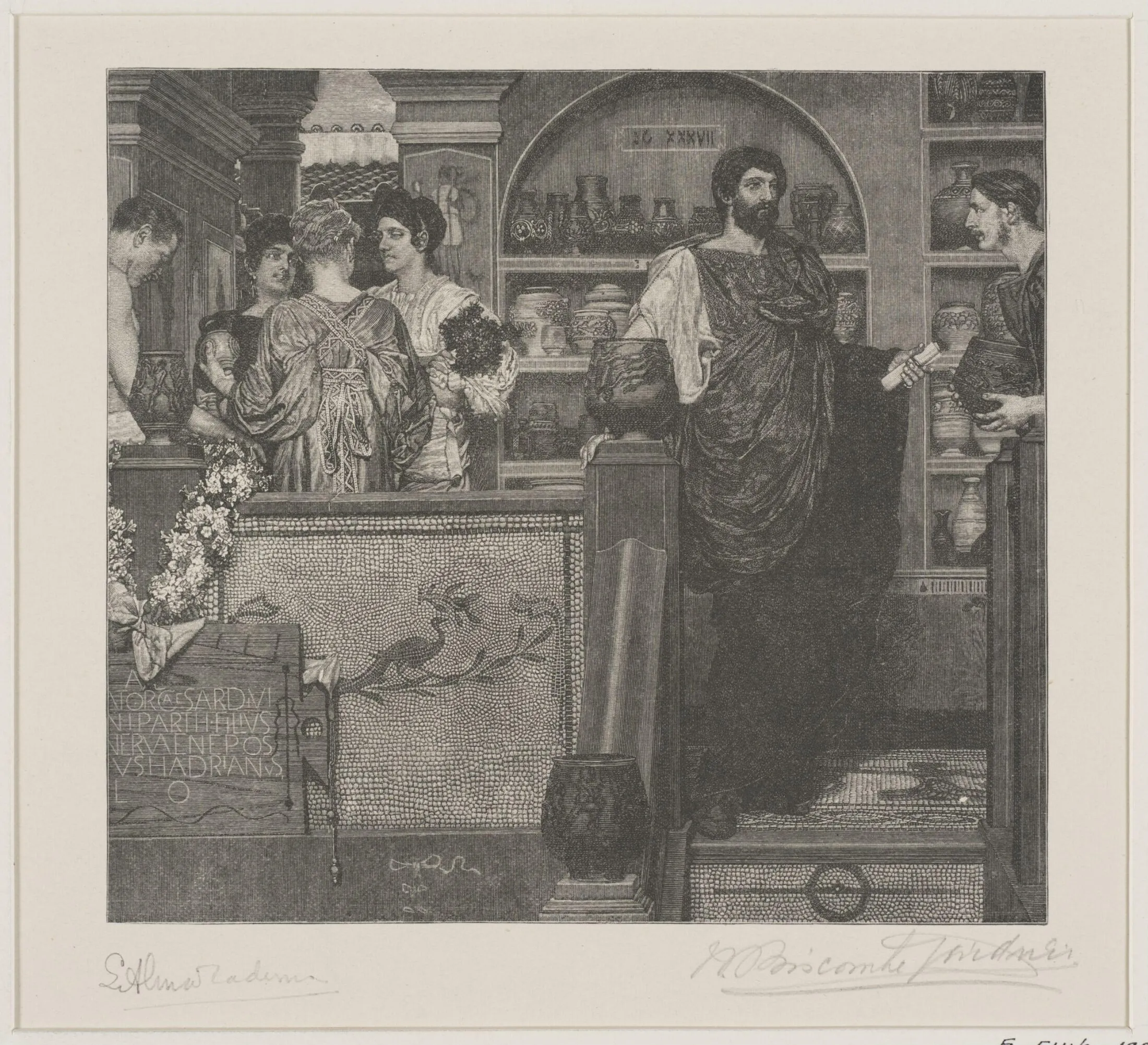
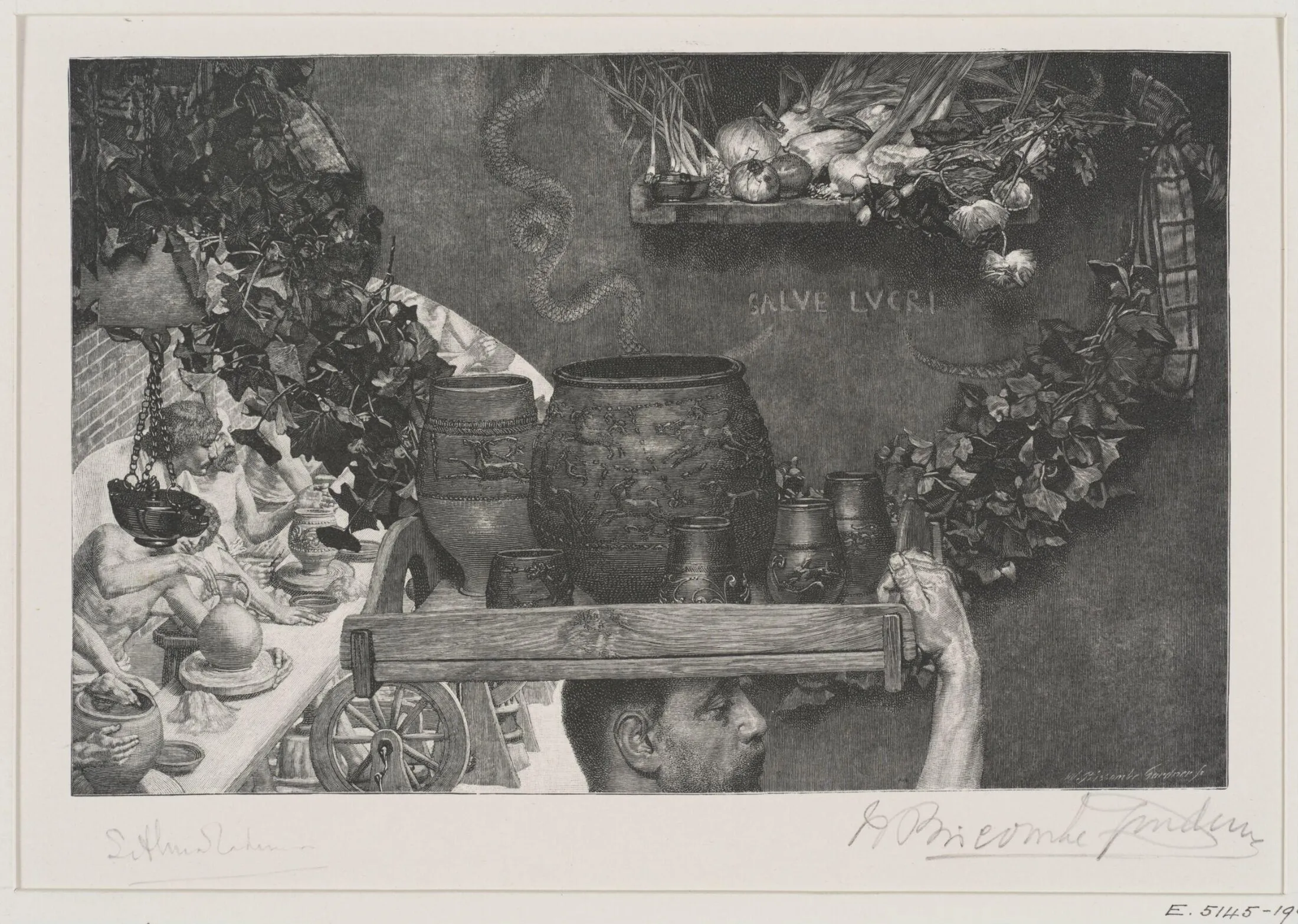
His engraving of Opus 261, Hadrian Visiting a Romano-British Pottery, known simply as "The Potteries" (now in the V&A), is a miracle of translation. He mimicked the slush of wet clay, the glint of Roman glass, and the heavy folds of wool—all with a tool no wider than a needle.
He was the "High Definition" channel of the 1880s. When Lawrence Alma-Tadema wanted his work to be seen not just by the elite, but by the empire, he needed a man who could make wood sing.
The Family Trust
The trust went deep. It wasn't just Lawrence who relied on him. When Laura Alma-Tadema, a formidable artist in her own right, had her painting Always Welcome featured in the Illustrated London News in May 1888, it was Gardner who held the graver.
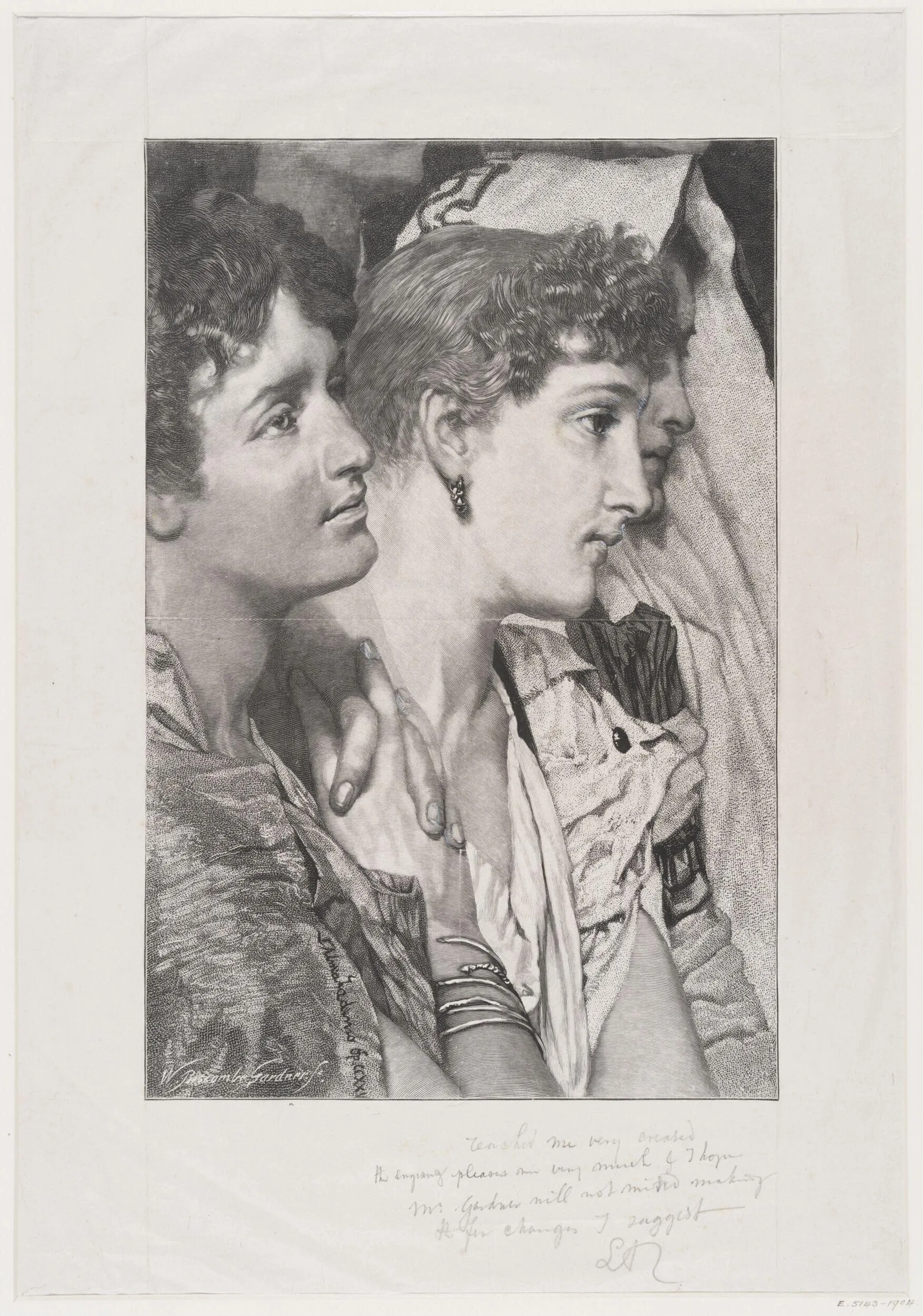
He treated the magazine page with the same reverence Blanchard gave the gallery print. While others churned out images, Gardner signed his blocks. He produced "proofs on India paper"—luxurious, hand-pulled impressions taken before the block was subjected to the brutality of the steam press. These proofs, like the one in the V&A, are the true survivors.
The Paper Ephemeral
Gardner represents the "Third Dip" of the Tadema industry.
First, the painting sold for thousands. Second, the copyright sold to a print publisher for hundreds. Third, the magazine rights sold to the Graphic or ILN for the mass market.
Gardner was the architect of this final, vast tier. He made the exclusive inclusive.
Today, his work is harder to find than the great steel engravings. Newspapers were meant to be read and discarded; used to wrap fish or light fires. But in the archives, on pages yellowed by a century of time, the lines are still sharp. They are the evidence of the moment when "High Art" met the "Mass Media," and a woodblock cutter proved that a deadline was no excuse for a lack of beauty.
Leave a Visiting Card
Consulting the visiting cards...