Behind every great painter of the Victorian age stood an invisible army of translators. In an era before high-resolution digital screens, the fame of an artist was not carried by the original canvas—which often vanished into the private halls of tycoons—but by the prints that filled the homes of the world.
For Lawrence Alma-Tadema, the most vital of these translators was Leopold Lowenstam.
Lowenstam was more than a technical craftsman; he was the "authorized voice" of the Tadema aesthetic. Their partnership was one of the most significant in the history of Victorian art, built on a foundation of technical mastery and a friendship so deep it blurred the lines between professional collaboration and family life.
The Prodigy from the North
Born in Düsseldorf in 1842 and trained at the Amsterdam Academy, Leopold Lowenstam was a prodigy of the needle and acid bath. He did not come to etching as a secondary pursuit; he was a master of the craft from his youth, winning medals for engraving before he had even left school.
His talent was so undeniable that in 1871, the Swedish government recruited him to establish a national etching school in Stockholm. For his service to Swedish art, he was awarded the Knight’s Cross of the Order of Vasa.
But it was in London, where he arrived in 1873, that he found his true muse. In the studio of Alma-Tadema, Lowenstam found a painter whose obsession with texture and light demanded a new kind of etching—one that could "translate" the coolness of marble and the warmth of skin into a world of black and white.
Symbiosis and Scrutiny: The Intimate Taskmaster
The relationship between Alma-Tadema and Lowenstam was uniquely intimate. Unlike many artists who kept their engravers at arm's length, Tadema welcomed Lowenstam into the very heart of his home, Casa Tadema.
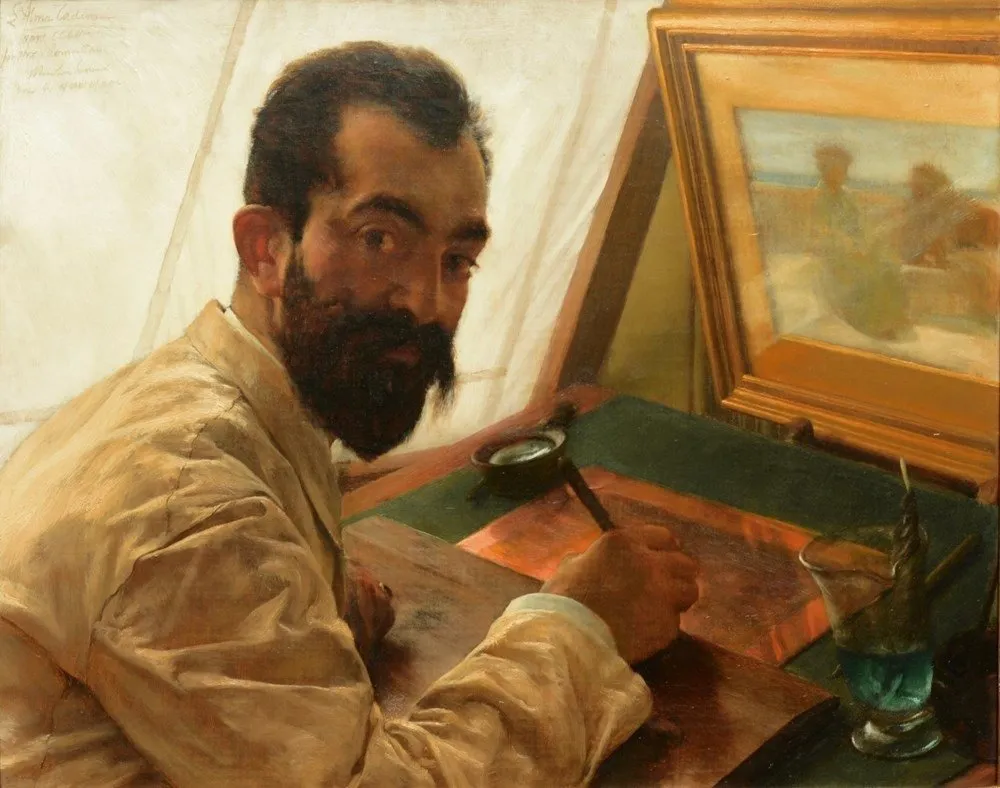
The proof of this intimacy lies in a woman named Alice Search. Alice was the governess for Tadema’s children, Laurence and Anna, and a central figure in the household. In 1883, she and Lowenstam were married. To celebrate the union of his preferred etcher and his children’s governess, Alma-Tadema produced a work of extraordinary personal significance: The Portrait of Leopold Lowenstam (Opus CCXLVII).
This portrait captures Lowenstam in the act of creation, bent over a copper plate, his needle moving with precision. It is a meta-artistic tribute—a master painter immortalizing the man who would make his work immortal.
However, this personal warmth did not exempt Lowenstam from Alma-Tadema’s legendary professional standards. Once a painting was finished, Tadema famously transitioned from "Artist" to what he called his "Tradesman" persona. He viewed his engravers as the vital final link in his global supply chain and policed their output with brutal scrutiny.
Primary research into the Dutch source "Kunst in reproductie" reveals that Tadema could be a harsh taskmaster. In one instance, regarding a proof for the etching of A Favourite Author, Tadema sent a blistering letter to Lowenstam, rebuking the master etcher for what he perceived as a lack of professional distance:
"You are childish and infatuated with your work... I decline to sign such works as it stands."
Tadema’s "scolding" was not an act of cruelty, but a manifestation of obsessive quality control. He knew that for his "Empire of Marble" to stand, every single line etched by Lowenstam had to be perfect. This tension—between the family friend and the demanding CEO of a global art brand—defines the complexity of their bond.
The "Soft" Translation
What made Lowenstam the "standard" etcher for Alma-Tadema was his command of the "soft" etching style. While other collaborators like Auguste Blanchard specialized in the sharp, crystalline lines of steel engraving—perfect for Tadema’s architectural masterworks—Lowenstam was the master of atmosphere.
Using sophisticated techniques like chine collé, Lowenstam created a tonal depth that felt more like a charcoal drawing than a print. His etchings for works like Pleading, The Oleander, and First Whisper of Love possess a romantic, hazy quality. They don’t just show the scene; they radiate the mood.
When you look at a Lowenstam print, you aren't looking at a copy. You are looking at a collaborative performance. Often, these prints were signed in pencil by both Alma-Tadema (on the lower left) and Lowenstam (on the lower right). This dual signature was a mark of shared authorship—an acknowledgment from the world’s most successful painter that the etcher was his equal in the creation of the final image.
The "Oscar" of the Etching World
In the specialized world of Victorian printmaking, there was no higher endorsement than being named the Premium Plate of the Year by The Art Journal.
To receive this plate, a subscriber had to commit to a full year of the magazine. In return, they received a masterpiece of the printer’s art: a large-format etching, often hand-pulled on "India Paper" using the chine collé technique to achieve a tonal depth that no machine-made print could replicate.
In 1909, this honor was bestowed upon Leopold Lowenstam for his translation of Alma-Tadema’s A Harvest Festival.
The choice was a sensation. Lowenstam had been dead since 1898, yet more than a decade after his passing, his needlework was still deemed the pinnacle of the craft. While other engravers like Auguste Blanchard dominated the high-end market for exclusive, independent prints, the Art Journal Premium Plate was how the Tadema aesthetic reached the heart of the home. To own one was a mark of supreme taste—a "dead man's victory" for the etcher who mastered the soft light.
The Engine of Fame
We often credit the new money of the Victorian age for Tadema’s wealth. But it was Lowenstam who provided the "product" for that market.
His plates were the engines of Tadema’s global fame. A single painting could only be in one room at a time, but Lowenstam’s etchings could be in thousands of rooms across London, Paris, and New York. Through the publisher Pilgeram & Lefevre, Lowenstam’s work ensured that the "Tadema Brand" was a household name.
The economic reality was staggering. Victorian etchers were often paid substantial fees, reflecting their role as the true drivers of the art market. For the public, owning a hand-signed Lowenstam etching was a mark of taste, a "velvet rope" entry into the world of high art that was otherwise reserved for millionaires.
Lost and Found: The Final Thread
Leopold Lowenstam died in 1898 at the age of 56. Even after his death, his influence persisted; in 1909, the Art Journal chose his engraving of A Harvest Festival as its Premium Plate of the year.
For over a century, Tadema’s wedding-gift portrait of Lowenstam was a ghost. After its exhibition in 1884, it vanished from the public record. Art historians considered it "lost," a tragedy given its status as a rare portrait of a Victorian craftsman at work.
Then, in 2016, a man walked onto the set of the BBC’s Antiques Roadshow with a painting that had been in his family for generations. He was the great-great-grandson of Leopold Lowenstam. The expert, Rupert Maas, was stunned. The "lost" masterpiece had been safe all along, cherished by the descendants of the man it depicted.
Its rediscovery was more than a market sensation; it was a reconnection to the human thread that linked the painter and the etcher. Today, those of us who collect Tadema prints look for that specific combination: the tell-tale "soft" line of the Lowenstam needle and the two pencil signatures at the bottom of the sheet—a reminder that beauty is rarely a solitary act, but a conversation between friends.
Key Works by Lowenstam after Alma-Tadema:
- Pleading (circa 1878) – A masterclass in romantic atmospheric etching.
- First Whisper of Love (1876) – One of the earliest and most successful collaborations.
- This is Our Corner – An intimate etching of Tadema’s daughters, Laurense and Anna.
- A Favorite Custom – A technical feat in capturing the texture of water and marble.
- A Harvest Festival – His final great legacy, published posthumously in 1909.
Leave a Visiting Card
Consulting the visiting cards...