
In the grand, marble-lined universe of Lawrence Alma-Tadema, Sir Edward Poynter was the "fixed point."
Born in the same year—1836—the two men were the twin pillars of the High Victorian establishment. If Lawrence was the "Roman Realist" who brought the past to life with sunshine and silk, Poynter was the "Academic Architect" who held the line with steel and precision. Their relationship was not one of warm, boisterous laughter like Lawrence’s friendship with George Henschel, but one of deep, professional alliance—a "Technical Cold War" fought on the walls of the Royal Academy.
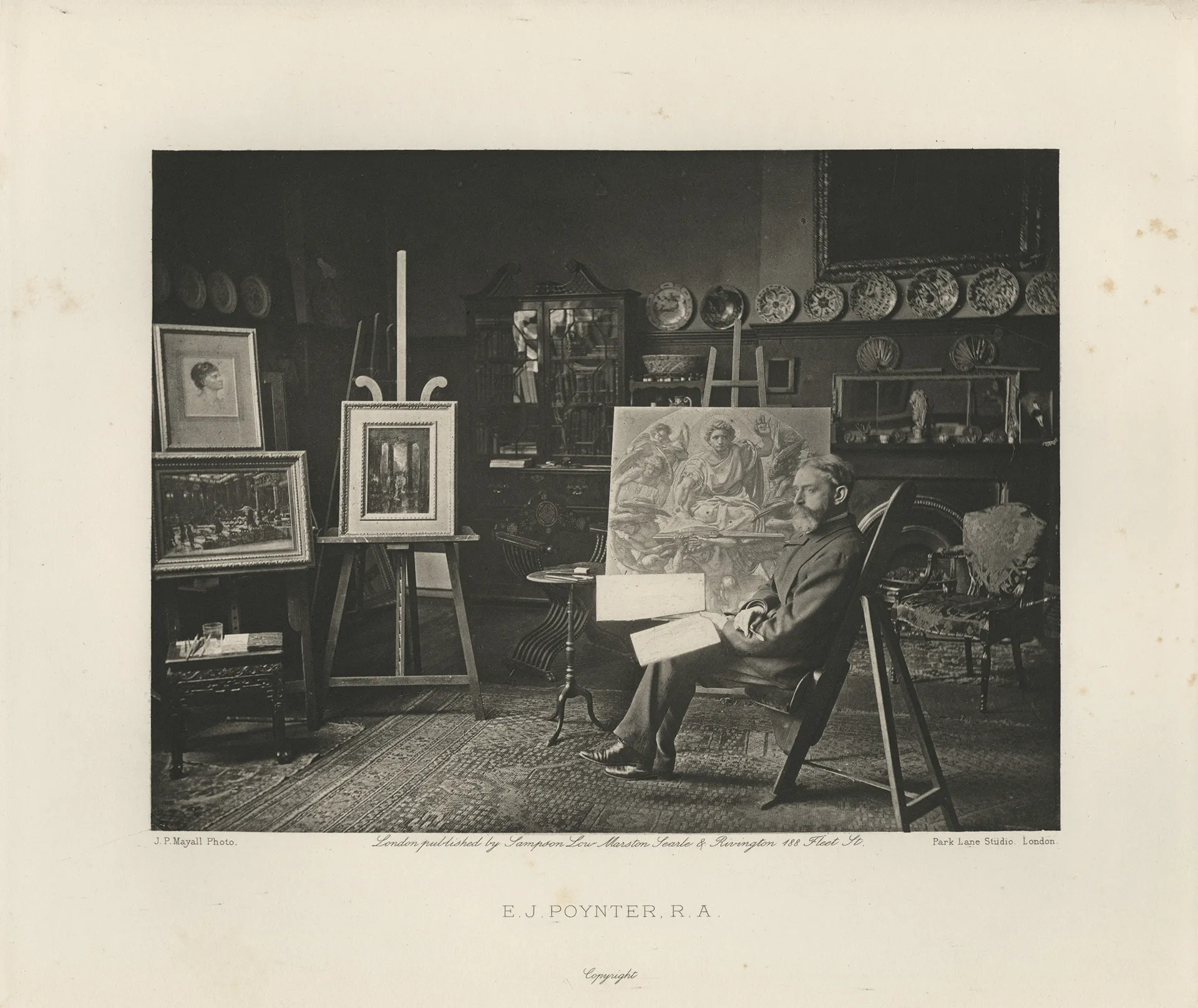
The 1836 Dynamic: The Parallel Lives
To look at the artist Alma-Tadema is to see a man who lived a life in parallel with Poynter. They arrived in London from different worlds—Poynter from the elite schools of Paris and Rome, Tadema from the studios of Antwerp—but they met at exactly the same peak.
In Tadema’s world, Poynter represented the "Academic Guard." While Lawrence was the popular superstar, the man who made the ancients feel like "people from next door," Poynter was the intellectual weight. They were frequently paired by critics: Lawrence was the master of texture (marble, skin, water), while Poynter was the master of structure (bone, muscle, history).
It was a rivalry of mutual respect. Lawrence knew that while he could paint the feel of a Roman villa, Edward Poynter could draw the geometry of the pyramids better than any man alive.
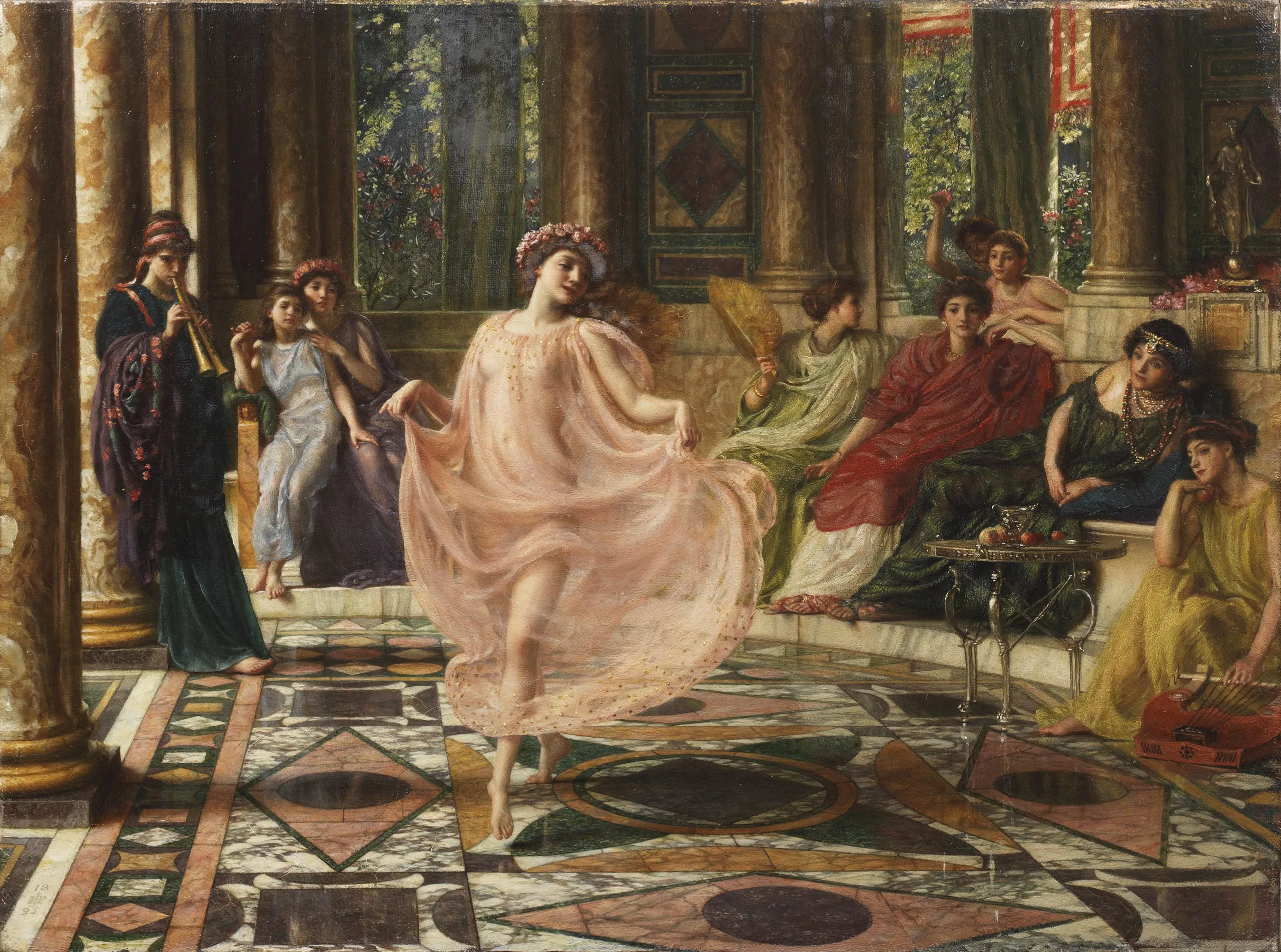
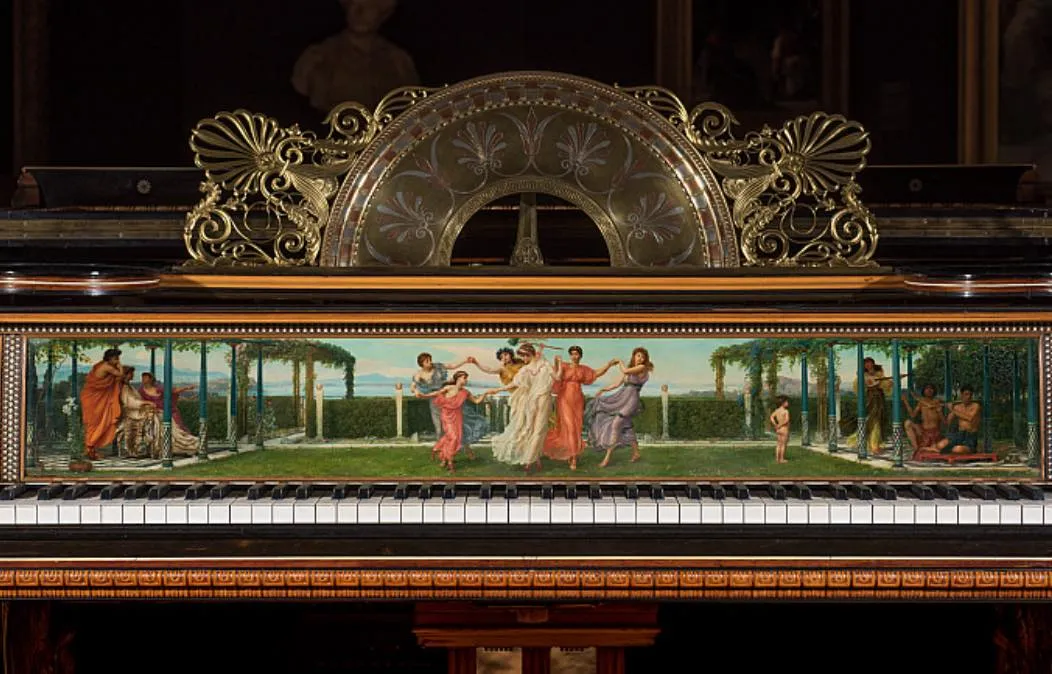
The Collaborative Core: The Marquand Piano
The ultimate proof of their bond lies in the most expensive piece of furniture ever created: the $50,000 Steinway for the American financier Henry Marquand.
Tadema was the mastermind of the project, designing the entire music room to be a "Sanctuary of Sound." But when it came to the fallboard—the piece of wood that would hover over the keys, the most intimate and visible part of the instrument—Tadema did not paint it himself.
He personally chose Poynter.
He commissioned Poynter to paint The Wandering Minstrels, a task that took the Englishman four long years of meticulous labor. By placing Poynter’s work inside his own design, Tadema was essentially saying: "In this temple of beauty, your accuracy is the standard I trust." It remains one of the greatest collaborative moments in art history, a literal merging of their two styles into a single instrument.
The Macdonald Web: Tadema's Social Link
Poynter also acted as Tadema’s bridge into the most powerful artistic family in England: the Macdonald sisters.
Through Poynter’s wife, Agnes, Lawrence was connected to a social web that included Edward Burne-Jones and Rudyard Kipling. When you saw Poynter and Tadema standing together at a Royal Academy banquet, you weren't just seeing two painters; you were seeing the heads of an "Artistic Empire."
Poynter was the "Institutional Representative" of this clan. He ran the National Gallery and then the Royal Academy itself. For Tadema, having the President of the RA as a peer and a collaborator meant that his "foreign" Roman fantasies were protected by the highest British authority.
The Final Eulogy
The depth of their professional bond was revealed at the very end. When the artist Alma-Tadema died in 1912, it was Sir Edward Poynter, as President of the Royal Academy, who stood before the world to deliver the official eulogy.
Poynter’s words were carefully chosen. He praised Tadema’s "extraordinary technical skill," but his voice carried the weight of a man who had lost his most significant contemporary. They had stood guard over the "Classical Dream" together for fifty years.
The Museum Sanctuary
For Lawrence Alma-Tadema, the "Sanctuary" was an experience of life and beauty. For Edward Poynter, the "Sanctuary" was the Museum of Order.
Inside Casa Tadema, Poynter was the guest who reminded everyone that art was a serious, disciplined science. He was the "Sentry" standing guard at the standards of High Art while the "vulgarity" of modern life threatened to erupt like Vesuvius.
Their friendship was a shared defense of the "Classic" against the "Common." Together, they ensured that for a few golden decades, the ancient world wasn't just a memory—it was the most prestigious reality in London.
Leave a Visiting Card
Consulting the visiting cards...