
If you walk past 44 Grove End Road in St. John’s Wood today, you will see a blue plaque. It is a standard, ceramic disc of official history, proclaiming that Sir Lawrence Alma-Tadema, the great painter of Victorian marble, lived and died here.
It is a true statement, but it is also a lie of omission.
For nearly thirty years, this house was indeed "Casa Tadema"—a palatial, aluminum-domed reconstruction of Imperial Rome where the most famous people in London drank wine and posed on tiger skins. But before the marble, before the knighthood, and before the parties, this house belonged to another genius, and it held another story—one so tragic and scandalous that when it ended, the owner fled the country within a week, leaving his paints wet on the palette and his canvases unfinished on the easel.
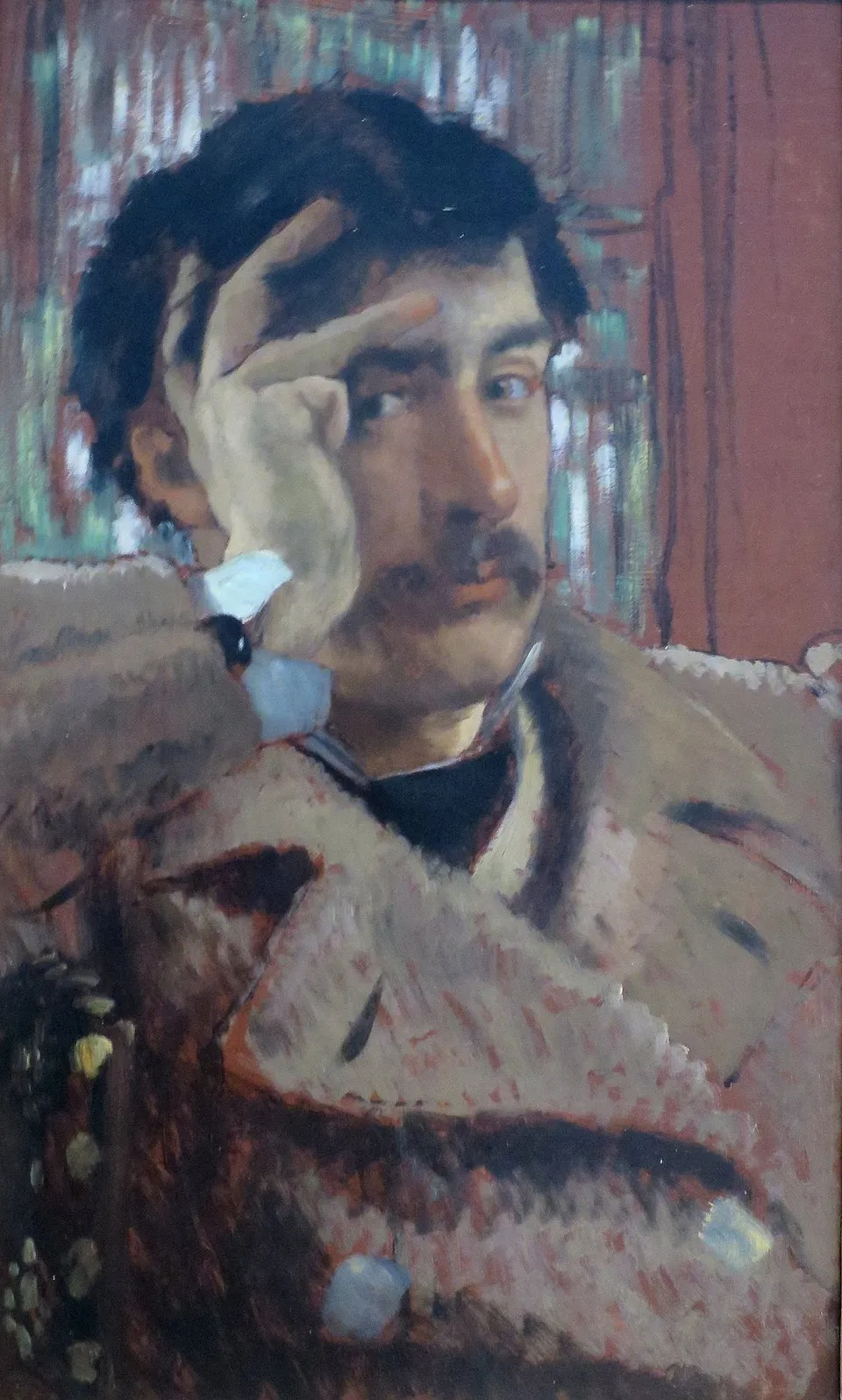
To understand the soul of Alma-Tadema’s house, one must first meet the ghost in its garden: James Tissot.
The Sanctuary of the Outcast
In 1873, the French painter James Tissot bought the lease for 17 Grove End Road (as it was then numbered). He was a refugee of sorts, having fled Paris after the bloody fall of the Commune. He was wealthy, handsome, and impeccably dressed—a man who painted the rustling silks of high society with a devastatingly sharp eye.
But Tissot did not come to St. John’s Wood to join the British establishment. He came to build a fortress against it.
In 1876, a young Irish divorcée named Kathleen Newton moved into the house. She was stunningly beautiful, with large, haunted eyes and a past that polite Victorian society considered unforgivable. She had a child out of wedlock; she was separated from her husband; she was a "ruined" woman.
Tissot did not care. He adored her. And because he refused to hide her, "Society" punished him.
The neighbors in St. John’s Wood—typically a bohemian and forgiving lot—reportedly would cross to the other side of Grove End Road rather than risk walking past Tissot’s gate and acknowledging the "scandalous" arrangement within. Invitations dried up. The great doors of Mayfair closed.
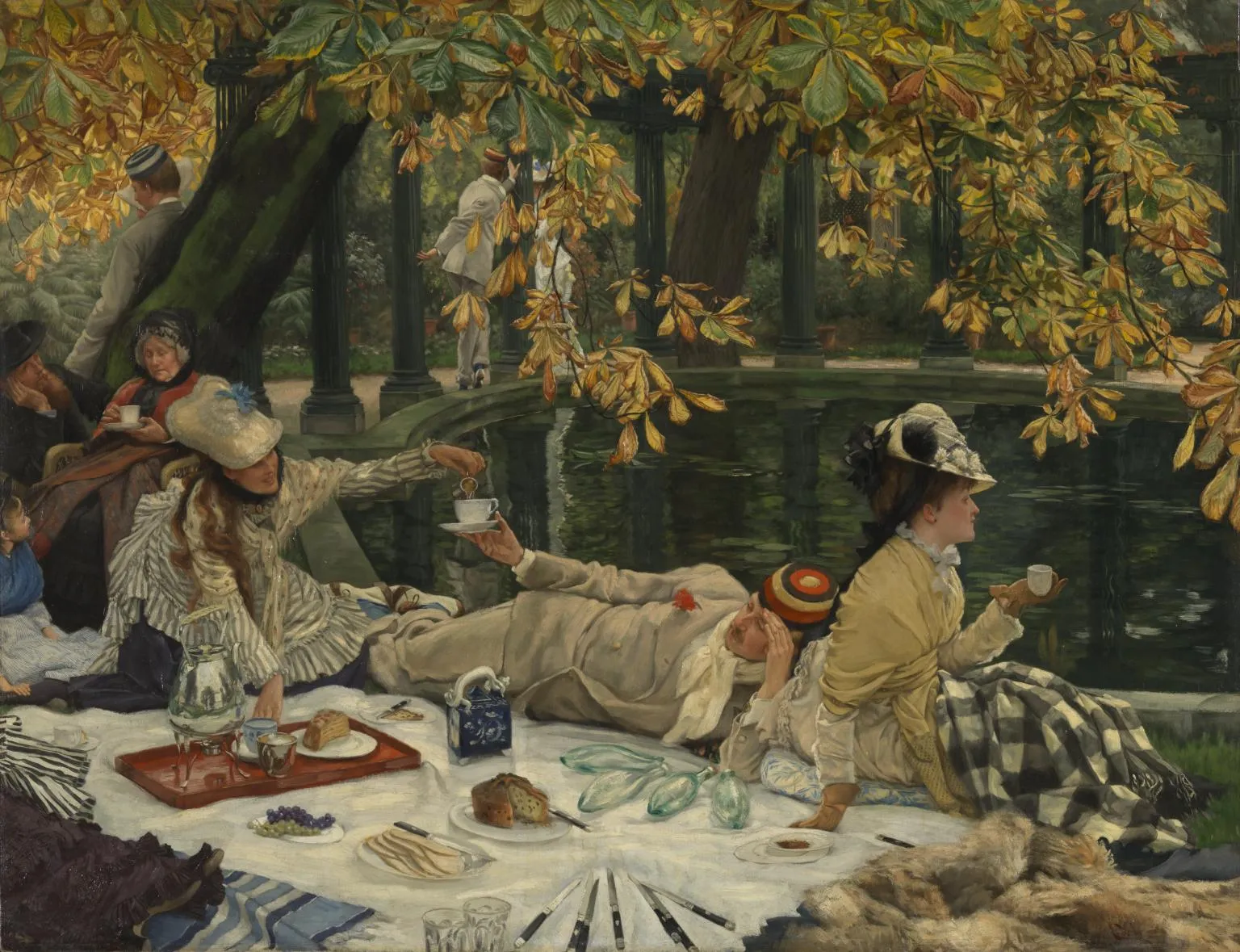
So, Tissot turned inward. He transformed 17 Grove End Road into a self-contained universe, a domestic sanctuary where Kathleen was queen. He famously built a curved colonnade around a garden pool—a direct architectural quote from the Parc Monceau in his beloved Paris. It was a piece of France transplanted to London soil, a stage-set for their private happiness.
For six years, they lived in this sun-drenched isolation. You have seen this garden, even if you don't realize it. Every time you look at Tissot’s paintings from this period—The Hammock, Holyday, On the Grass—you are looking at Kathleen Newton in the garden of 17 Grove End Road. She is the woman reconciling on the lawn; she is the figure reading in the shade of the chestnut trees; she is "La Mystérieuse," the muse he painted over and over again, capturing her fading bloom with obsessive tenderness.
The Wet Palette
The idyll could not last. Kathleen was dying of tuberculosis, the "white plague" that stalked the nineteenth century. As her health declined, Tissot’s paintings became more intimate, more shadowed. He painted her reclining on chaises, wrapped in blankets, her eyes bright with fever, the garden colonnade looming behind her like a stone witness.
On November 9, 1882, Kathleen Newton died in the house. She was twenty-eight years old.
The devastation was total. Tissot—the man known for his cool, detached observation of modern life—broke completely. He reportedly spent hours praying by her coffin, unable to let go.
Then, he ran.
Within a week of the funeral, Tissot abandoned 17 Grove End Road. He did not pack up his life; he simply walked away from it. Accounts from the time suggest a scene of Pompeian abruptness: paints were left drying on palettes, brushes were unwashed, and half-finished canvases stood on easels, gathering dust in the silence of the studio. He returned to Paris and never lived in London again.
The house sat there, a fully furnished tomb of a love affair, waiting for its next occupant.
Enter the Roman
In 1883, Lawrence Alma-Tadema purchased the lease.
He was, in many ways, Tissot's mirror image: another immigrant (Dutch, trained in Antwerp by the same master, Henri Leys), another lover of history, another obsessive technician. But where Tissot was the scandalous outsider, Alma-Tadema was becoming the consummate insider.
He didn't just move in; he exorcised the building through architecture.
Over the next two years, Alma-Tadema gutted the villa. He reoriented the layout, turning Tissot's "modern" French house into an "ancient" Roman palace. He clad the walls in marble, installed a copper-covered apse, and built a three-story studio capped with a dome of aluminum—a metal so rare and futuristic at the time that it reflected a cool, silvery light, perfect for painting white marble.
But curiously, he did not destroy everything.
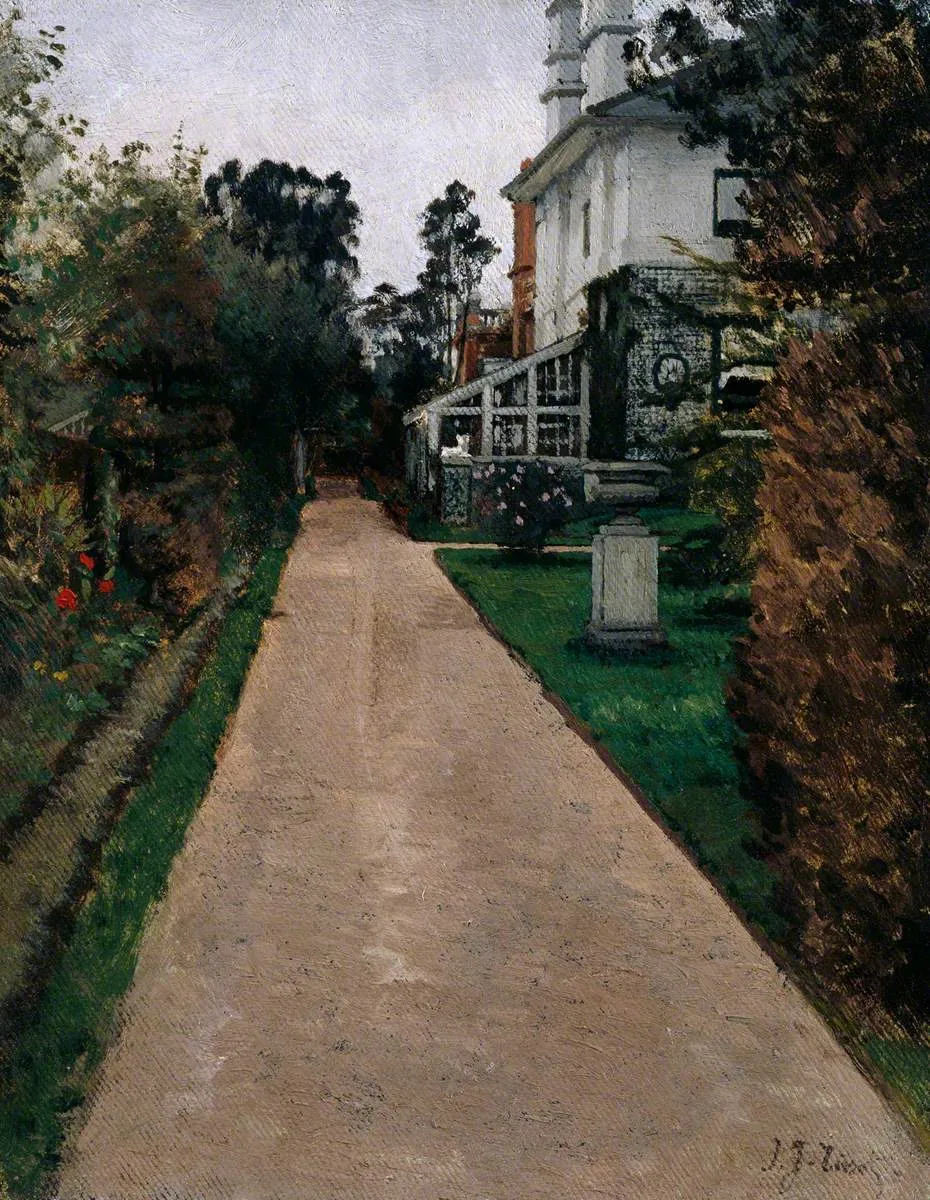
Alma-Tadema kept the conservatory, the glass-walled conduit between art and nature that Tissot had used to light his models. And mostly notably, he kept the garden colonnade.
He thoroughly "Romanized" it, of course. Tissot’s cast-iron French chic was overlaid with concrete to look like stone; replicas of Pompeian bronzes were added; ivy was trained to grow in classical swags. But the bones of the garden remained Tissot’s.
When you look at Alma-Tadema’s famous painting In My Studio or his masterpiece The Roses of Heliogabalus, you are seeing the same light, the same physical space that Tissot had painted a decade earlier. The Model’s Entrance—a discreet side door ingrained in the new architectural plans—was a practical addition for Alma-Tadema’s professional models, but in the context of the house’s history, it feels like a silent nod to the "hidden" women of St. John's Wood.
The Haunting
Did the ghosts linger?
Laura Alma-Tadema’s paintings suggest they did. Her work often depicted the domestic interiors of the house, and in her quiet, Dutch-inflected scenes, we see traces of the house’s previous life—the specific fall of light in a corridor, the view from a window that hadn’t been altered.
There is an irony in the legacy of 44 Grove End Road. It became famous as the party house of the fin de siècle. It was where the "Olympians" gathered—Winston Churchill, Caruso, Tchaikovsky, the Prince of Wales. It was a place of noise, music, and performance.
But beneath the noise, the silence of 1882 remained. The garden where Alma-Tadema’s daughters played tennis was the same lawn where Kathleen Newton had coughed her fractured life away. The studio where Alma-Tadema painted his visions of imperial decadence was the same room where Tissot had left his wet brushes in a panic of grief.
A Tale of Two Loves
Today, the blue plaque honors only the knight, not the exile. But the house is a monument to both.
It tells the story of two different ways of loving art and life. Tissot’s love was private, fragile, and doomed—a "secret garden" that withered when the muse died. Alma-Tadema’s love was public, robust, and architectural—a "palace of art" built to endure for the ages.
Yet, in a final twist of fate, both houses were lost. Tissot’s sanctuary was dismantled by grief; Alma-Tadema’s palace was dismantled by modernity, converted into flats, its aluminum dome stripped, its marble sold off.
What remains are the paintings. Place Tissot’s The Hammock next to Alma-Tadema’s The Voice of Spring. The styles are different—one is modern fashion, the other ancient fantasy—but look at the trees. Look at the quality of the filtered sun. Look at the peace of the enclosed garden.
They are painting the same sanctuary. One painted it as a memory of a lost love; the other painted it as a dream of an eternal afternoon. But the roots of those trees drink from the same soil.
Author’s Note
This article draws on deep research into the property records of St. John’s Wood and the biographies of both artists. The anecdote regarding Tissot’s abandonment of the studio is based on contemporary accounts from 1882.
Acknowledgements
This article draws heavily on the research of Melissa Buron ("Grove End Road: A Tale of Two Artists") and Krystyna Matyjaszkiewicz ("James Tissot’s Studio-Houses"), published in British Art Studies, Issue 9 (2018).
Leave a Visiting Card
Consulting the visiting cards...