
Dates matter.
Sir Lawrence Alma-Tadema died on June 25, 1912.
To understand the tragedy of his death, you have to look at the calendar.
Two months earlier, in April 1912, the Titanic had sunk. The un-sinkable ship, a symbol of Edwardian confidence and engineering, had hit an iceberg and dragged the optimism of the age down with it.
Two years later, in August 1914, the guns of World War I would begin to fire.
Alma-Tadema died in the eerie twilight between these two events. He was the artistic equivalent of the Titanic—a grand, luxurious, beautifully crafted vessel that was about to disappear under the icy waves of the 20th century.
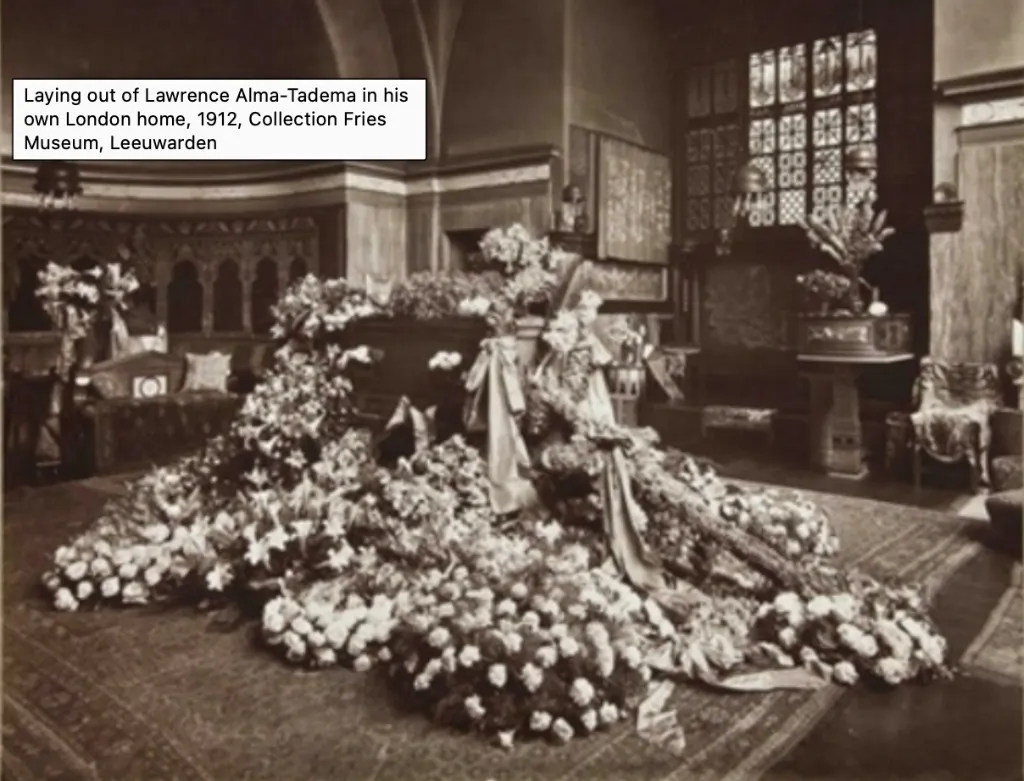
The Final Summer
He was seventy-six years old. He was suffering from ulcerated bowels, a painful condition that he tried to treat with visits to the spa in Wiesbaden, Germany.
He traveled there in June 1912 with his daughter Anna. He hoped the waters would cure him. But his body was simply worn out. He had painted non-stop for sixty years. The "boy who was supposed to die" at fifteen had finally run out of borrowed time.
He died in a hotel room in Wiesbaden. It was a quiet end for a man who had lived such a loud life.
The Crypt of Heroes
The news traveled fast to London. It was treated as a national loss.
But burial in the "Painters' Corner" of St. Paul's Cathedral was not a right; it was a permission that had to be negotiated. Behind the scenes, Sir Edward Poynter, the President of the Royal Academy and an old colleague of Tadema’s, led the charge to ensure the artist was granted the ultimate honor.
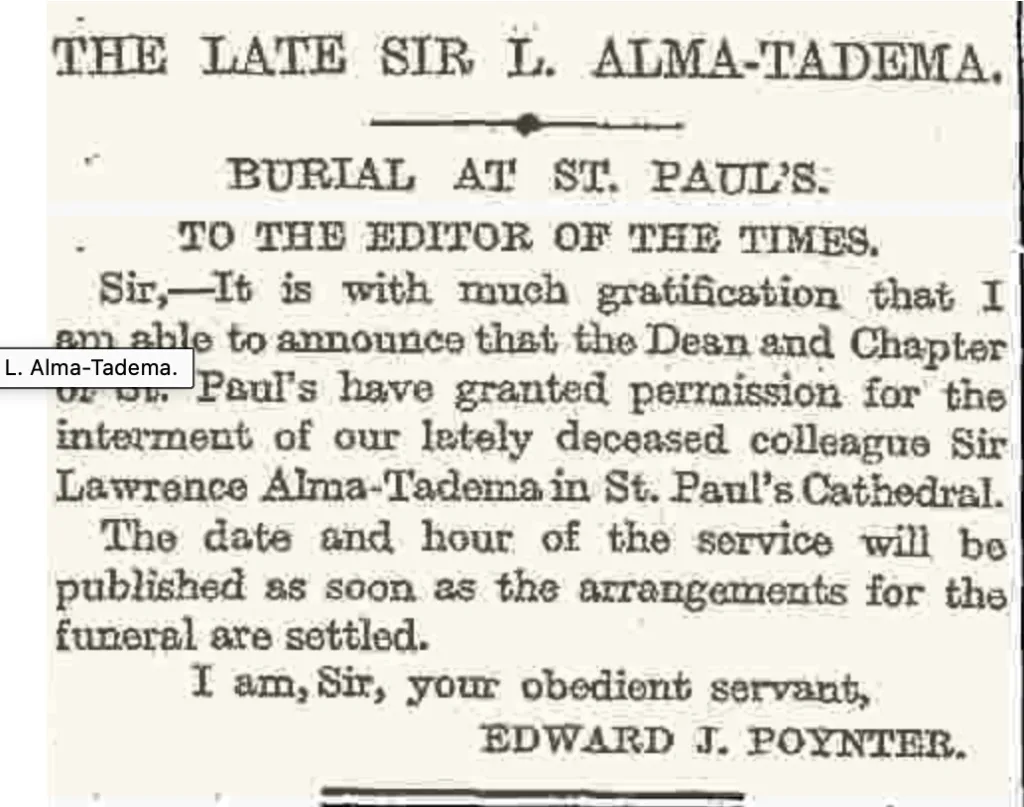
As Poynter’s letter to The Times shows, the decision rested entirely with the Dean and Chapter of St. Paul's. It was their "permission" that allowed the heavy oak coffin to enter the crypt and join the pantheon of British legends—Reynolds, Turner, and Wren.
This was more than just a funeral; it was act of final assimilation. The Dutch boy from Dronryp was being officially rebranded by the Church and the Academy as a Pillar of the British Empire.
The Legal Purgatory: The Last Denizen
But even as the stone was being prepared, a quiet scandal bubbled in the letters page of The Times.
While the Academy was claiming Tadema as a "British hero," H.S.J. Maas, the Consul General of the Netherlands, stepped forward to remind the public of an awkward legal truth: Sir Lawrence was technically still Dutch.
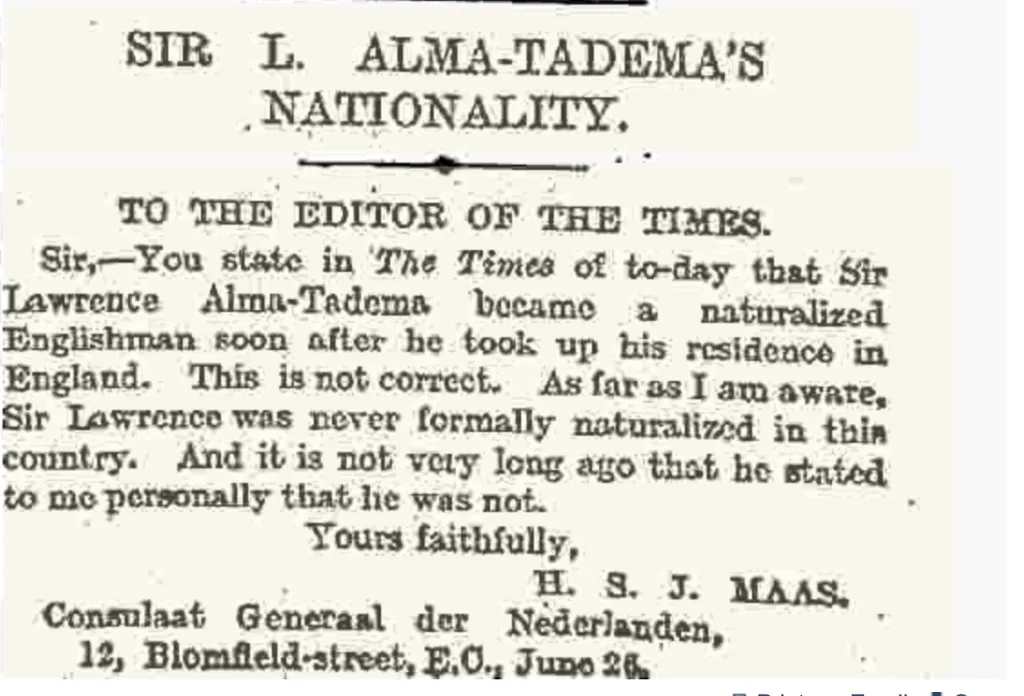
In 1873, Tadema had been granted Letters of Denization by Queen Victoria—a medieval legal status that made him a permanent resident with travel and property rights, but technically kept him a subject of the Netherlands. He was the last person in British history to receive this status.
By burying him in St. Paul’s, the British establishment was completing a "cultural naturalization" that the law had never finalized. It was a victory for Poynter and the Academy, but it was a victory that would be short-lived.
The Sudden Silence
But the true tragedy wasn't the death itself; it was the silence that followed.
Almost immediately, the curtain fell.
The critics who had politely applauded him while he was alive suddenly turned on him. The "modernist" movement, led by critics like Roger Fry, had been gaining strength for years. They hated everything Tadema stood for. They hated his detail. They hated his sentimentality. They hated his success.
With the master dead, they were free to tear him apart.
Within a year, his reputation began to slide. Within two years, the war started, and nobody wanted to look at pictures of happy Romans anymore. The sun-drenched, peaceful classical world he painted was replaced by the mud and mustard gas of the trenches.
Sir Lawrence Alma-Tadema died at the exact right moment. He missed the horror of the 20th century. He never saw his reputation destroyed. He never saw his paintings sold for scrap. He closed his eyes believing that beauty had won.
Leave a Visiting Card
Consulting the visiting cards...