
The air down here is different. It is cooler, heavier, and smells faintly of stone dust and centuries of incense. Above, in the nave of St. Paul’s Cathedral, the tourists shuffle and whisper under the great dome. But here in the Crypt, the "National Memory Chamber" of the British Empire, there is only the silence of white stone and black marble.
To be buried here is not a right; it is a concession from the Crown. Under the Burial Act of 1852, the gates to this underworld only open with a Royal Sign Manual—the personal, written command of the Sovereign.
And yet, here he is.
Walk past the sprawling tomb of the Duke of Wellington. Ignore, for a moment, the resting place of Admiral Nelson. Turn towards the "Painters’ Corner," the quiet enclave where the Empire tucks away its visionaries. There, lying in the company of J.M.W. Turner and Sir Joshua Reynolds, is a slab of black marble that feels impossibly dark against the pale floor.
It marks the final resting place of Lawrence Alma-Tadema.
The State Occasion
It is difficult for us now, looking back through the lens of modernism, to understand just how large Lawrence Alma-Tadema loomed in 1912. When he died in Wiesbaden, Germany, his body wasn’t just shipped home; it was repatriated like a fallen general.
His funeral was a State Occasion in all but name. King George V sent a personal representative. The Royal Academy turned out in full ceremonial force. The service was not merely grieving a painter; it was mourning the "Painter of the Empire," the man who had given the Victorians their visual vocabulary for greatness.
He was lowered into the crypt not as a guest, but as a resident. He took his place next to Sir Christopher Wren, the architect who built the very roof over his head. It was the ultimate validation. The Dutch village boy had become a permanent part of the British foundation.
He was not the only 'foreigner' to be honored this way—Benjamin West (American) and Henry Fuseli (Swiss) had preceded him. But like them, Alma-Tadema had ceased to be an outsider. He was no longer Dutch; he was an Institution.
The Black Marble Seal
But the story does not end with the funeral. Four years later, in 1916, the world had broken.
The Great War was tearing Europe apart. The Victorian dream of order and beauty was bleeding out in the trenches of the Somme. And yet, back in London, the Royal Academy of Arts was quietly settling a debt of honor.
They commissioned Sir Reginald Blomfield, a titan of classicism who would go on to design the Menin Gate, to create a permanent marker for their champion.
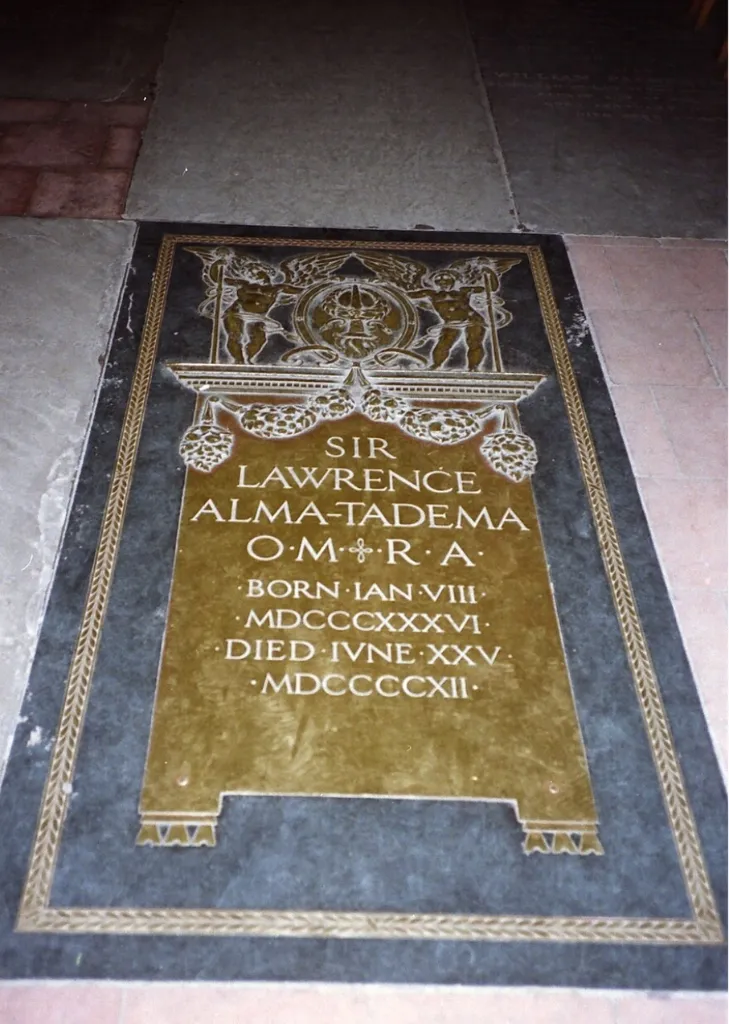
Blomfield understood his subject. He did not choose white Carrara marble, the material Alma-Tadema painted with such sunlight and joy. Instead, he chose the gravity of black marble and the sharp, industrial gleam of brass.
The design is severe, elegant, and permanent. The brass lettering, crafted by the master metalworker William Bainbridge Reynolds, cuts through the darkness of the stone. It is a tactile monument—you want to run your hand over the cool, smooth surface, just as you want to touch the textures in a Lawrence Alma-Tadema painting.
The Institutional Home
There is a poignant irony in the timing. In 1916, while the craftsmen were polishing the brass of his memorial, the art market had already abandoned him.
In 1913, just a year after his death, the contents of his magnificent house, "Casa Tadema," were auctioned by Hampton & Sons. The sale was a disaster. The collections that had cost a fortune sold for a pittance. His daughters, Anna and Laurence, were left with a fraction of the wealth they had grown up with. The market had spoken: Alma-Tadema was worthless.
But the Royal Academy did not care about the market. They cared about the legacy. By paying for this memorial in 1916—three years after the crash—they were making a defiant statement. They were honoring a man the world had already rejected. They were standing by their champion when no one else would.
The Echo
Today, the noise of the critics has faded. The prices of his paintings have soared back into the millions. The crowds have returned to marvel at the "Roses of Heliogabalus."
But down here, in the cool quiet of the crypt, none of that matters.
Pause at the slab. The brass is still bright, polished by the care of generations of vergers. To your left is purely English genius—Turner and Constable. To your right is the military might of Wellington. And in the center, unmoved by the century of neglect that raged above him, lies Lawrence Alma-Tadema.
He is the foreign knight who painted the past so perfectly that he was invited to sleep forever in the heart of the Empire. The marble is cold to the touch, but the name upon it burns with a quiet, imperishable gold.
Leave a Visiting Card
Consulting the visiting cards...