
There was a golden staircase in St. John's Wood that led straight into the world of Alma Tadema.
It gleamed in the afternoon light, burnished brass catching the sun. Visitors climbed it slowly, uncertain. At the top, the world changed.
This was Casa Tadema. Lawrence Alma Tadema's home. And it was unlike anywhere else in Victorian London.
Step inside, and you left the smog behind. The noise faded. You entered a dream of the ancient Mediterranean—marble and light, silk and music, beauty made real.
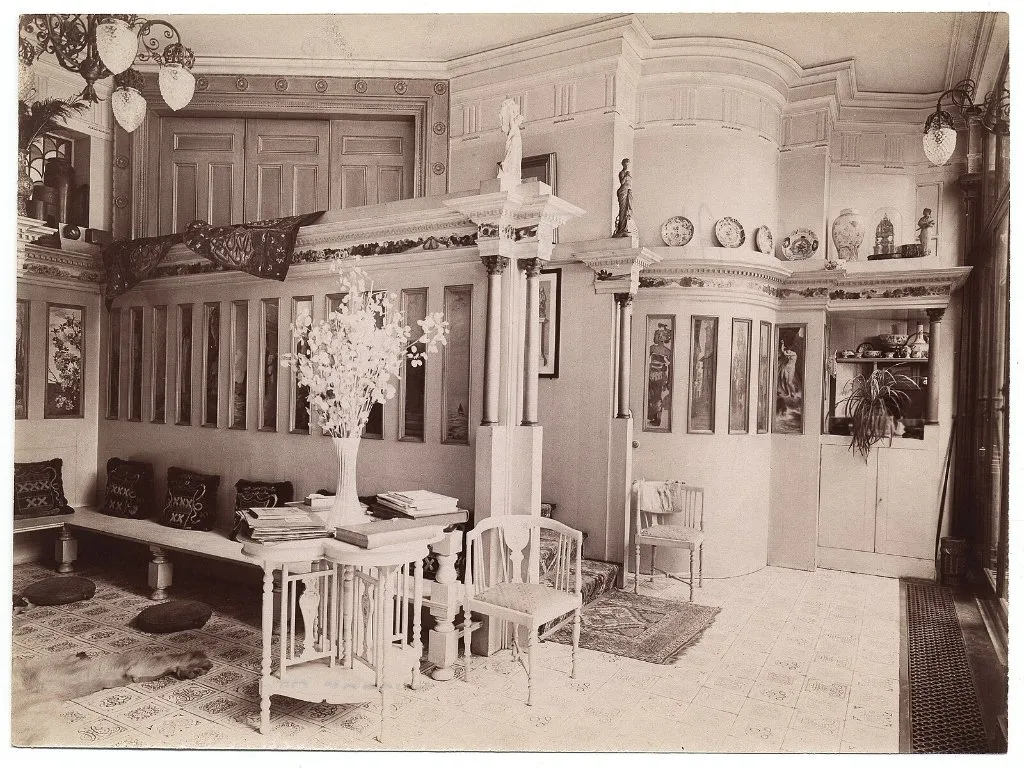
But Casa Tadema was more than a house. It was a gathering place. A sanctuary. And on certain evenings, when the light turned gold and the air grew soft, the greatest musicians of the age would climb those brass stairs to visit the artist.
Nine of them, Alma Tadema painted. Nine portraits. Each one a testimony.
This is their story. And his.
The Painter Who Loved Music
Lawrence Alma Tadema painted marble. Everyone knows this.
Cool white stone. Sunlit terraces. Roman villas where beautiful people reclined in eternal afternoon.
But fewer people know he loved music just as deeply.
His father was a notary who also loved music. As a boy, Alma Tadema took music lessons, and for a short time, his teachers even suggested he might possess a musical career. But art won out. Yet he never lost that connection. Music, to him, was painting's sister—another way to create beauty, another refuge from the world.
When he designed his London home, he made sure music had a throne.
In the center of the studio stood the famous “Autograph Piano.” A magnificent Steinway grand, inlaid with ivory and mother-of-pearl. But its true treasure lay hidden. Inside the lid, on a special vellum lining, the famous musicians who played for the artist signed their names.
It was a guestbook of sound. We know Paderewski's signature was there—proof of the private concert he gave in the studio. It is likely that other close friends like Joachim, Henschel, and Richter also left their mark on the instrument, creating a physical archive of the music that filled the house.
He hosted musical gatherings on Tuesday evenings. These were the legendary "Famous Tuesdays." Composers, pianists, violinists, singers—they all came.
Some performed. Some listened. For the favored guests, the welcome was legendary.
And some, the exceptional ones, he painted.
The Nine Portraits
Between 1879 and 1909, Alma Tadema painted nine musicians. Not commissions, exactly. More like honors. Friendships made permanent.
George Henschel (Opus CCII - 202)
The First. George Henschel was a singer, a pianist, a conductor. He was the first conductor of the Boston Symphony Orchestra and founded the London Symphony Concerts. He brought the romance of Brahms into the Sanctuary.
Thekla Friedländer (Opus CCVII - 207)
The Voice in the Wainscoting. A delicate soprano and a forgotten star of the Leipzig Gewandhaus. Tadema painted her on a tiny panel, an intimate "Cabinet Picture" that captures the sunlit clarity of her voice.
Sir Felix Semon & Auguste Redeker (Opus CCXVI - 216)
The Guardian & The Contralto. A rare double portrait. Sir Felix was the laryngologist who saved the Victorian voice; Auguste was the contralto who gave it depth. Together, they represent the union of Science and Song.
Hans Richter (Opus CCXXVII - 227)
The Titan. Hans Richter conducted the first complete performance of Wagner's Ring Cycle. He built cathedrals of sound. But in Alma Tadema's studio, the thunder revealed his quiet soul.
Jules de Soria (Opus CCLXXXVIII - 288)
The Ghost. Jules de Soria was a wine merchant by day and a baritone by night. But he sang so beautifully that composers like Massenet and Fauré wrote music for him. His portrait is lost to history.
Ignacy Jan Paderewski (Opus CCCXI - 311)
The Virtuoso. Women fainted when he played. He traveled with a retinue like a king. But Alma Tadema painted the serious artist behind the fame—the man who would one day become Prime Minister of Poland.
Joseph Joachim (Opus CCCXVIII - 318)
The Soul. The high priest of the violin. Brahms wrote his Violin Concerto for him. Alma Tadema painted him not performing, but listening—capturing the deep, attentive silence of a master.
Maurice Sons (Opus CCCXL - 340)
The Musician's Musician. He held a fortune in his hands—the legendary 1741 'Vieuxtemps' Guarneri violin. Alma Tadema painted him playing in the studio, an intimate snapshot of music at home.
Ilona Eibenschütz (Opus CCCXCVI - 396)
The Last Link. A favorite student of Clara Schumann and Brahms. She represents the end of an era. Painted when she was thirty-eight and Tadema seventy-three, a final tribute to the Romantic world they both loved.
The Gatherings
We know they happened on Tuesdays. "Memorable Tuesday evenings," wrote J. Comyns Carr, the art critic and friend who was often there.
He called Alma Tadema a rare host. "The instinct of hospitality belongs to many," he wrote, "but the genius of hospitality is rare." Alma Tadema had that genius.
Carr remembered vividly the very last Tuesday gathering at Townshend House, before the family moved to the larger Grove End Road. There was a fear in the room that night. A quiet anxiety among the friends. They worried that in a bigger, grander house, the intimacy they loved would be lost. That the magic would fade with the old wallpaper.
But they needn't have worried. "The change belonged only to the building," Carr later wrote. The warmth remained.
Imagine one of those evenings in the 1890s.
The golden staircase glows in the lamplight. Guests arrive—artists, musicians, writers. The Prince of Wales might be there. Or Tchaikovsky. Or Oscar Wilde.
The studio is vast, filled with silvery light. Conversation hums. Then someone sits at the piano. Or lifts a violin.
And the room falls silent.
Music fills the space. Brahms, perhaps. Or Schumann. Or something new, just composed.
Alma Tadema listens. His wife Laura listens. Their daughters Anna and Laurence listen.
This is what Casa Tadema was for. Not just to house paintings. But to house beauty itself. To create a space where art and music and friendship could flourish.
A sanctuary from the industrial city outside. A pause button. A deep breath.
Leave a Visiting Card
Consulting the visiting cards...