
In the gold-leafed silence of Sir Lawrence's famous 'Casa Tadema', amidst the marble, the leopard skins, and the heavy scent of ozone and roses, there was always music.
We know the singers who filled that room: the celebrated 'singing conductor' George Henschel and the crystalline soprano Thekla Friedländer. But behind every great voice in Victorian London, there stood a shadow. It was the shadow of a man who held the power of silence in his hands: Sir Felix Semon.
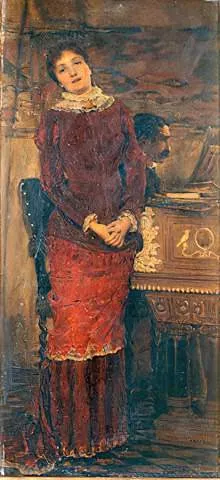
His name would eventually be preceded by a title, but in 1880 he was simply Felix. And standing beside him, in a rare double portrait painted by Lawrence Alma-Tadema (Opus CCXVI), is the woman who gave that shadow its light: Auguste Redeker.
This is not just a portrait of a doctor and his wife. It is the story of the man who saved the Victorian voice, and the woman who embodied its richest sound.
Part I: The Man Who Mapped the Silence
To understand Felix Semon (1849–1921), you must first forget the stiff collar and the Knighthood that would come later. You must imagine a young medical student in the coffee houses of Vienna, arguing about music with his friend, a brooding composer named Johannes Brahms.
Semon was born in Danzig, but his soul was forged in the fires of German Romanticism. He was a gifted pianist and composer long before he was a doctor. When he came to London in 1874, he brought with him more than medical textbooks; he brought the spirit of the German musical tradition.
The Architect of Laryngology
In the 1870s, "throat doctors" were viewed with suspicion—little better than quacks selling lozenges. Semon changed everything.
He didn't just look down throats; he mapped the neurology of the voice. He formulated what is still known today as "Semon's Law". It was a discovery as terrifying as it was brilliant. Semon proved that in progressive diseases of the throat, the "abductor" muscles (which open the vocal cords for breathing) become paralyzed before the "adductor" muscles (which close them for phonation).
For the great singers of the age, Semon was a wizard. He could look into the larynx with his mirrors and predict the future of a voice. He understood that for a singer, a vocal injury was not a medical issue; it was an existential crisis. He treated the throat with the reverence of a pianist tuning a Steinway.
By 1882, he had founded the Throat Department at St. Thomas's Hospital, the first of its kind in the British Empire. He was the architect of a new science.
Part II: The Lost Contralto
If Semon was the guardian of the instrument, Auguste Redeker (Lady Semon) was its master player.
History has largely forgotten her voice, overshadowing her with her famous husband. But in the late 1870s, "Fräulein Redeker" was a force of nature. She was a Contralto—the deepest, richest female register, associated with earth mothers, tragedies, and the solemnity of religious music.
She was a regular performer at the "Popular Concerts" (the "Pops") and the famous conductor Hans Richter's 'Richter Concerts', often sharing the bill with her frequent singing partner Thekla Friedländer.
Her voice had a gravity all its own. Sir George Henschel, the great conductor, recalled meeting her in Halle, the birthplace of Handel. Writing in his memoirs, he described the magic of performing Handel's Messiah with her:
"The young lady who... sang the contralto part in the Messiah with myself in the bass part, was Auguste Redeker... the lovely singer who a few years later enchanted all London with her beautiful voice and charming presence."
To hear Redeker sing Brahms was to hear the music as the composer intended—heavy with emotion, grounded, and profoundly serious. It is no wonder she caught the eye of the doctor who had debated Brahms in Vienna.
We need not guess how they met. Historical records confirm that it was in the "enchanted circle" of Alma-Tadema's studio that their paths crossed. Semon, a regular guest at those musical evenings, met Augusta Redeker there, likely during one of the famous Tuesday gatherings. The studio was not just a place of painting; for them, it was where their partnership began.
Part III: The Union (1879)
In 1879, the "Musical Salon" celebrated its greatest union. Dr. Felix Semon married Auguste Redeker.
For the Victorian public, this was the end of "Fräulein Redeker." As was the custom, she retired from the professional stage to become the mistress of a prominent medical household. But for the inner circle—for Alma-Tadema, Henschel, and Joachim—it was a beginning. The Semon household became a twin-star to Casa Tadema.
While Tadema’s studio was where the art was made, Semon’s home was where the artists were healed and celebrated.
Their dinner table became a legendary intersection of Art and Science. Presided over by Lady Semon—whose "magnificent voice" still captivated private audiences—the guest list read like a Who's Who of the Victorian intellect. Not only did musicians gather there, but so did medical titans like Lord Lister (the father of antiseptic surgery) and Sir James Paget (the founder of scientific pathology, famous for identifying "Paget's Disease").
(The circle was indeed intimate. The Pagets were not just distant admirers; Alma-Tadema personally helped Miss Rose Mary Paget expand her autograph collection, playfully sourcing signatures from his dealer. In 1899, when Sir James and his daughter called to congratulate him on his own knighthood, Tadema famously "rushed out" to catch them, later writing a note regretting that he had missed them by mere moments.)
The Audacity to Marry
In rigid Victorian society, for a rising doctor to marry a "stage performer" was often social suicide. A contemporary report in the British Medical Journal marvelled at his double-gamble:
"It was surely as risky a speculation as ever a young man embarked in; and, to make things worse, within two years of settling down to practise he had the audacity to marry; but those who enjoyed the privilege of the friendship of Fräulein Redeker knew it to be the wisest and most prudent thing that he had ever done."
To Semon, Auguste was not a "woman of the stage"; she was a high priestess of Brahms.
However, following the custom of the time, Auguste's professional career largely concluded upon her marriage. The "retirement" was not necessarily forced, but it was the expected price of admission to the medical aristocracy. She traded the applause of the Royal Albert Hall for the exclusive approval of the "Hall of Panels."
The Double Portrait (Opus 216)
Painted in 1880/1881, shortly after their wedding, Opus CCXVI is unique. Alma-Tadema almost always painted his friends on single, narrow panels (the famous "Hall of Panels"). By painting Felix and Auguste together, he broke his own rule to honor their partnership.
He acknowledged them as a unity: Science and Song.
The painting measures roughly 30 x 14 centimeters (11.8 x 5.5 inches). While significantly larger than Thekla's tiny palm-sized portrait, it remains an intimate "Cabinet Picture," far smaller than the 80cm-tall works that lined the famous "Hall of Panels."
This elongated format allows Felix and Auguste to stand side-by-side, occupying a space that feels substantial yet private. It captures the transition of power: Auguste is no longer the public performer; she is the private muse. Felix is no longer just the bachelor scientist; he is the patriarch. On one side, the man who mapped the silence; on the other, the woman who filled it.
Part IV: From Doctor to Knight
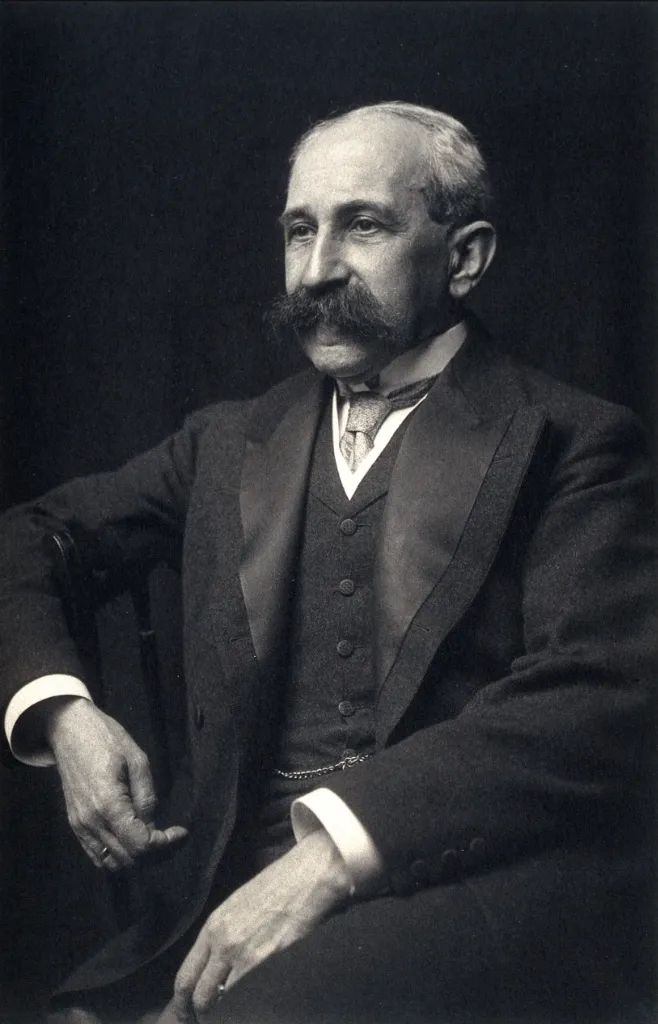
The trajectory of Felix Semon's life parallels Alma-Tadema's own. Both were immigrants—one Dutch, one German—who conquered the heights of British society through sheer brilliance.
Semon's rise was meteoric. His path to the throne was paved by the "Jersey Lily." It was through his successful treatment of Lillie Langtry—the famous actress and companion to the Prince of Wales—that Semon was introduced to the future King Edward VII.
- In 1897 (Queen Victoria's Diamond Jubilee year), he was summoned to attend the Queen herself. The Knighthood followed almost immediately.
- In 1901, he was appointed Physician Extraordinary to King Edward VII.
By the turn of the century, "Sir Felix" was a pillar of the Edwardian establishment. Yet, Mrs. Alec Tweedie notes that Semon and Alma-Tadema remained "intimates." They dined together, not as Knight and Artist, but as two boys from the continent who loved German music and English success.
Part V: Legacy & The Shadow of War
When Semon retired in 1909, the gratitude of his profession was overwhelming. The banquet was a final reunion of the "Germanic Circle." Sir Lawrence Alma-Tadema himself arrived later in the evening to honor his friend, joining George Henschel, Sir Paolo Tosti, and the German Ambassador Count Metternich.
The artist Sir Hubert von Herkomer—a fellow German-born Knight, Royal Academician, and titan of Victorian art—paid him a unique tribute.
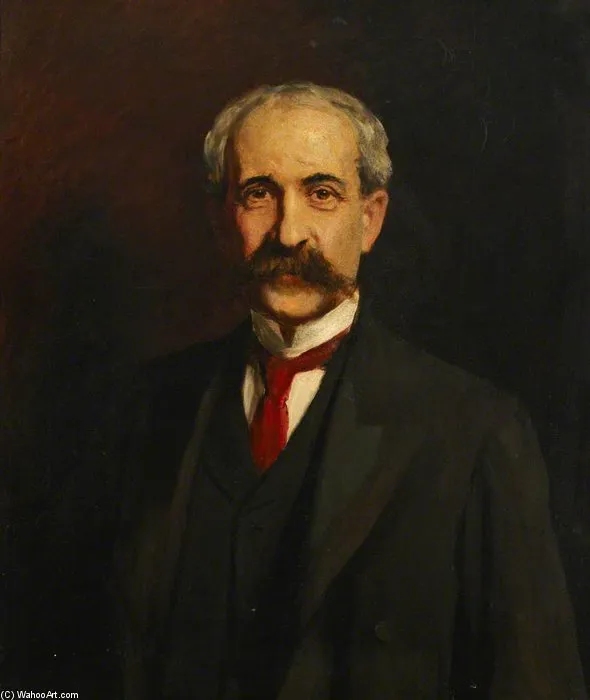
In the golden age of Victorian banquets, the menu card was more than a list of courses; it was often a commissioned work of art, prized as a souvenir. Herkomer personally designed the menu for Semon's farewell dinner, sketching a "striking picture" of the doctor for the cover.
But he went further. He offered to paint a formal portrait for £600 (equivalent to over £75,000 today), donating the entire fee to Semon's memorial fund. Semon used this fund to establish the Semon Lectureship at the University of London, which remains the "blue ribbon" of world laryngology today.
Lady Semon, too, was honored. In a gesture typical of the era, the committee recognized that a great man's career was often built by his wife's social grace. She was presented with a diamond and pearl pendant—likely a piece in the fashionable "Garland Style" from Cartier or Garrard—as a sparkling recognition that she was not just a partner in life, but a partner in his triumph. Sir Felix later wrote that he was "deeply moved" to see his "faithful helpmate" acknowledged by the scientific world.
Part VI: Rignalls & The Golden Summer
Following his retirement, the couple left the smog of London for Rignalls, a magnificent new country estate in Great Missenden, Buckinghamshire. Nestled in the rolling Chiltern Hills, some 35 miles north-west of the capital, it was the perfect retreat for a "Golden Summer."
The sheer scale of the project was a testament to Semon's immense wealth. Designed by the modernist architect Charles Holden (famous for his later designs of London's iconic Underground stations), the house was an Arts & Crafts masterpiece. But if the bricks were Felix's, one suspects the soul of the place belonged to Auguste.
The extensive gardens were designed by Gertrude Jekyll, the legendary artist-gardener who revolutionized British horticulture. She treated the soil like a canvas, applying the principles of Impressionist painting to her borders—drifts of color that faded from cool blues to hot oranges. To commission Jekyll was to commission a living work of art.
It is poignant to imagine the "Lost Contralto," whose voice once filled the Albert Hall, now tending to Jekyll's silent borders of lavender, lilies, and scrolling pergolas. Rignalls was the ultimate symbol of their journey: the immigrant doctor and the singer had not just joined the British establishment, they had shaped its very landscape. (Rignalls remains a private residence today and is not open to the public.)
Did Alma-Tadema ever walk these gardens? It is almost certain. He lived for three years after the house was finished, and given their intimacy, one can easily picture the aging artist visiting Rignalls in those final summers—perhaps advising Auguste on the color of her borders, just as he had once captured the color of her voice.
There is a fascinating contrast here: while Tadema poured his entire fortune into his London "Palace of Art" and never sought a country seat, Semon followed the path of the English aristocracy, retiring to the shires. One lived for Art, the other for Assimilation. But in the garden at Rignalls, the two paths likely crossed in quiet friendship.
Part VII: The End of the Circle
But the end of the story is shadowed by the tragedy of World War I (1914).
Their union had produced three sons, who fully integrated into the British elite. The eldest, Dr. Henry Semon, followed his father into medicine, becoming a distinguished dermatologist. When World War I broke out, Sir Felix proudly sent all three sons to fight for Britain.
Yet, despite his knighthood, his service to the King, and his sons' sacrifice, the "Germanic Circle" of St. John's Wood became a target. Sir Felix and Lady Semon faced painful anti-German discrimination. In 1919, two years before his death, he resigned from the very medical society he had helped to build.
Ideally, this should have been the happy ending: the stockbroker's son from Danzig and the "Lost Contralto" reigning as landed gentry in Buckinghamshire. But the silence of the war had already fallen.
Alma-Tadema, who died in 1912, was spared this final heartbreak.
But in Opus CCXVI, the silence has not yet fallen. The doctor and the contralto stand together, young and at the height of their powers, preserved forever in the amber light of the studio.
Primary Sources
- Banquet to Sir Felix Semon, British Medical Journal (July 10, 1909).
- Obituary: Sir Felix Semon, British Medical Journal (March 12, 1921).
- Rignalls: Site Dossier, Buckinghamshire Gardens Trust (2019).
- The Semon Lectures, University of London.
Leave a Visiting Card
Consulting the visiting cards...