
It is 1896. The light in the studio of Alma Tadema is cool and silver, filtered through the high onyx windows. The air smells of drying oil paint and hothouse flowers.
And then, a sound tears through the silence.
It is not the bright, soaring voice of a Stradivarius. It is something darker. Something guttural. It growls on the low G-string like a wild animal, then climbs into a singing tone of immense, muscular power.
The man playing it is Maurice Sons. But the instrument he holds is the true protagonist of this story.
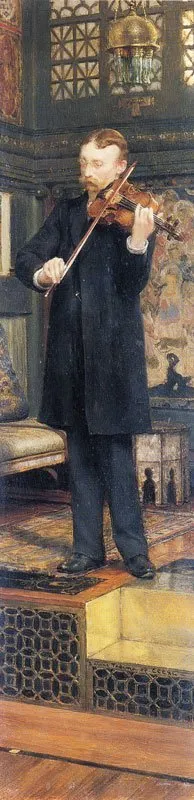
This is the story of the "Vieuxtemps" Guarneri—an instrument that traveled from a funeral procession in Belgium to the golden sanctuary of Alma Tadema, and eventually, to a valuation of sixteen million dollars.
The Anti-Stradivari
In the world of violins, there are two gods.
There is Antonio Stradivari, the perfectionist. His violins are golden, polished, and possess a sound like a soprano—pure, brilliant, effortless.
And then there is Bartolomeo Giuseppe Guarneri, known as "del Gesù."
He was the "rough genius" of Cremona. He worked quickly, obsessively. His violins are not polite. They are built for power. While a Stradivari floats above an orchestra, a Guarneri cuts through it.
The violin Maurice Sons brought to Casa Tadema was a Guarneri del Gesù made in 1741.
It was perhaps the most perfect example of its kind in existence. Unlike so many instruments that had been polished and patched over the centuries, this one was pristine. It still wore its original thick, dark varnish. It was a beast in a state of nature.
1891: The Acquisition
Maurice Sons was a Dutch violinist, a professor at the Royal College of Music, and the leader of the Scottish Orchestra. He was a man of skill. But on June 27, 1891, he became a man of history.
It was already a legend. It had belonged to the Belgian virtuoso Henri Vieuxtemps, who loved it so violently that he spent his final years paralysed, just watching it in its case. When Vieuxtemps died in 1881, the violin was not packed away. In a moment of supreme Romantic theatre, his student Eugène Ysaÿe carried it on a velvet pillow behind the hearse, walking the streets of Verviers like a knight bearing a holy relic.
The price Maurice Sons paid is lost to history, but the context tells us it was a king's ransom. Just a year earlier, the "Messiah" Stradivari had sold for £2,600—a world record at the time, equivalent to the price of a grand London house. For a working musician, acquiring the "Vieuxtemps" was not just a purchase; it was a life-altering financial commitment. Arthur Hill of the famous dealership noted in his diary that even his firm was "not rich enough to keep the violin ourselves," despite its "perfect" tone.
Ten years later, it belonged to Maurice Sons. And five years after that, he brought it up the golden staircase of Alma Tadema's home in St. John's Wood, joining the circle of the "Famous Tuesdays."
Opus 340: Painting the Beast
When Alma Tadema decided to paint Sons (Opus 340), he didn't just paint a man. He painted a double portrait.
Look closely at the painting.
Alma Tadema was a man obsessed with texture. He spent his life painting the translucence of marble, the weight of bronze, the drift of rose petals. In the violin of Maurice Sons, he found a texture to match his own obsession.
He painted the wood not as a flat brown surface, but as a living thing. You can feel the depth of that famous "del Gesù" varnish. You can see the asymmetry of the f-holes, the "rough genius" of the maker preserved in paint.
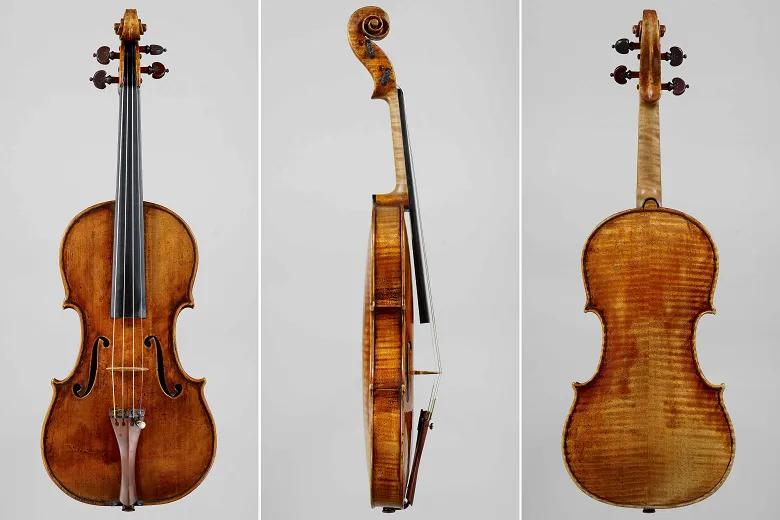
Alma Tadema understood that this wasn't just a prop. It was a voice.
The sound of the Guarneri—dark, gritty, limitless—was the sonic equivalent of Casa Tadema itself. The house was not a light, airy rococo palace. It was a Roman basilica. It was heavy with bronze, lined with marble, filled with the rich, complex scents of incense and flowers.
A bright, thin violin would have been lost here. But the Guarneri? The Guarneri belonged.
The Sixteen Million Dollar Legacy
Maurice Sons eventually sold the violin in 1927. He likely never imagined its future.
It passed through hands, through collections, through centuries. And in 2012, it was sold for a reported sum exceeding sixteen million dollars.
Tragically, Maurice Sons left no recordings. His sound on those Tuesday evenings is lost to silence.
But the instrument remembered. Because the "Vieuxtemps" has been preserved in such pristine condition, when we hear it played today, we are hearing the closest possible echo of what Alma Tadema heard in his studio.
It is now played by the virtuoso Anne Akiko Meyers. In this recording, she performs Bach's Air—a piece that was a staple of the Victorian repertoire and would have almost certainly resonated within the walls of Casa Tadema. It is considered the "Mona Lisa" of violins.
For those who want to see the "texture" that would have captivated Alma Tadema, you can watch this short documentary which offers rare close-ups of the wood and varnish.
But whenever we look at this masterpiece by Alma Tadema, we travel back to a time before the millions. We go back to a Tuesday evening in 1896.
The guests have thinned out. The cigar smoke curls against the aluminum ceiling. And Maurice Sons lifts the heavy, dark wood to his chin. He draws the bow. And for a moment, the "Hall of Panels" vibrates with the voice of 1741—a sound that is older than the house, older than the painter, and destined to outlive them all.
Leave a Visiting Card
Consulting the visiting cards...