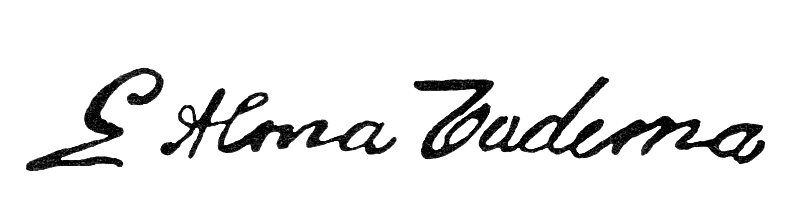
We often assume that great fortunes are lost in flames. We imagine casinos, bad investments, or profligate heirs throwing gold coins from carriage windows.
But the vast fortune of Sir Lawrence Alma-Tadema did not burn. It simply evaporated.
It was destroyed not by recklessness, but by prudence. It was the result of a "safe" plan, executed perfectly by honest men, which ultimately condemned two brilliant women to a life of "gentle poverty" in the drafty corridors of London hotels.
The Fortress of 1912
When Sir Lawrence Alma-Tadema died in June 1912, he left behind an empire.
His estate was valued at £58,834—an immense sum, equivalent to over £7 million today. But his true wealth was in the physical world he had built: the "Sanctuary" at Grove End Road, filled with Roman couches, silver lyres, and walls of onyx.
His plan for his daughters, Laurence and Anna, was simple and protective. He would build them a financial fortress that no storm could breach.
He placed the bulk of his money into a Life Interest Trust, appointing two trustees to guard it: his solicitor, Sir George Lewis, and his brother-in-law, Dr. Washington Epps. The capital would be locked away, untouchable. The daughters would live off the interest—the "fruit" of the tree—forever safe, forever provided for.
It was the perfect Victorian strategy. But it relied on three pillars that were about to collapse: the stability of the pound, the survival of his executors, and the belief that the world of 1912 would last forever.
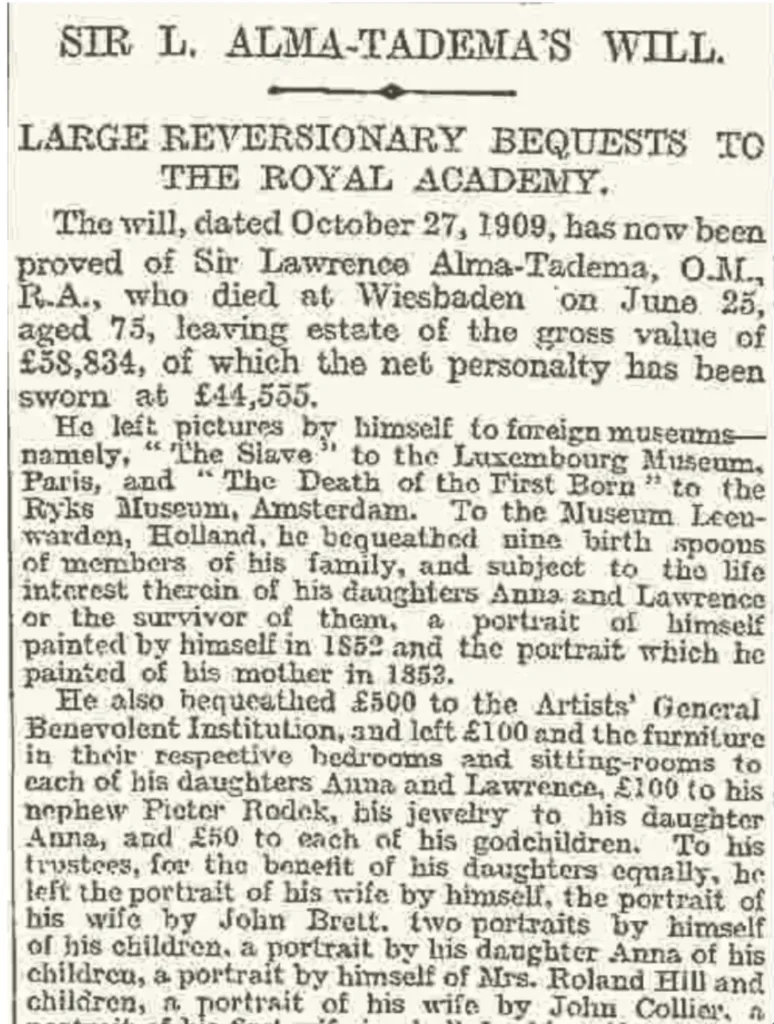
The Summer the Walls Fell: A Timeline of Disaster
The tragedy began before the funeral flowers had wilted. The timeline of the family's collapse reveals a perfect storm of loss:
-
December 1911: Sir George Lewis (The Elder) dies.
- This was the first domino. Lewis wasn't just a lawyer; he was the primary Executor and Trustee appointed in Tadema's will. He was also the legendary "fixer" of Victorian society—the man who kept the Prince of Wales out of court and knew every secret in London. Oscar Wilde once said, "George Lewis is the only person in England who knows the truth about everything."
- Tadema had chosen him because he was the ultimate shield. He believed that with Lewis at the helm, his daughters' fortune would be protected by the most powerful legal brain in the Empire. When Lewis died six months before Tadema, that shield vanished.
-
June 1912: Sir Lawrence Alma-Tadema dies.
- It was the end of an era. His passing was marked by a magnificent state funeral at St. Paul's Cathedral, attended by royalty and the artistic elite. But while the organ thundered and the crowds mourned, the legal clock on his estate began to tick.
-
August 1912: Dr. Washington Epps (the remaining Trustee) is terminally ill.
- Epps was the "Kind Uncle"—Laura’s beloved brother and the family physician who had treated their colds, bandaged their fingers, and celebrated their birthdays. He was the soft, reliable heart of the family's support system.
- But in the crucial weeks after Lawrence's death, Uncle Washington was himself on his deathbed (he would die in October). The one man who truly loved the girls and understood their vulnerability was physically too weak to sign the papers.
-
August 16, 1912: The "Notice to Creditors" is published. With no healthy male guardians left, Anna and Laurence are named "Administratrices."
- This was a legal catastrophe. Because the named executors were either dead (Lewis) or incapacitated (Epps), the High Court required someone to step forward to personally guarantee the estate's debts before a single penny could be released.
- The term "Administratrix with Will Annexed" meant "The will exists, but the protectors are gone." Overnight, the two artists were forced out of their studio and into the cold brutality of business law, personally liable for the liquidation of their father's empire.
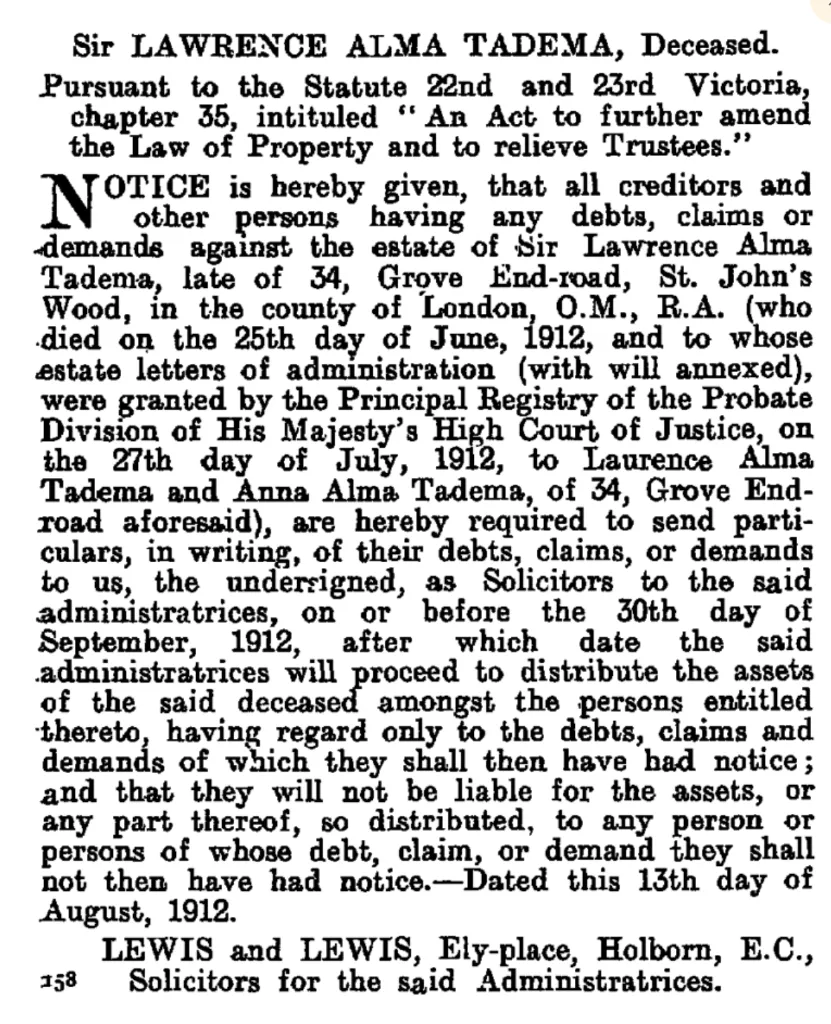 The Times (London), August 16, 1912: The legal notice that confirmed the sisters' new role. "Administratrices" (plural) reveals they were now legally responsible for the debts. Also note the solicitors: "Lewis and Lewis"—the firm of the late Sir George.
 -
December 5, 1912: The Auction that Failed.
The house was offered for sale at the Mart in Tokenhouse Yard. The reserve price was rumored to be high—Tadema had, after all, poured £70,000 (over £8 million today) into its creation. But when the auctioneer asked for bids, the room went cold. The bidding stalled at £30,000. The sisters, perhaps unable to stomach the insult to their father's legacy, withdrew the property.
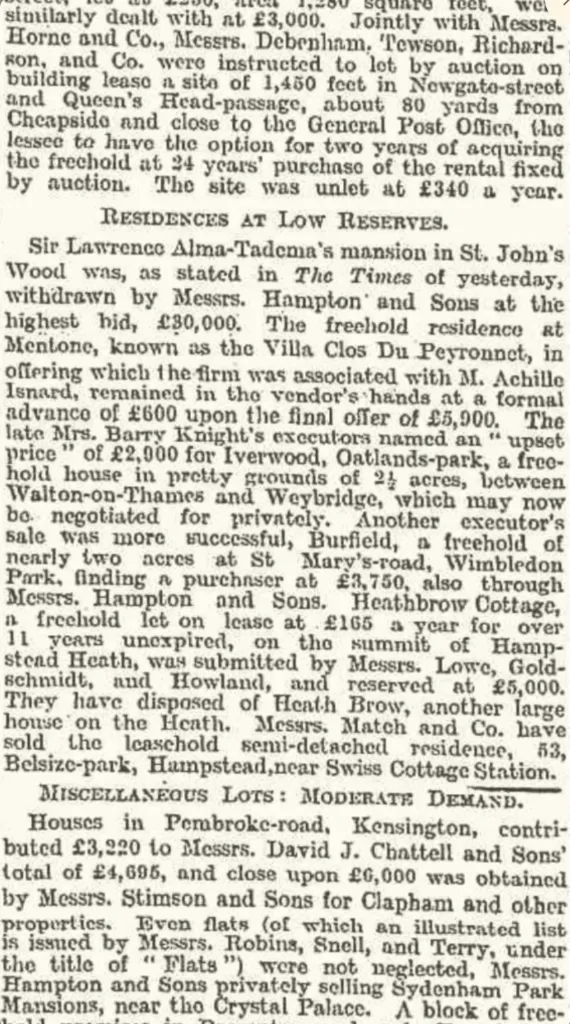
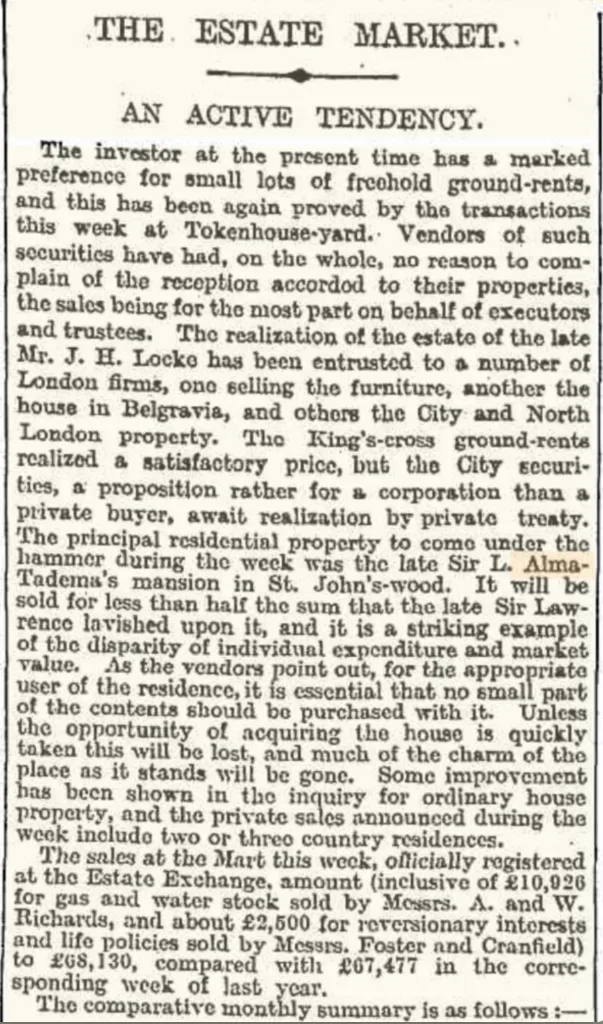 The Times (December 1912) analyzes the failure. On the left: The result (Withdrawn at £30k). On the right: The economic autopsy. It notes a market preference for "small lots" and "flats," and calls the house a "striking example of the disparity of individual expenditure and market value."
Deep Dive: The Economics of a "White Elephant"
Why did the "Palace of the Beautiful" fail? The Times property correspondent wrote a brutal post-mortem (see clipping above right) that perfectly diagnosed the tragedy.
He identified a "disparity of individual expenditure and market value."
This was the "Individual Expenditure Fallacy." Sir Lawrence had built the house for a specific genius—himself. He had built it for a man who needed a 60-foot studio and a window made of Mexican onyx. But the market of 1912 had shifted. The Times noted a "marked preference for small lots" and observed that "even flats... were not neglected." The era of the "Artist Prince" living in a single-family palace was dead; the era of the efficient apartment had begun.
The running costs alone were prohibitive. Research into 1912 London wage data reveals the scale of the burden: a butler commanded £40-£100 a year, a professed cook up to £70, and housemaids £25. A house of 66 rooms required a staff of at least six to ten people just to function. The annual bill for wages and board would have exceeded £500—roughly the entire annual salary of a successful doctor or lawyer. To buy the house was to inherit a massive, recurring debt.
The article also contained a chilling prophecy regarding the contents:
"Unless the opportunity of acquiring the house is quickly taken... much of the charm of the place as it stands will be gone. As the vendors point out... it is essential that no small part of the contents should be purchased with it."
This reveals the sisters' desperate strategy. They withdrew the house because they knew that without the Roman couches, the stuffed birds, and the "Hall of Panels," the house was just a cold, marble echo chamber. They were trying to save the Gesamtkunstwerk (the total work of art). But when no buyer materialized, they were forced to sell the contents in 1913, fulfilling the prophecy and stripping the house of the very "charm" that made it valuable.
-
June 9-16, 1913: The Contents Sale. Facing massive death duties and overheads, the sisters authorized a 6-day auction of the contents.
- This was the dismantling of the soul of the house. The famous Hall of Panels was removed from the walls. Paintings by John Singer Sargent and Lord Leighton, inscribed "To my friend Alma-Tadema," were pried out of the woodwork to be sold as individual lots. The "Hall of Friendship" was physically dismantled for cash.
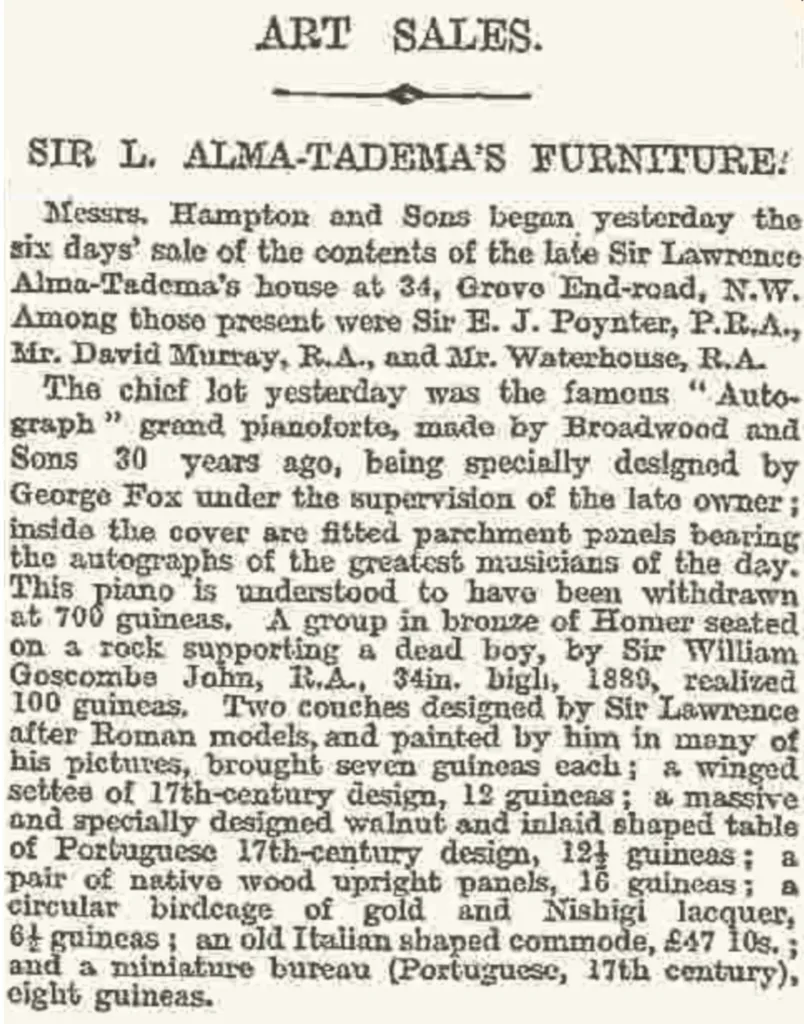 The Times (London), June 10, 1913: The sale begins. Note the presence of his rival, Sir Edward Poynter, watching the dismantling.
 -
1913-1921: The Eight Paradoxical Years. The traditional narrative paints these years as a "silence," but for Anna, they were a period of intense activity.
- She did not vanish into the shadows. In 1915, she painted the cover of The Tatler (a portrait of Gladys Cooper), and in 1919 she was commissioned to record the Paris Peace Conference. She was working, earning, and striving.
- But the house was a beast that devoured income. Even with her commissions and the trust fund, the math didn't work. The sisters were living in a "White Elephant" that required a millionaire's income to heat and staff, while earning a professional artist's wage in a war-torn economy. The tragedy wasn't that they were idle; it was that their industry couldn't outpace the inflation.
- We do not know if they lived in the empty shell during this time, or if they rented it out to no avail. But the 1921 sale suggests a final breaking point—a moment when the sheer impossibility of the situation forced a surrender.
-
1921: The Final Capitulation. The house is finally sold, presumably to Hampton & Sons, the firm who had handled the contents sale. It is bought not as a home, but as a development opportunity to be chopped into flats.
- This was the defining signal that the Victorian age was dead. In the harsh economic reality of post-war London—with its servant shortages and crushing heating costs—no one wanted, or could afford, a single-family "Palace of Art." The only sensible destiny for Tadema's marble fantasy was to be sliced up into efficient, modern units. The era of the grand studio was over; the era of the apartment block had begun.
- The price was reportedly under £25,000. But the tragedy was in the math. £25,000 in 1920 had the purchasing power of roughly £10,000 in 1912 monies. The War had destroyed the value of the pound. The sisters didn't just sell for a loss; they sold for a fraction of a fraction, walking away with barely enough to generate a modest middle-class income.
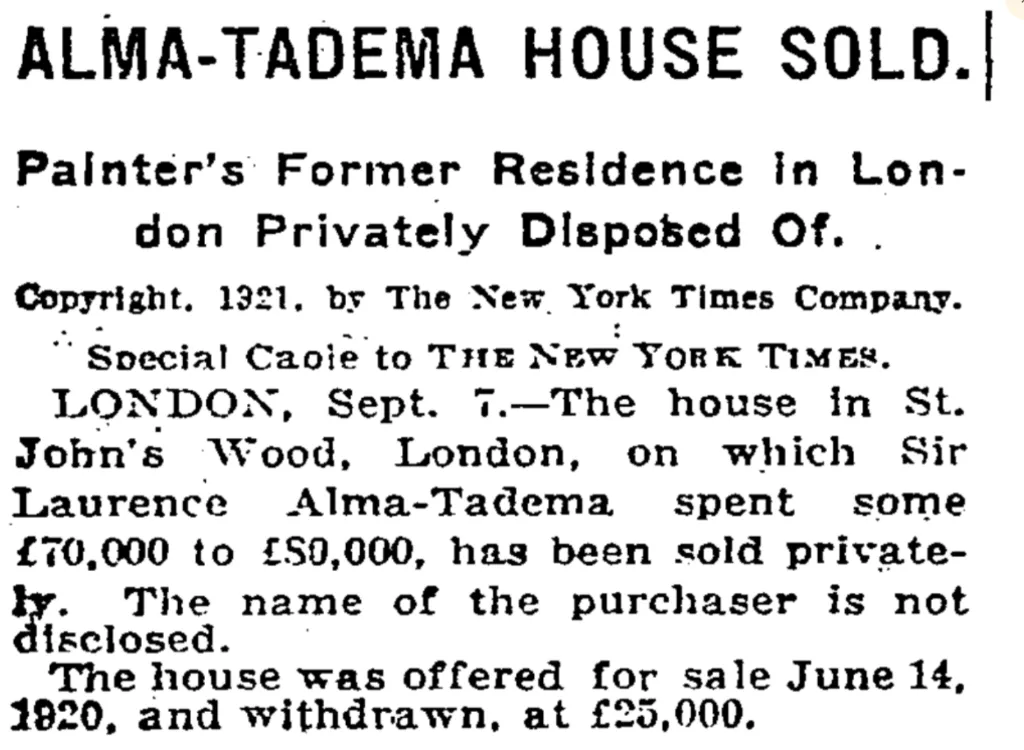 The New York Times, September 8, 1921: The final confirmation. The house was withdrawn at £25,000 in 1920, and then "privately disposed of" later—likely for even less.
The Invisible Thief
The liquidations of 1913 and 1920 were brutal, but they finally filled the trust fund. By 1921, the sisters had a capital of £25,000 safely in the hands of the Public Trustee.
To a Victorian like Alma-Tadema, this was "safety." The money was invested in Government Bonds (Gilts), which paid a fixed income—say, 3% a year. In 1912, that 3% was a comfortable fortune. It bought carriages, servants, and trips to Italy.
But then came the Great War.
Between 1914 and 1920, inflation in Britain soared by over 100%. The cost of bread, coal, and rent doubled. But the income from the "safe" bonds stayed exactly the same. In real terms, their income was halved. Then halved again as taxes rose to pay for the war.
The "fortress" had become a prison. The very safety mechanism their father had built was now the instrument of their poverty.
The Golden Handcuffs
This financial strangulation forced the sisters to physically shrink their lives.
Because their income could no longer support them, they had to liquidate their history. The 1920 sale forced them out of the "Sanctuary" and into smaller, rented quarters. The famous "Autograph" Broadwood Piano—the inlaid masterpiece inscribed by the Muses—was sold to a buyer in Surrey. The instrument that had once been played by Tchaikovsky and Saint-Saëns left the family forever.
Anna even had to give away the family treasures she could no longer house. In 1921, she donated the family "relics" and her father's Royal Academy Diploma to the Royal Academy and loaned a collection of family portraits to the Victoria & Albert Museum.
They were trapped in a "Strict Settlement." They were the beneficiaries of a trust holding millions in today's money. They could see the capital sitting in the vaults. But they could not touch a single penny of it. They were freezing in hotel rooms, unable to afford coal, while guarding a fortune that was destined for someone else.
The Final Ledger
The ultimate irony lies in the final accounting.
When Anna died in 1943, in Chelsea during the Blitz, the trust finally wound up. The Public Trustee transferred the capital to the Royal Academy to found the Alma-Tadema Scholarship.
The amount transferred was £25,278.
The trustees had done their job according to the law. They had preserved the capital intact. They had not lost a single pound of the principal.
But the system itself had failed. The legal structures designed to protect the "weak" sex had instead trapped them. The sisters had lived as the "poorest rich women in London," guarding a treasure chest they were forbidden to open, casualties of a changing world that their father—for all his genius—could never have predicted.
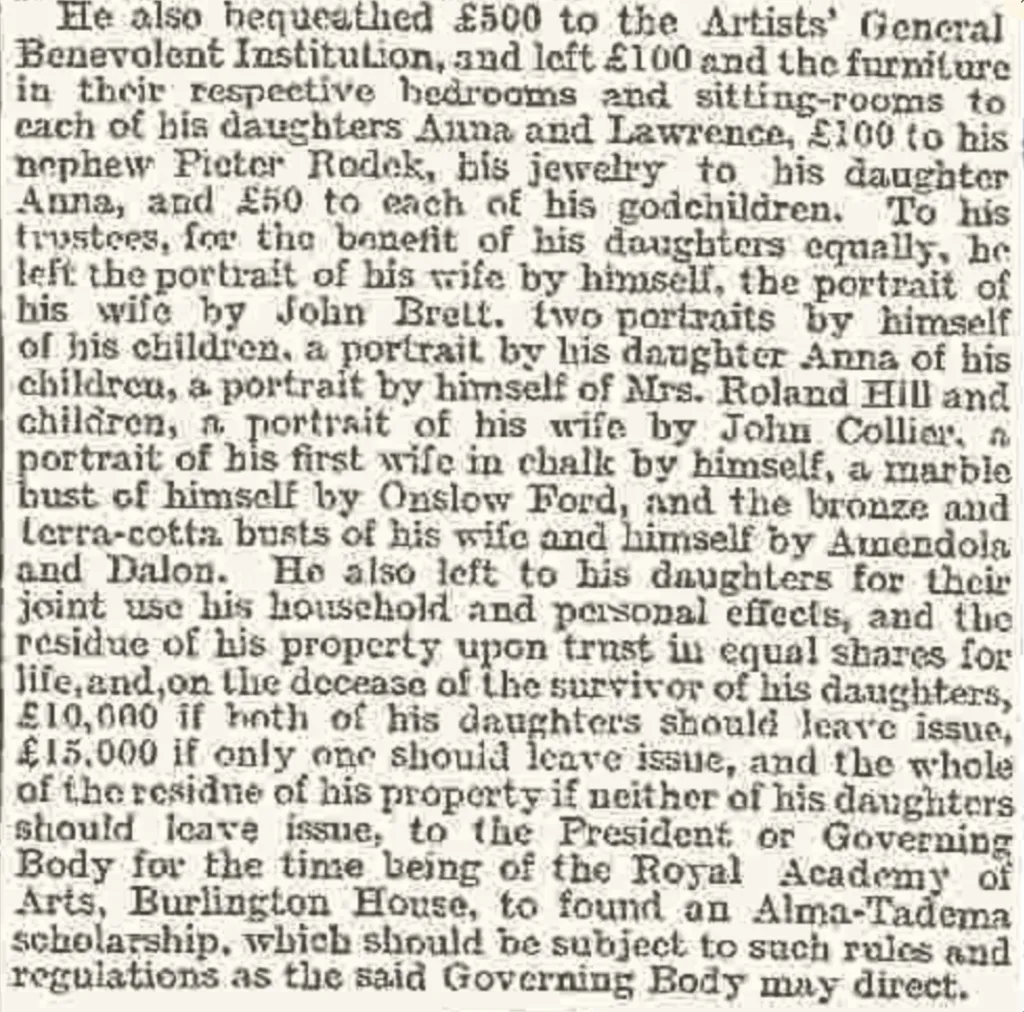
Leave a Visiting Card
Consulting the visiting cards...