
It is July 5, 1912. The air in London is thick, not with the typical coal-smoke of the East End, but with a heavy, ceremonial silence that has descended upon St. Paul’s Cathedral.
The Great West Doors, usually swung open for tourists and pilgrims, now admit a smaller, more somber congregation. These are the titans of the Victorian age—John Singer Sargent, Sir Edward Poynter, and Briton Riviere—men who have defined the visual language of an Empire. They stand in the nave, their silk hats held against their chests, waiting for the arrival of a friend who spent his life chasing a light that London only occasionally provides.
The Journey from the Rhine
Ten days have passed since Lawrence Alma Tadema stilled his hand in Wiesbaden.
While the public saw only the polished oak of the casket, the journey home had been one of sterile, imperial precision. The German specialists at the spa had prepared the body for its final repatriation, sealing the master of marble within a lead-lined shell designed to cross the borders of Europe one last time.
There is a quiet irony in the wood they chose: unpolished oak. For a man who lived amidst the shimmering surfaces of silvered ceilings and brass staircases, his final vessel was remarkably, almost defiantly, austere. A simple silver plate bore his name, his honors, and the dates that pinned him to history: 1836 to 1912.
The Geopolitics of the Pews
As the choir begins the rhythmic, ancient tread of Croft’s Burial Sentences, the pews reflect a world that would soon be torn apart.
Sitting in the dim, amber light of the choir are the proxies of three kingdoms. Queen Alexandra is represented by a private secretary; beside them sit the representatives of the King and Queen of Norway, and, most poignantly, the representative of the German Emperor, Wilhelm II.
In this moment, the "Sanctuary" that Tadema built at Casa Tadema seems to have expanded to cover all of Europe. Even the Netherlands Minister is present, standing as a witness to the boy from Dronryp who became the most "British" painter of his era, yet remained, in his deep color and sturdy patience, fundamentally Dutch.
The Sound of the Sanctuary
The silence of the Cathedral is a participant in the service. When the hymn "Grant them, O Lord, eternal rest" rises toward the Whispering Gallery, it is a deliberate echo of his social world.
The tune was composed by Harvey for the funeral of Sir John Stainer, another regular at the "Musical At Homes" of Grove End Road. This was the music Tadema had heard in the twilight of his own studio, now amplified to the scale of a mountain.
Standing closest to the altar are Anna Alma-Tadema and Laurence Alma-Tadema. They are "Chief Mourners" in every sense—veiled in the absolute black of Edwardian grief, watching their father’s coffin rest upon a catafalque that seems too large for a man who famously stood only five feet tall.
The Offering of Flowers
Amidst the black silk and gray stone, the flowers provide the only points of color—the very hues Tadema might have used in a painting of a Roman spring.
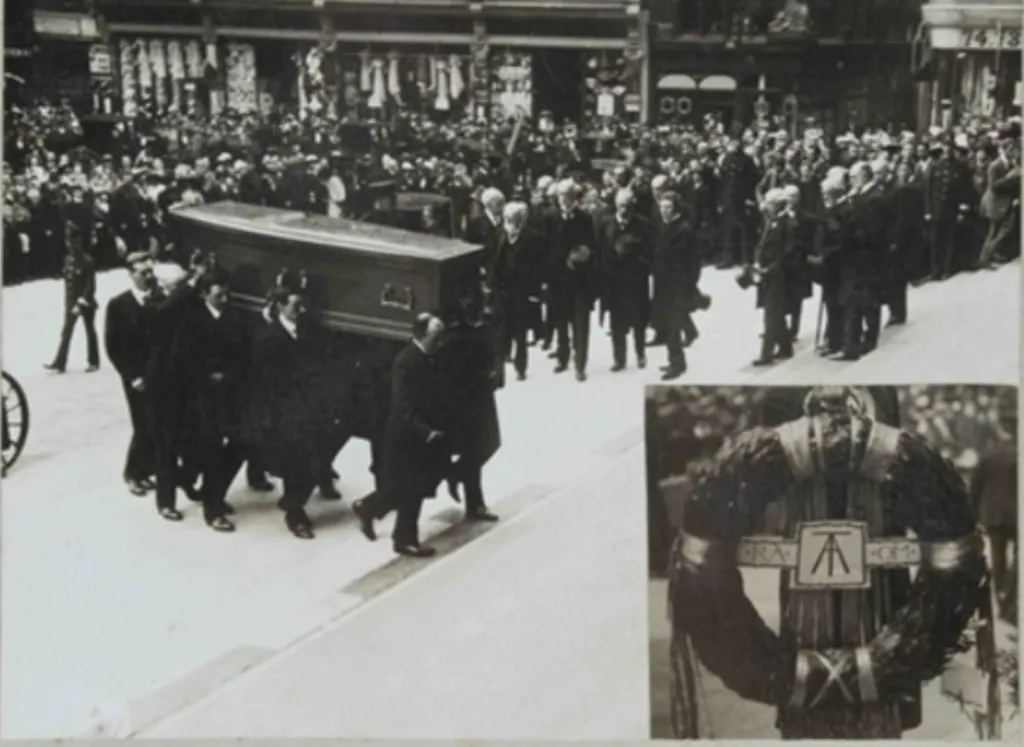
Queen Alexandra sent a massive wreath of purple and white blossoms. Beside it rested the Royal Academy's tribute: a ring of laurel leaves punctuated by a single, blood-red flower, designed by the sculptor Sir George Frampton.
It was a visual summary of his life: the purple of imperial favor, the white of his marble, and the laurel of a victory won over a childhood sickness that should have taken him decades earlier.
The Neighbors in the Crypt
The most haunting moment occurs when the coffin is positioned above the open floor. The choir sings the anthem "They that bear the body," a piece specifically chosen for the men of music who passed before him.
Then comes the music of the earth returning to the earth. As the lead-lined casket is lowered slowly into the darkness of the "Painters' Corner," the voices lift into "I heard a voice from Heaven."
He is laid to rest next to Lord Leighton and Sir John Millais. The "Great Triumvirate" of Victorian art is now complete in the soil of St. Paul's. They are neighbors in the dust as they were neighbors in the Royal Academy.
The Echo of the March
As the service ends, the heavy, crushing chords of Handel’s "Dead March" in Saul begin to rumble through the stone floorboards. It is the sound of an age ending.
The congregation spills out into the July afternoon, the sunlight hitting the brass fittings of the waiting carriages. The "Sanctuary" at Casa Tadema remains, with its Hall of Panels and its Autograph Piano, but the hand that colors the world has finally stilled.
The music fades, but the marble remains cool to the touch, long after the last carriage has rattled away into the London fog.

Leave a Visiting Card
Consulting the visiting cards...