
It is December 1902. The Nile is a ribbon of molten glass reflecting a sky so blue it feels bruised. On the deck of a luxury steamer, the "St. John Aird of the Large Heart"—Sir John Aird, the man who built the modern world—stands in conference with Lawrence Alma-Tadema. Around them, the desert heat is a living thing, smelling of ancient dust, sun-baked mud, and the sharp salt of the Red Sea.
Sir John Aird has just tamed the river with the Aswan Dam, a masonry giant that is currently drowning the temples of the past even as it promises a fertile future for the living. The party he has assembled for the dam’s dedication is a curated gallery of Edwardian power; among the guests is a twenty-eight-year-old Winston Churchill, a young MP who watches as the "Engineer of Empire" hosts the elite on the banks of the Aswan.
Aird turns to the artist—a man who has spent forty years resurrecting Rome and Egypt from the silence of library archives—and offers a commission. He wants a tribute to this river. Alma-Tadema, moved by the "supreme delight" of witnessing the scenes that had inspired his brush for decades, gives his patron three potential subjects. Without a moment of hesitation, Aird chooses the grandest: the discovery of a child in the reeds. He chooses a story of salvation to celebrate a project of Imperial subjugation.
The $35 Million Reckoning
For most of the 20th century, the world forgot this moment of filtered sunlight and celebratory processions. The art establishment had adopted a simple, brutal rule: Impressionism was good; Victorian art was bad.
By the mid-century, Alma-Tadema was dismissed as "kitsch." His paintings were mocked as "chocolate box" decorations for a decayed upper class. In 1960, his masterworks were changing hands for a few hundred pounds, often purchased solely for their ornate, gilded frames.
Then came November 4, 2010.
At Sotheby’s in New York, lot number 26 came up for auction: a massive canvas, measuring over seven feet wide. The pre-sale estimate was high—$3 to $5 million—a figure that already signaled a recovery of the artist’s reputation. But when the bidding started, the room erupted. Two bidders—fighting via anonymous telephone lines from opposite sides of the globe—drove the price up in increments of hundreds of thousands, then millions.
The winner was a private collector, widely rumored in the art world to be the Qatari Royal Family acquiring the masterpiece for a then-planned Orientalist Museum. When the hammer finally fell, the total price reached $35,922,500. It was the most expensive Victorian painting ever sold—a price tag that didn't just break a record; it broke the curse on the entire Victorian Era.
The Expedition: The Spirit of the Nile
The journey that inspired The Finding of Moses was a six-week pilgrimage through the heat and light of the desert. Alma-Tadema was 66 years old, and though he had painted Egypt many times, he had never stood upon its soil. He had relied on his massive library of 4,000 photographs and his endless hours in the British Museum.
Now, he filled his sketchbooks with the atmosphere (and forensic details) of the living world. He didn't sketch the dam's modern masonry. Instead, he absorbed the specific curve of a lotus stem, the movement of the blue-black water, and the way the limestone cliffs glowed like embers at sunset. His personal collection (now preserved in the Birmingham Portfolio) was flooded with new data: sketch plans of the Island of Philae and detailed studies of Egyptian ornament that would find their way into every square inch of his subsequent canvases.
This was the "Project of the Century." Aird’s dam was a miracle of engineering, but for Tadema, the true miracle was the silence of the ancient motifs he found there. Moved by the "supreme delight" of witnessing scenes that had inspired his brush for decades, he offered his patron three potential subjects for a celebratory commission. Without a moment of hesitation, Aird chose the grandest: the discovery of a child in the reeds. He chose a story of salvation to celebrate a project of Imperial subjugation.
It was a profound irony: the man responsible for the drowning of the Temple of Philae was the one paying for its most glorious resurrection on canvas.
The Obsession: Two Years at Grove End Road
When Alma-Tadema returned to London, he brought the desert back to his high-Victorian studio at 17 Grove End Road. He treated the story of Moses not as a Sunday School fable, but as a historical documentary of 1300 BC.
The process was so consuming that it swallowed two years of his life. He worked with a "limitless patience and matchless skill," applying layer after layer of translucent glazes to create the peculiar, shimmering light of the Nile. The project became a source of national fascination; King Edward VII even visited the studio to witness the work in progress, watching as the artist painstakingly detailed the hieroglyphs on a red granite statue.
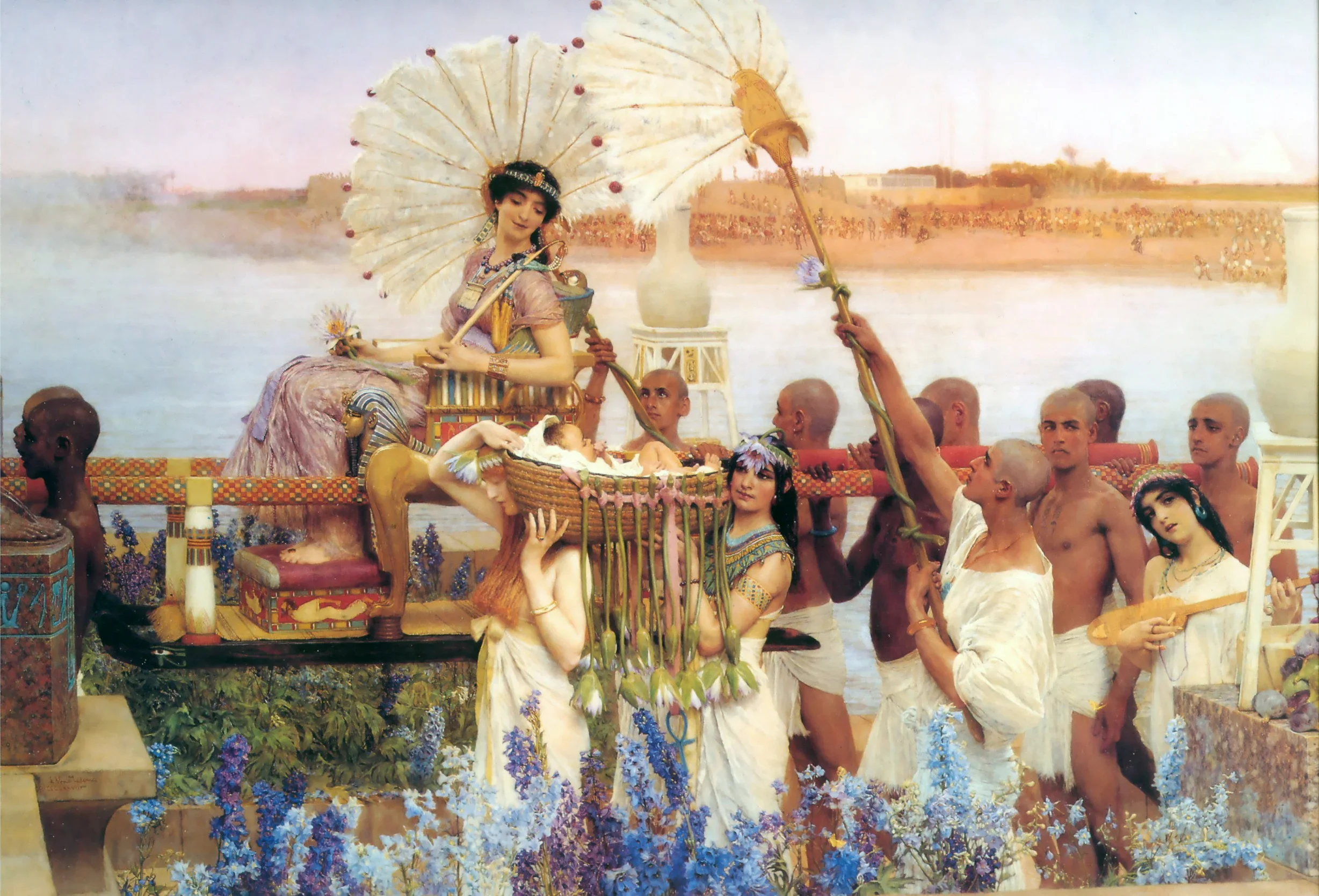
- The Botanical War: In the foreground, the purple Delphiniums (Larkspurs) shimmer with a vitality that seems almost supernatural. To capture this exact shade, Tadema refused to work from memory or dried specimens. During one London winter, he had fresh crates of the flowers shipped from Nice, France, every single week for months. He would not paint a single wilting petal.
- The Hieroglyphs of Power: The red granite statue to the left is not a generic Egyptian prop. It is based on a statue of Seti II from the British Museum. The base is inscribed with authentic hieroglyphs that read: "Beloved of Ra, King of Upper and Lower Egypt." They are filled with blue pigment, exactly as they would have appeared in antiquity.
- The Mosaic of Identity: The Princess is carried on a throne derived from depictions in 19th-century publications like Prisse d’Avennees’ L'Histoire de l'Art Égyptien. Her feet rest on a stool decorated with bound Asiatic prisoners—a chillingly accurate detail that marks her as a royal and symbolizes the very captivity from which she is saving the infant.
The work took so long that Tadema’s wife, the painter Laura Alma-Tadema, famously quipped that by the time Sir Lawrence finished the canvas, the infant Moses was "two years old, and need no longer be carried."
The Composition: A Hierarchy of Gaze
Alma-Tadema’s choice of composition was masterful and psychological. Most artists depicting this scene place the focus on the basket in the reeds. Tadema does the opposite.
He places the focus on the Pharaoh’s Daughter. She sits high on her carrying chair, elevated above the viewer, looking down with an expression of imperial bemusement. She is the center of the world. The baby Moses is almost incidental, tucked away in the reeds at the bottom of the frame, held by an olive-skinned servant.
The background provides the intellectual weight. On the far bank of the river, blurred by the hazy day’s heat and the shimmering blue of the water, teams of Hebrew slaves labor under the watchful eyes of Egyptian overseers. On the distant horizon, the rose-colored Pyramids of Giza stand against the sky.
There is a geographical "error" here—Aswan, where Aird built his dam, is hundreds of miles from the Pyramids. But Tadema was not painting a map; he was painting a summary of an entire civilization. We, the viewers, are looking up at the Princess, while she looks down at the future prophet. It captures the exact moment where the immense power of Egypt (the Princess) adopts the force that will eventually destroy it (Moses).
The Fall and the Cinematic Legacy
When the masterpiece was finally exhibited at the Royal Academy in 1905, it was the summit of Tadema’s career. But the air was already cooling. French Realism and the avant-garde were sweeping away the "Victorians in Togas." Within a few decades, the painting’s journey through the market became a ghost story of shifting tastes:
- 1904: Aird pays 5,000 guineas (roughly $25,000) for the work.
- 1935: At a London auction after the death of Sir John Aird's heirs, it fetches only 820 guineas.
- 1942: It sells for a humiliating 260 guineas. There is a persistent legend that it was purchased solely for its frame, and the canvas was nearly discarded.
The silence lasted until the 1960s, when Allen Funt, the creator of the television show Candid Camera, began buying Tademas when no one else would. Funt recognized that these weren't just paintings—they were storyboards for a visual language that had conquered the world.
Indeed, the true heirs to The Finding of Moses were not painters, but the directors of Hollywood. Cecil B. DeMille famously kept prints of Alma-Tadema's work in his studio. The wide-angle perspective, the cast of thousands, and the imperial scale of his epics Cleopatra (1934) and The Ten Commandments (1956) are direct visual echoes of Tadema’s Nile. When you see Charlton Heston standing before a palace in Technicolor, you are seeing the ghost of the $35 million masterpiece.
The Return of the King
The 2010 sale at Sotheby's was more than just a financial record; it was a reckoning. The $35,922,500 price tag proved that while taste is fickle, the sheer, undeniable craft of a master remains a bridge to the eternal.
Today, Moses resides in a private collection—shrouded in the silence that often follows such tectonic shifts in the market. But he is no longer an exile. When the painting was loaned back to London in 2017 for the At Home in Antiquity exhibition, thousands stood before it in silence. They weren't looking at "kitsch." They were looking at a testament to a man who, for six weeks in 1902, looked at the Nile and saw a world he had known his entire life—and then spent two years of his life making sure we could see it, too.
Leave a Visiting Card
Consulting the visiting cards...