
It is 1857 in Antwerp, and the light is gray. In the studio of Louis de Taeye, the air smells of old paper and damp wool. A young man of twenty-one bends over a sheet of paper, his brush moving with a hesitation that will one day vanish, but today is full of earnest intent. He is not yet the master of Mediterranean sunlight. He is Lourens, a student, and he is painting a shadow.
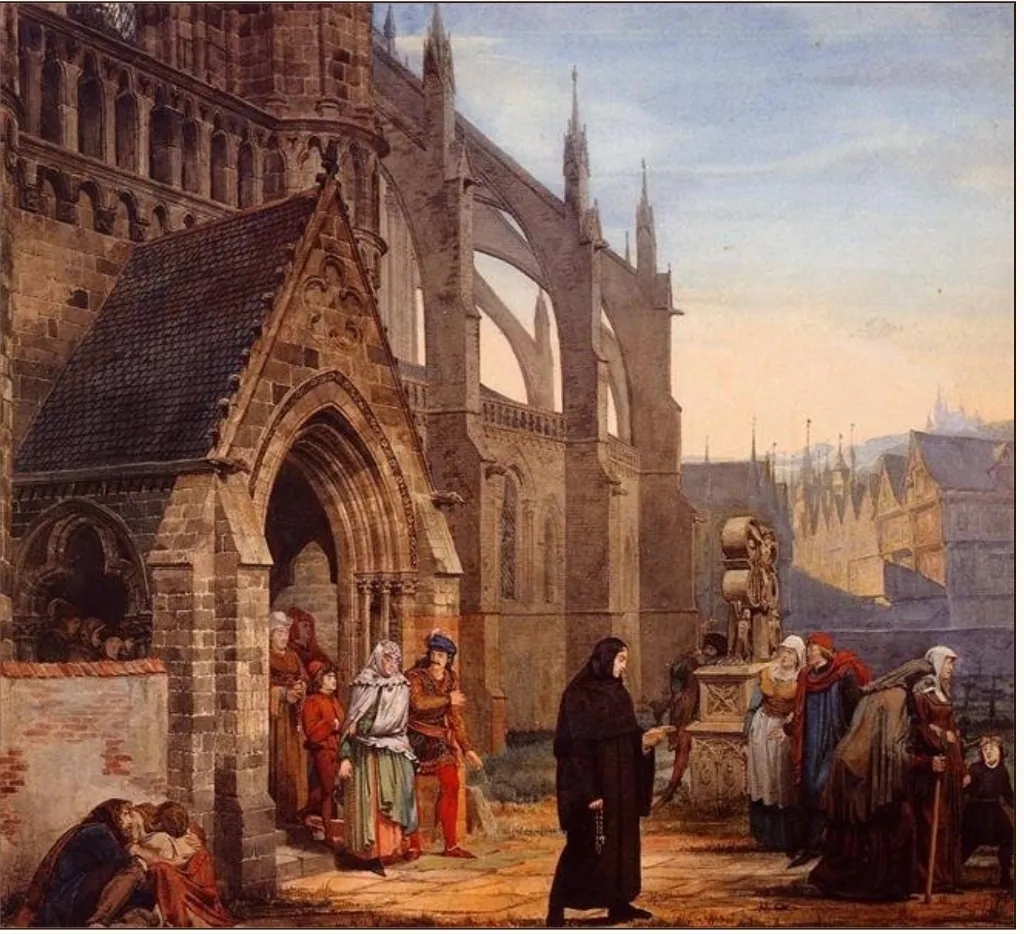
We know Sir Lawrence Alma-Tadema for his blinding white marble and azure seas, for women in togas languishing on leopard skins. But before the sunlight, there was the twilight. "Faust and Marguerite" (Opus VII) is a rare artifact from this forgotten dawn—a watercolor that whispers of a different artist entirely, one steeped in the brooding romance of the North.
The Devil’s Bargain
To understand the painting, we must first understand the shadow that hangs over it. By 1857, Johann Wolfgang von Goethe’s Faust was not merely a play; it was a cultural obsession.
The Legend of Faust and Marguerite
For those who do not know the story, it is the ultimate tragedy of desire. Faust is a weary scholar, an old man who has consumed all the knowledge of the world and found it empty. In his desperation, he makes a pact with Mephistopheles, the devil: his soul in exchange for unlimited knowledge, power, and, significantly, a return to youth.
But the devil is cruel. He does not lead Faust to wisdom, but to Marguerite (or Gretchen). She is the archetype of innocence—young, devout, and utterly unaware of the dark forces circling her. She is not a conquest for Faust; she is the collateral damage of his deal with hell.
The story tells of their seduction, her fall from grace, and her ultimate doom. She bears Faust's child out of wedlock, accidentally kills her mother with a sleeping potion provided by Faust, drowns her infant in madness, and is finally executed. It is a story of absolute ruin born from a single encounter.
The Shadow of Ary Scheffer
To understand the choice Alma-Tadema made, we must understand the visual landscape of 1857. The art world was in the grip of "Faust-mania," and one artist reigned supreme over the subject: the Dutch-French master Ary Scheffer (1795–1858).
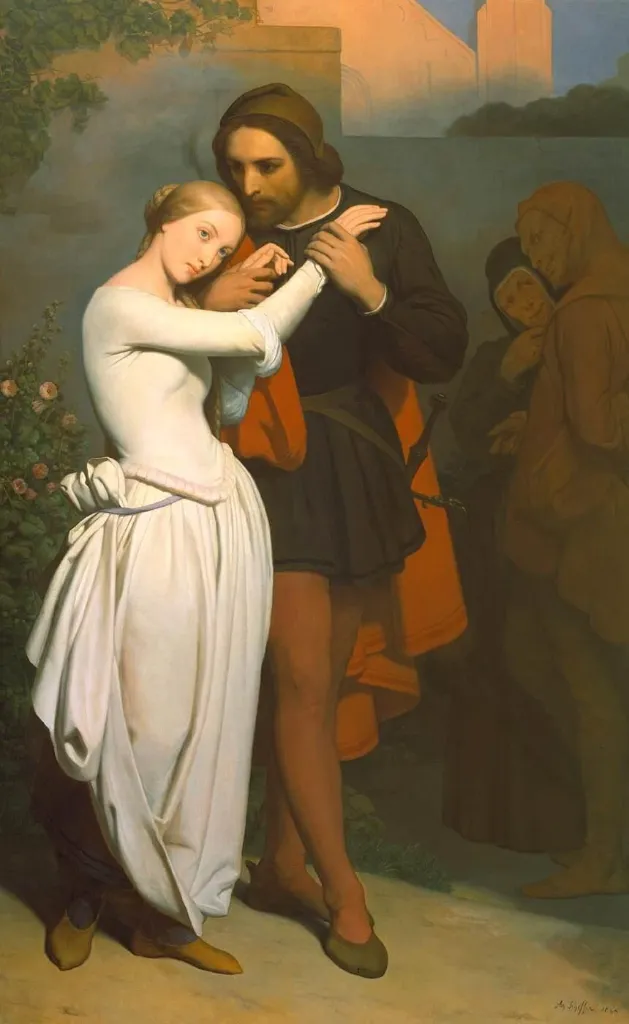
Scheffer virtually monopolized the visual identity of Marguerite. He didn't just paint her once; he created a celebrated cycle of paintings that followed her entire tragic arc, from Marguerite at the Spinning Wheel to Marguerite at the Fountain. These images were reproduced as engravings and sold across Europe; you could practically find a Scheffer hanging in every bourgeois parlor.
His most famous interpretation was "Faust and Marguerite in the Garden" (1846). In Scheffer’s vision, the seduction is a soft, dreamlike surrender. The garden presence is minimal—a few roses suggesting the bower—so that the focus remains entirely on the emotional communion of the couple, and the world outside is stripped away.
The Encounter
Alma-Tadema knew this tradition. He would have seen Scheffer’s prints in Antwerp. Yet, he turns his back on the soft garden bower. He chooses a harder, colder, and more public moment: The Meeting at the Church.
Marguerite has just emerged from the cathedral, her hands likely clasped or holding the folds of her dress, her mind likely filled with the sermon she has just heard. She walks onto the street, and there, waiting for her, is Faust. He is no longer the old scholar; he is a handsome young nobleman in red, accompanied implicitly by the unseen influence of Mephistopheles.
In the painting, Faust is not blocking her path but walking alongside her, leaning in, offering his arm and his compliments. In Goethe's text, this is the moment he says: "My fair lady, may I make free to offer you my arm and company?"
The tragedy is in her refusal—she rejects him here—yet the visual tells us he has already stepped into her world. He is the red stain against the gray stone, the worldly voice interrupting her spiritual silence.
The Gothic Shadow
The architecture here is not a backdrop; it is a character. The massive flying buttresses and intricate stonework loom over the figures, dwarfing them. This is the heavy, religious world that Marguerite belongs to—a world of order, faith, and weight.
Alma-Tadema, even at twenty-one, shows his obsession with structure. The influence of his teacher, Louis de Taeye, is visible in the meticulous rendering of the brickwork and the historical accuracy of the costumes. The church stands for salvation, yet here, right at its threshold, the devil's bargain begins to unfold. Use the visual of the church's massive scale to emphasize how small Marguerite is against the forces—both religious and demonic—that control her fate.
A Mirror to the Soul
It is a strange thing to look at this painting and realize it was Opus VII. Number seven. In a career that would span hundreds of masterpieces, this was one of the very first he deemed worthy of a number. And he kept it. For fifty-five years, as he moved from Antwerp to Brussels, to London, as he built his palace in St John’s Wood, as he became a knight of the realm, this small watercolor remained with him.
Why? Perhaps it was a reminder. A memento of the year he turned twenty-one—the same age Goethe was when he began writing Faust. Or perhaps it was a nod to the road not taken. Had he continued on this path, following the footsteps of Ary Scheffer and the romantic dramatists, we would not have the Finding of Moses or The Roses of Heliogabalus. We would have another painter of history, competent and dark, lost in the crowded salons of the 19th century.
The Unbroken Thread
Yet, if you look closely, the seed is there. The obsession with accuracy. The texture of the fabric. The way the figures interact, not as actors on a stage, but as people caught in a private moment. The silence is already there.
The painting resurfaced recently, selling at Christie’s in 2019 for £13,750—a modest sum for a master, but a king’s ransom for a memory. It traveled from his studio to the auction block, carrying with it the invisible fingerprints of a young man who did not yet know he would conquer the world with light.
The Echo and the Abyss
And so, the figures walk on, away from the church and toward the tragedy that awaits them. The young artist grew up, found the sun, and forgot the shadows. But in this small square of paper, the twilight lingers. It reminds us that even the brightest day begins in the dark, and that before we can paint the light, we must first understand the shadow.
But Faust was only the beginning of Tadema's exploration of doomed desire. If Faust was the tragedy of innocence seduced, his next great romantic subject would explore something far darker: the tragedy of unwanted, violent obsession.
From the quiet streets of Antwerp, we turn next to the blood-stained forests of mythology.
Next in the Trilogy: The Death of Hippolyte: When Love Becomes a Weapon
Leave a Visiting Card
Consulting the visiting cards...