We left Faust and Marguerite in the quiet, lingering twilight of Antwerp. There, the tragedy was a whisper—a glance, a thought, a soul slowly turning toward shadow. It was the tragedy of seduction.
If Faust was about the loss of innocence, Opus XIII, The Death of Hippolytus, is about the violence of obsession.
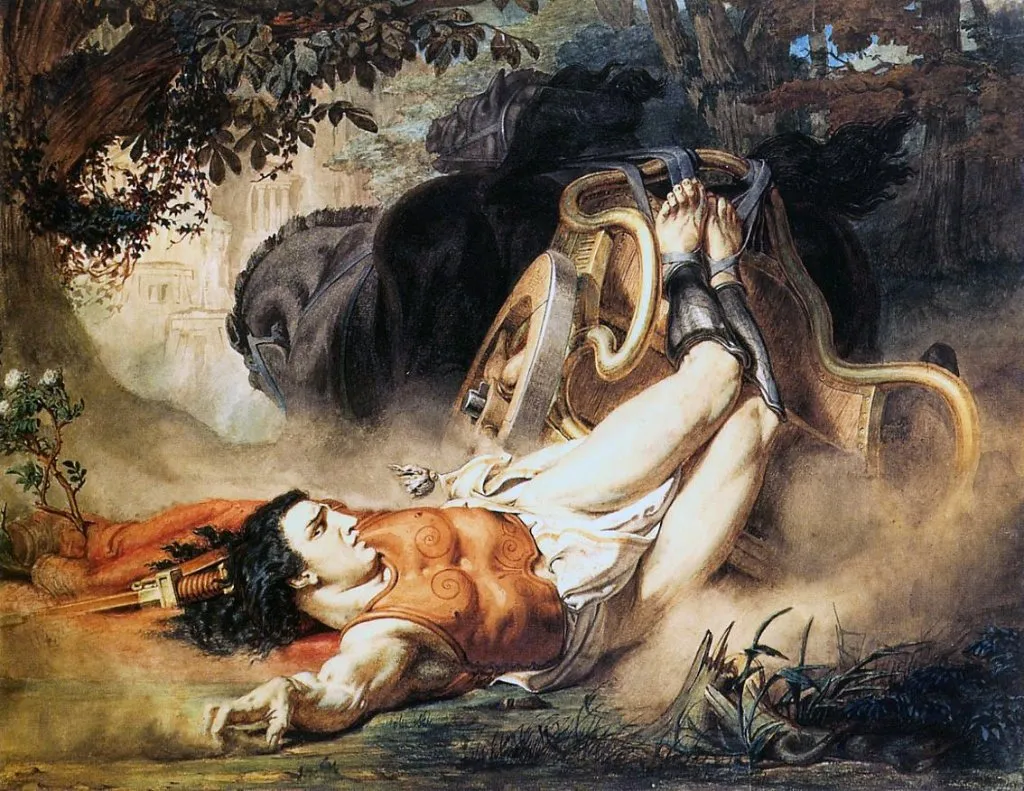
Painted 1860 • Oil on panel • Private Collection
The Curse of the Stepmother
Before we look at the canvas, we must understand the bloodline. This is not a story of romance; it is a story of ruin.
Hippolytus was the illegitimate son of the great hero Theseus. He was a young man of extremes—extreme beauty, doubtless, but also extreme chastity. He worshipped Artemis, the goddess of the hunt and eternal virginity, and in doing so, he committed the dangerous sin of scorning Aphrodite, the goddess of love.
The gods do not take scorn lightly.
Aphrodite, insulted by this cold adolescent disdain, enacted a punishment of terrifying precision. She did not strike Hippolytus directly. She struck properly, through the heart of another. She caused Phaedra—Hippolytus's own stepmother—to fall into a consuming, maddening love for him.
The tragedy that Euripides wrote in 428 BC unfolds with inevitable cruelty. Phaedra, consumed by a forbidden lust she cannot control, eventually confesses her feelings. Hippolytus, horrified, rejects her with a brutal, misogynistic revulsion.
Shamed, rejected, and terrifyingly vengeful, Phaedra commits suicide. But she leaves behind a note—a lie that would act as a weapon from beyond the grave. She claims that he attacked her.
Theseus returns to find his wife dead and this note in her hand. Blind with grief and rage, he does not ask questions. He calls upon his own father, the sea-god Poseidon, to fulfill one outcome: the death of his son.
The Runaway Chariot
And so we come to the moment Alma-Tadema chose to paint.
Hippolytus is exiled, driving his chariot away from the city, grieving his father's hatred. According to the myth, a bull from the sea startled his horses, but Alma-Tadema transports this violence into a different setting entirely.
In his vision, the terrified horses have veered off the road and into a dense, oppressive forest. The chariot is not crashing against sea-cliffs, but overturning amidst the gnarled roots and heavy shadows of an ancient wood. This is Artemis's domain—the wild, untamed forest—but nature here offers no sanctuary.
The horses, mad with fear, have lost all control. The chariot capsizes, sending Hippolytus tumbling into the dust. The reins—the very symbols of Phaedra's failed control—are tangled, dragging his body through the underbrush. He is innocent, yet he is being destroyed by the very nature he worshipped.
The Painting: Opus XIII
In 1860, Alma-Tadema was not yet the "Painter of Marble." He was still under the spell of his teacher, Baron Leys, and the mood is distinctly Merovingian—heavy, dark, and psychological.
The Death of Hippolytus feels claustrophobic. The trees loom over the scene, blocking out the sky. It lacks the crystalline sunlight of his later Pompeian scenes, giving us instead the jagged, confused energy of a nightmare.
The Forest vs. The Sea: A Deliberate Divergence
Why did Alma-Tadema paint a forest when the myth explicitly describes a crash on the seashore? This choice is a fascinating insight into the young artist's mind.
First, strictly logically, he may have imagined the horses fleeing inland from the shore after being startled. But artistically, the choice is far more potent.
- The Romantic Gloom: In 1860, Alma-Tadema was heavily influenced by German Romanticism. In that tradition (think of Goethe or Wagner), the "Dark Forest" is the primal stage for tragedy and magic. A bright, sunny Greek coast would have felt too rational for this nightmare.
- The Irony of Sanctuary: Hippolytus was the devotee of Artemis, the goddess of the forest. By placing his death in the woods, Alma-Tadema adds a cruel layer of irony. Hippolytus is dying in his own sanctuary. The very nature he worshipped has turned into his tomb.
- Visual Dignity: Painting a supernatural "Bull from the Sea" is visually risky—it can easily look ridiculous or like a "monster movie." By removing the monster and focusing on the psychological terror of the horses in a dark wood, Tadema makes the tragedy more human and less fantastic.
This "forest gloom" connects the painting to the Northern European tradition rather than the Mediterranean world he would later claim as his own.
The Impossible Love Trilogy
If you trace the thread of "Romance" through Tadema's early catalogue, a pattern emerges. He was seemingly fascinated by the different forms that forbidden love can take.
- Faust (Opus VII): Love is a Seduction. It is a bargain that corrupts the soul.
- Hippolytus (Opus XIII): Love is a Weapon. It is an external, violent force that crushes the body.
The young artist was wrestling with the Victorian fascination with "The Femme Fatale" and the "Fallen Woman," but he was looking at it from the perspective of the male victim. Hippolytus is destroyed not by his own action, but by the "Bad Romance" imposed upon him.
From Chaos to Silence
Paintings of violence were rare for Alma-Tadema. He quickly learned that his genius lay not in the crash of the chariot, but in the silence after the storm. He would soon abandon these chaotic, nutritious myths for scenes of quiet tension.
But before he could find that peace, he had one more form of "Impossible Love" to explore. He had painted the Sinner (Faust) and the Victim (Hippolytus). Now, he would paint the Saint.
In his next great romantic work, he would travel to a convent in 6th-century Poitiers, to find a man who loved a Queen he could never touch.
Next in the Trilogy: Venantius Fortunatus: The Love That Does Not Speak
Leave a Visiting Card
Consulting the visiting cards...