
We have traveled a long, dark road to get here. We began with the whisper of seduction in Faust. We crashed into the violent woods of Hippolytus. In those paintings, love was a force that consumed, corrupted, and destroyed.
But in 1862, Lawrence Alma-Tadema found a third way. In Opus XV, Venantius Fortunatus Reading His Poems to Radagonda VI, he paints a love that neither seduces nor destroys. It simply is.
This is the conclusion to the "Impossible Love" trilogy. And it ends not with a bang, but with a silence.
The Queen and the Poet
To understand the silence, we must understand the noise that preceded it. The 6th century was a time of fire and blood history calls the "Merovingian" era. It was ruled by brutal Frankish kings who treated wives like chattel and war like sport.
Radegund was a prize of that war. A Thuringian princess, she was captured as a child and forced into marriage with King Clotaire I—a man who eventually murdered her own brother. Broken by violence, she did the unthinkable: she fled the King.
She retreated to Poitiers, founded the Convent of the Holy Cross, and shut the heavy doors against the world. She traded her crown for a hairshirt, her jewelry for prayers. She wanted peace.
Then, there came a knock at the door.
It was Venantius Fortunatus. An Italian poet, a man of letters wandering through a barbarian world, he dazzled the court with his Latin verse. But when he met Radegund, the wandering stopped.
He stayed for twenty years.
Their relationship is one of history’s most beautiful mysteries. It was an amicitia—a spiritual friendship of intense depth that defies modern labels.
He sometimes addressed Radegund as "Mother" (honoring her age and rank) and Agnes as "Sister." Yet, the poems he wrote for Radegund burn with a devotion that feels far more than filial. He called her "light of my eyes," "my delight," and wrote that "no shadows can obscure my love for you."
It was a Romance of the Soul. Because physical love was impossible (she was a nun, he a priest), all that passion was poured into the only vessel allowed: Poetry. They loved each other through words.
"Though the sky may cover the stars with clouds,
To my love for you, no day is ever sunless...
My light, my delight, the refuge of my soul."
— Venantius Fortunatus, Poem to Radegund
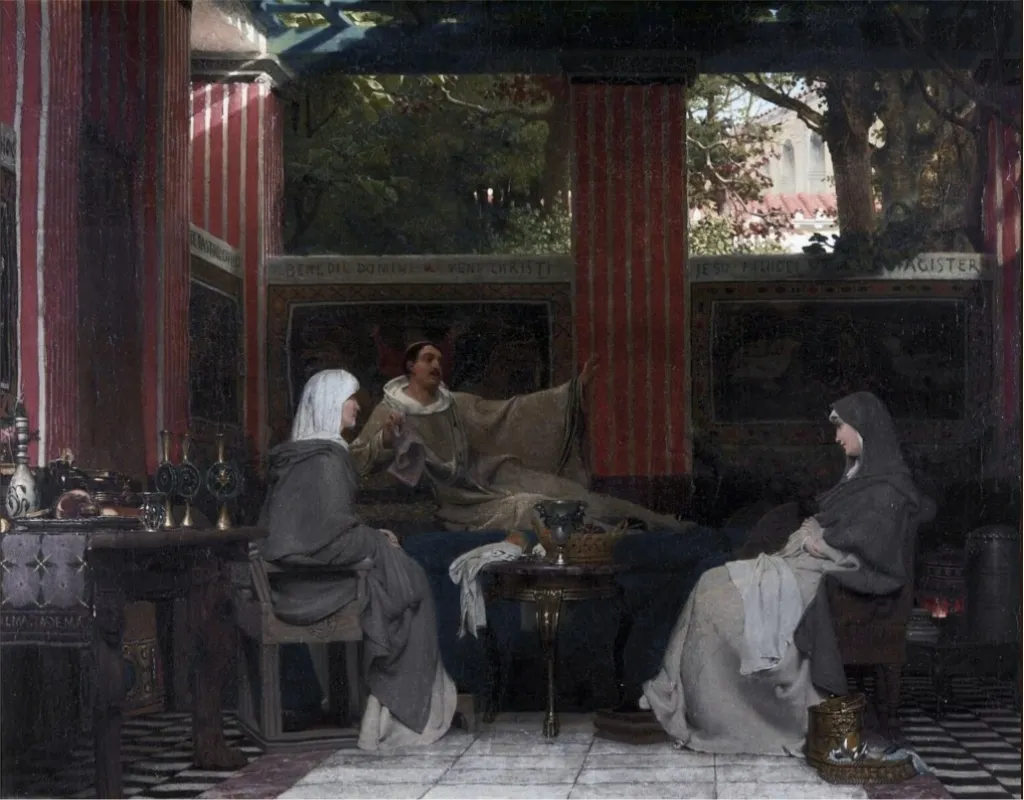
Painted 1862 • Oil on panel • Dordrechts Museum, Netherlands
The Painting: Opus XV
This is the island Alma-Tadema paints, but visually, it is something new.
In previous works, the Merovingian world was dark and claustrophobic. But here, the walls have opened up. We are in an airy loggia, supported by pilasters struck with bold red vertical stripes—a detail that feels almost Roman in its geometry.
Through the open colonnade in the background, we see sunlight hitting the green leaves of the convent garden. This is not a fortress; it is a sanctuary of light.
This painting is a hybrid. The figures are still dressed in the heavy, woolen robes of the north—Venantius in his reclined ease, Radegund in her grey habit. Beside her sits Abbess Agnes, Radegund’s adopted daughter and the third member of this spiritual triangle. Her presence is crucial: she ensures this is not a tryst, but a community.
The tension in the painting lies in the space between them. They do not look at each other. They interpret the words hanging in the sunlit air. It is a portrait of intimacy without contact.
The Resolution of the Trilogy
Why does this painting matter in the young artist's journey? Because it solves the problem he set for himself three years earlier.
- In Faust, the man speaks to corrupt the woman.
- In Hippolytus, the woman speaks (a lie) to destroy the man.
- In Venantius, the man speaks to honor the woman.
Here, the "Impossible Love" is sublimated. It is transformed into art. The passion isn't gone; it is contained in the poetry.
This discovery changed Alma-Tadema. He realized he didn't need grand mythological crashes or melodramatic seductions to hold a viewer's attention. He could just paint people being in a room. He could paint the atmosphere of shared silence.
Venantius Fortunatus is the spiritual ancestor of his most famous later masterpieces. The quiet reading, the rapt listener, the heavy atmosphere of culture—it all starts here, in a stone room in Poitiers, with a poet reading to a Queen who had left the world behind.
The storm is over. The silence has begun.
Leave a Visiting Card
Consulting the visiting cards...