
In December 1912, a strange silence fell over the auction room at Tokenhouse Yard.
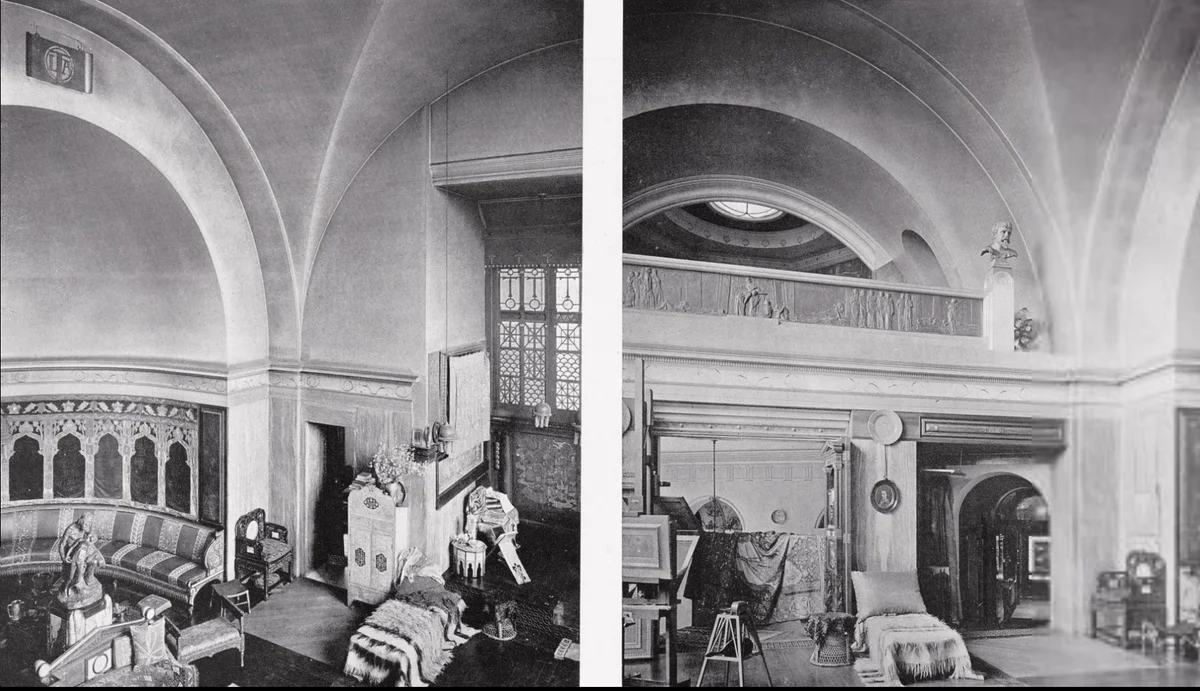
The auctioneer had just opened the bidding for 34 Grove End Road, the famous home of the late Sir Lawrence Alma-Tadema. The press had called it a "Palace of the Beautiful." It was arguably the most famous artist's studio in the world—a place visited by Tchaikovsky, Caruso, and Winston Churchill.
Sir Lawrence had poured his soul, and his fortune, into it. He had spent an estimated £70,000 (over £8 million today) transforming it into a Roman villa in the heart of St. John's Wood. It had a copper dome, a window made of Mexican onyx, and a "Hall of Panels" painted by thirty famous artists.
The reserve price was high. The expectation was higher.
"Do I hear £30,000?" the auctioneer asked.
Silence.
The bidding stalled. The hammer did not fall. The sisters, laurence and Anna, withdrew the house from the market in shock. They had just discovered a brutal economic truth that their father had never taught them: A house built for a genius is a liability to everyone else.
The "Individual Expenditure" Fallacy
Why did the most beautiful house in London fail to sell?
The answer lies in a clipping from The Times property column of December 1912. The correspondent, writing with the cool detachment of an accountant, diagnosed the tragedy perfectly:
"The sale... is a striking example of the disparity of individual expenditure and market value."
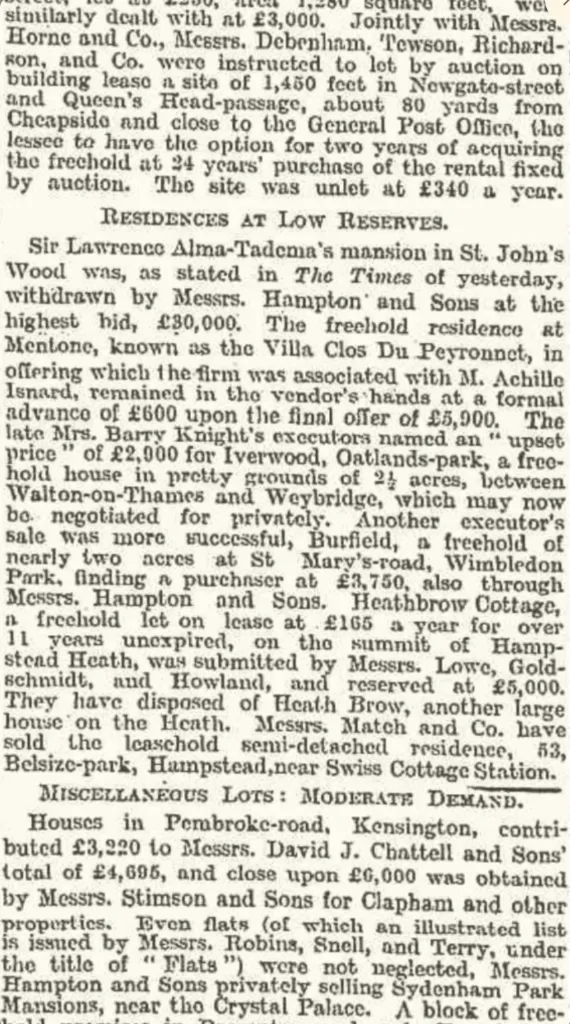
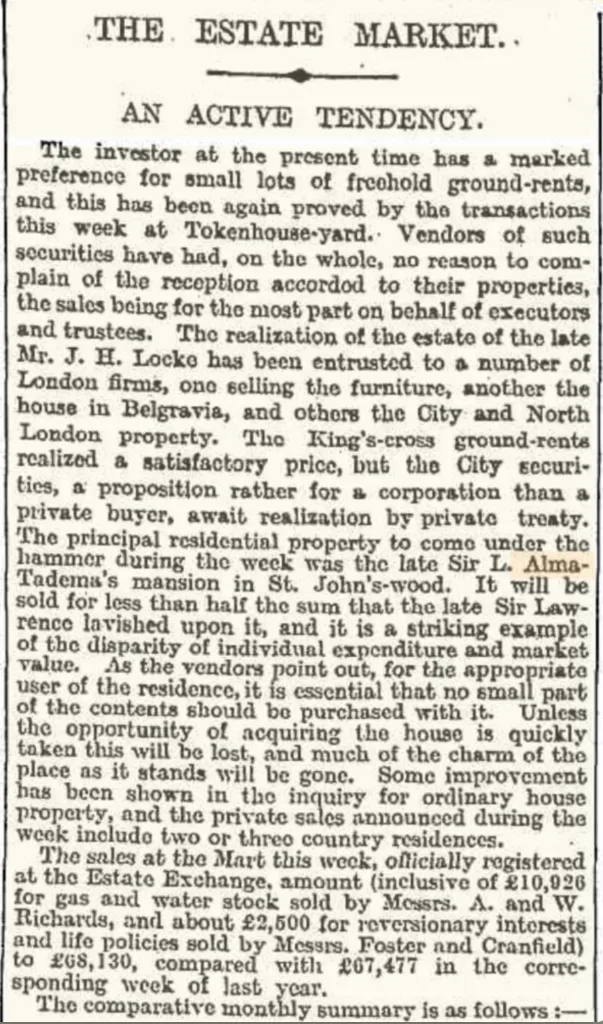
This was the trap. Alma-Tadema had not built a house; he had built a stage set for his own life.
He needed a 60-foot studio to paint colossal canvases like The Roses of Heliogabalus. He needed a gallery to display his collection of Japanese bronzes. He needed an atrium to host parties for 200 people.
But a stockbroker in 1912 didn't need a studio. He needed bedrooms. A lawyer didn't want a "Hall of Panels" that required specialized insurance; he wanted a garage for his new motor car.
By customizing every inch of the property to his specific genius, Alma-Tadema had rendered it functionally useless to 99% of the population. He had spent a fortune making it unsellable.
The Servant Crisis
The second nail in the coffin was invisible, but fatal: Labor.
"Casa Tadema" was a machine that ran on human fuel. It required a regiment of servants to function. There were brass stairs to be polished, acres of marble to be swept, and coal fires to be stoked in dozens of rooms.
In 1886, when Tadema bought the house, labor was cheap. But by 1912, the economic tectonic plates had shifted. A butler commanded up to £100 a year. A professed cook demanded £70. Even a humble housemaid cost £25. The annual wage bill alone for the necessary staff of ten would have topped £500—a fortune in an era where a gentleman could live comfortably on £300. The Great War was looming, which would drain the labor pool entirely.
A house that required a staff of ten was no longer a luxury; it was a logistical nightmare. The rich of the new century wanted efficiency, not feudalism. They wanted central heating, not coal scuttles.
The Prophecy of the "Shell"
The Times correspondent made one final, chilling prediction:
"Unless the opportunity of acquiring the house is quickly taken... much of the charm of the place as it stands will be gone. As the vendors point out... it is essential that no small part of the contents should be purchased with it."
This reveals why the sisters withdrew the house in December 1912. They weren't just being stubborn about the price; they were fighting to save the art.
They knew that the house was the contents. The onyx window, the brass stairs, the inlaid piano, the Hall of Panels—they were all part of a single, unified vision (a Gesamtkunstwerk). If you removed the furniture, the house wouldn't just be empty; it would be dead.
But the market didn't care about "charm." It cared about square footage.
When the contents were finally auctioned off in June 1913—scattered to the winds in 1,511 separate lots—the prophecy came true. The house became a shell. It sat empty and echoing for years, a "White Elephant" that the sisters could neither sell nor afford to keep.
The End of the Artist-Prince
When the house finally sold in 1921, it wasn't bought by another artist. It wasn't bought by a Lord.
It was bought by developers.
And they did exactly what the market demanded: they chopped it up. The great studio became a partition wall. The Roman atrium became a hallway for flats. The "Palace of the Beautiful" was sliced into efficient, manageable apartments for the modern middle class.
The sale of 34 Grove End Road was more than just a bad real estate deal. It was the tombstone of an era. It marked the moment when the Victorian dream of the "Artist-Prince"—the solitary genius living in a custom-built temple—collided with the cold, efficient reality of the 20th century.
Sir Lawrence had built a home for the ages. But he forgot to check if the ages could afford the heating bill.
Leave a Visiting Card
Consulting the visiting cards...