
It is a Tuesday evening in late Victorian London. Outside, the fog is a thick, yellow curtain, tasting of coal smoke and the iron tang of the river. But inside the golden doors of Grove End Road, the air has changed. It is warm, perfumed with the scent of Mediterranean hyacinths and the rich, woodsy aroma of fine cigars.
Across the room, standing with a posture so perfect it seems carved from the very marble he famously painted, is Frederic Leighton.
To the public, he was "Jove"—the Greek god of the Royal Academy. To Lawrence Alma-Tadema, he was something more complex: a rival, a professional soulmate, and the "Sun" that illuminated the entire classical world of their era.
The Dessert Knife and the Hall of Panels
We often imagine the great masters as somber figures staring from heavy frames. But the friendship between Leighton and Tadema was forged in the laughter of dinner parties and the "Famous Tuesdays" of the studio.
There is a moment, preserved in the amber of artistic gossip, that reveals the playful tension between them. Lawrence was building his "Hall of Panels"—a narrow, vertical corridor intended to be a "Liber Amicorum," or book of friends, rendered in wood. He approached Leighton for a contribution.
Leighton, ever the wit, picked up a thin-bladed dessert knife from the table. He held it up to the flickering candlelight, turned to Lawrence, and smiled:
"My dear Tadema, what sort of subject do you expect me to paint on this?"
Despite the joke, Leighton gave him a masterpiece. He painted The Bath of Psyche (1890), a vertical slip of grace measuring 189.2 × 62.2 cm—perfectly proportioned for the narrow Hall of Panels. The painting depicts Psyche in a moment of classical serenity, her nude form draped in translucent fabric as she stands before her bath, a terracotta amphora at her feet.
Exhibited at the Royal Academy in 1890, The Bath of Psyche was immediately recognized as one of Leighton's finest works. The Trustees of the Chantrey Bequest acquired it for the nation that same year, and it now resides in Tate Britain. Yet its spiritual home was always Lawrence's Hall—the ultimate endorsement. By placing Leighton at the start of his gallery, Lawrence was signaling to every visitor: "The President is my brother."
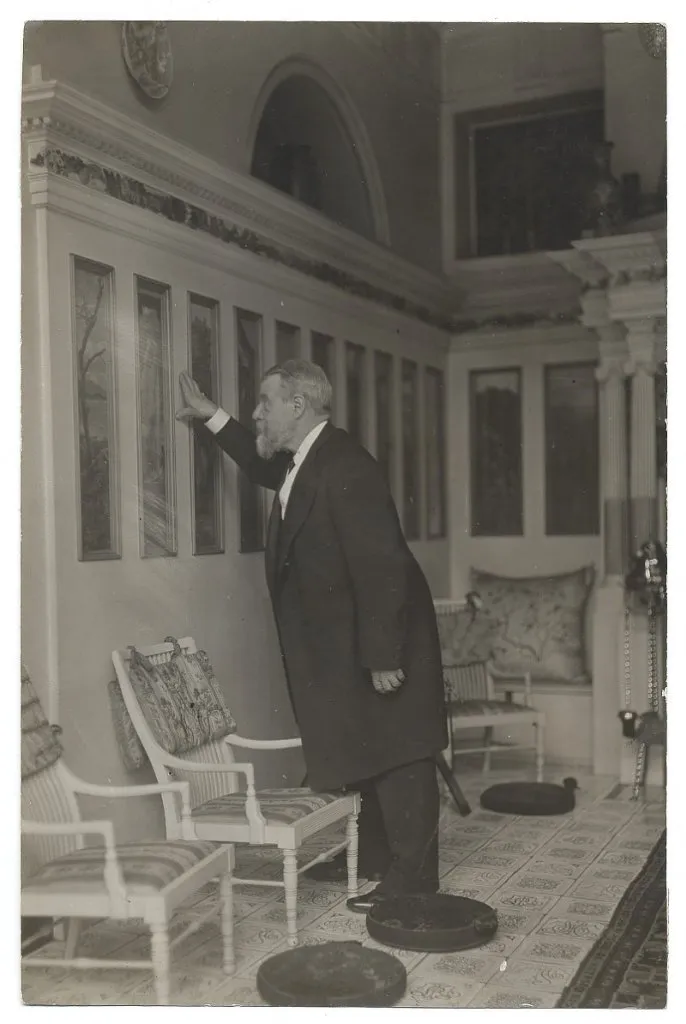
A photograph taken circa 1902 captures Lawrence standing in the Hall of Panels, his hand raised, gazing at Leighton's Bath of Psyche. It had been six years since Frederic Leighton's death, yet there he stood—contemplating the work of his departed friend. The inscription on the verso reads: "The picture at which he is looking is the one by Lord Leighton." It is an image of devotion frozen in time.
A Tale of Two Palaces
To understand their bond, one must walk through their homes. They were not merely houses; they were sanctuaries built against the ugliness of the industrial age.
In Holland Park, Frederic Leighton built his "Palace of the East." If you stand in the center of the Arab Hall, you can hear the rhythmic, hypnotic splash of the fountain against 15th-century Damascus tiles. The light is filtered through gold mosaics, creating a silence that feels sacred, almost tomb-like. Frederic Leighton was a solitary deity; his house was a temple with only one, small, hidden bedroom.
Then, there was Lawrence’s "Palace of Rome." It was louder, brighter, and lined with aluminum to catch the silver London light. While Leighton’s sanctuary was vertical—straining toward the lofty heights of Greek myth—Lawrence’s was tactile. He wanted to touch the stone, to smell the roses, to bring the ancients into the room as living, breathing neighbors.
The Great Exchange
In 1893, the two "Twin Gods" decided to formalize their connection through a "Great Exchange." It was a moment of profound mutual respect.
Lawrence gave Leighton In My Studio (Opus 310), a painting that captured the intimate, messy, beautiful reality of the Roman master’s working life. In return, Leighton presented him with the panel born from that dessert-knife joke—the vertical figure of Psyche that would stand guard at the entrance to Lawrence's studio.
By swapping these works, they were essentially opening portals between their two worlds. A guest in Leighton’s Silk Room could look at Lawrence’s canvas and feel the warmth of the red studio; a guest in Lawrence’s house could look at the Psyche panel and see into the ethereal Greek ideal.
The Shortest Peerage in History
Frederic Leighton was a man of firsts. Fluent in five languages, he could switch from French to German to Italian with the grace of a diplomat. He was the first (and remains the only) British artist to be elevated to the peerage.
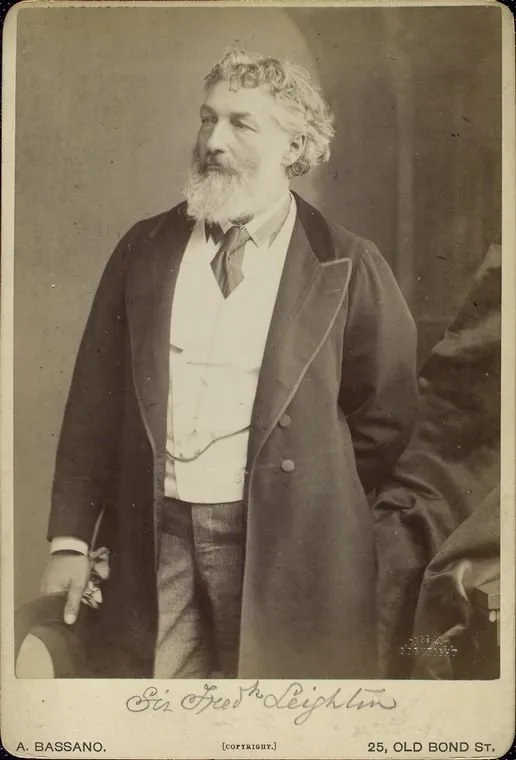
On January 24, 1896, Queen Victoria created him Baron Leighton of Stretton. But the "Prince of the Olympians" was already fading. He died the very next day. His peerage lasted for exactly twenty-four hours—the shortest in the history of the realm.
On his deathbed, surrounded by the gold and the silk of Holland Park, his final words were not about his wealth or his titles. He whispered: "My love to the Academy."
The Sun Goes Out
When Lawrence served as a pallbearer at Leighton’s funeral in St. Paul’s Cathedral, he felt a chill that no aluminum-lined studio could warm. He wrote to their mutual friend, George Henschel, with a rare, raw vulnerability:
"I have lost more than a friend; it is as if the sun has gone out of the sky."
Without Leighton’s commanding presence, Lawrence became the primary target for the rising tide of Modernists. The "Sanctuary" was no longer just a place of beauty; it had become a fortress under siege.
And yet, the marble remained. Today, when we look at their paintings, we see more than just classical reconstructions. We see a shared dream—a memory of two men who refused to accept the gray soot of London, and instead chose to build a world where the sun never truly sets.
Leave a Visiting Card
Consulting the visiting cards...