
Most artists have a studio. Tadema had a laboratory.
If you walked into his home on Grove End Road in the late 19th century, you would not just see paints and canvas. You would see shelves lined with measurement notebooks. You would see plaster casts of Roman busts. You would see stacks of photographs from Italian excavation sites, cabinets filled with ancient textiles, and drawers overflowing with architectural diagrams.
He was not just an artist. He was an archaeologist who happened to use a brush. And in his meticulous, obsessive quest for truth, he became the definitive classical painter of the Victorian era.
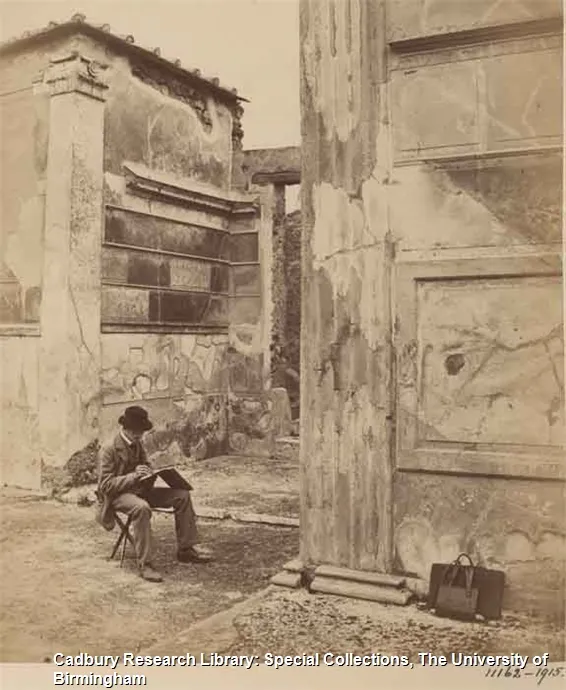
The Science of Beauty
To understand his work, you must understand his obsession.
When Alma-Tadema visited Pompeii, he didn't just admire the view. He got down on his knees. He measured the height of the columns. He traced the patterns of the mosaics. He studied the way sunlight hit the particular grain of Italian marble.
He believed that to paint a "classical" scene, you couldn't just dress a model in a bedsheet and put them in front of a white column. That was a lie. That was theater.
The truth required data.
You had to know how the toga was pinned (using a fibula, not a safety pin). You had to know what kind of silver cup they drank from (Cantharus or Kylix?). You had to know the architectural order of the temple in the background (Corinthian or Ionic?).
This rigor set him apart. While other artists painted vague visions of antiquity, Alma-Tadema painted reconstructed realities. He was a classical painter who worked with the precision of a civil engineer.
Tadema: The Marble Whisperer
This obsession is most visible in his stone.
Alma-Tadema is famous for his marble. He painted it better than anyone who has ever lived. But why?
Because he understood geology. He didn't just paint "white stuff." He painted the specific translucency of Carrara marble. He painted the way light penetrates the surface of the stone and bounces around before exiting (a phenomenon physicists call "subsurface scattering").
He knew that marble stains. He knew that steps get worn down in the middle where thousands of sandals have stepped.
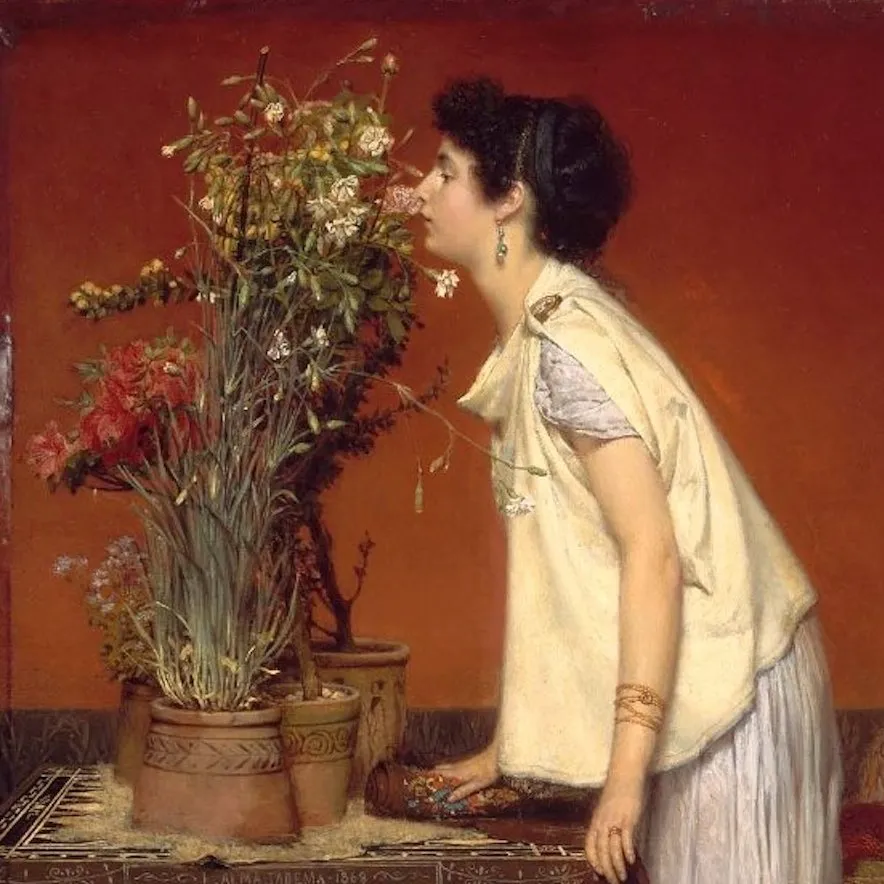
If you look closely at his painting The Roses of Heliogabalus, look at the marble floor in the background. You can feel the coldness of it. You can see the slight polish reflection. He achieved this by applying unmatched layers of glazing, building up the paint surface until it mimicked the polish of the stone itself.
The Library of Alexandria (in London)
His studio contained one of the greatest libraries on classical antiquity in the world.
He owned thousands of photographs of ruins. He had the complete excavation reports from Pompeii. He had books on Roman botany, Roman hairstyles, and Roman jewelry.
Before starting a painting, he would draft floor plans. He would calculate the lines of sight. He would ensure that if a figure was standing here, the shadow would fall exactly there based on the time of day and the latitude of Rome.
This wasn't just pedantry. It was a form of respect. He loved the ancient world too much to fake it.
Why It Matters
Why go to all this trouble? Why measure the ruins?
Because Alma-Tadema wanted you to feel like you were there.
He didn't want you to look at a picture of Rome; he wanted you to sit in it. He wanted you to feel the cool stone beneath your hand and smell the Mediterranean air.
By getting the facts right, he allowed the dream to feel real.
If the architecture was solid, if the light was accurate, if the costumes were correct, then the viewer could stop questioning the picture and simply inhabit it. He removed the barrier between the 19th century and the 1st century.
The Tadema Legacy in Hollywood
This "reality effect" was so powerful that it echo continued long after his death.
When Hollywood directors in the 20th century wanted to build Rome for movies like Ben-Hur, Cleopatra, and Gladiator, they didn't go to Rome. Rome was a ruin.
They went to the paintings of this classical painter.
They used his paintings as blueprints. The Rome we see in movies—the white city of colossal scale and shining grandeur—is Alma-Tadema's Rome. He proved that accuracy doesn't kill romance. In fact, if you look deep enough, the truth is the most beautiful thing of all.
Leave a Visiting Card
Consulting the visiting cards...