History often pivots on a single bullet.
In 1870, France declared war on Prussia. It was a foolish, disastrous decision that led to the collapse of the French Empire, the Siege of Paris, and a wave of violence that swept across the continent.
Brussels, where Lawrence lived, was technically neutral. But the chaos was too close for comfort. The sound of the cannons could almost be heard across the border. Lawrence, a widower with two small daughters, decided he couldn't risk it.
He packed his bags, took his children, and fled to London.
He thought it would be temporary. It turned out to be forever.
The Accidental Immigrant
If that war hadn't happened, the Tadema artist we know might have remained a continental painter. He might have stayed in Belgium, or moved to Paris like so many others.
London was an accident.
But accidents are often where innovation happens.
The Contrast of 1870
To understand the impact of his arrival, you have to look at the contrast.
In 1870, Paris was starving. The citizens were eating zoo animals during the Siege. The Commune would soon set the Louvre on fire. The center of the art world was burning.
London, by contrast, was stable. It was rich. It was peaceful. But it was also... dull.
British art in the 1860s was stuck. It was either "High Moral Narrative" (boring) or "Pre-Raphaelite Medievalism" (beautiful, but backward-looking). It needed a shock.
The Tadema artist provided that shock.
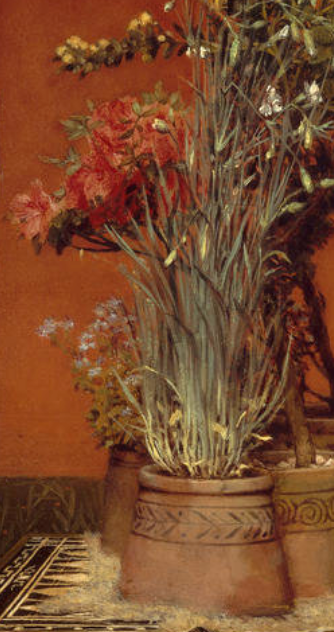
He arrived with a completely new style. It was Dutch realism applied to Roman subjects. It was sunny. It was secular. It didn't preach. It didn't try to teach you a moral lesson about Goodness or God. It simply said: "Look at this marble. Look at this blue sky. Isn't it wonderful to be alive?"
The Hunger for Light
The British public devoured it.
They were tired of heavy moralizing. They were tired of the gloomy weather. They looked at these paintings and saw a world they wanted to live in.
His "foreignness" actually helped him. Because he was an outsider, he wasn't bound by the strict rules of the British academy. He could paint what he wanted. He could be more sensual, more colorful, more daring.
The Legacy of the Refugee
It is strange to think that the most peaceful, sun-drenched paintings of the 19th century were the direct result of a violent war.
But chaos often pushes beauty to the surface. It pushed Lawrence across the Channel. It pushed him into the arms of the British public. And it proved that sometimes, the best thing that can happen to an artist—and to a country—is an open door.
The Tadema artist came as a refugee, but he stayed as a builder, constructing a shimmering city of marble in the heart of the London fog.