
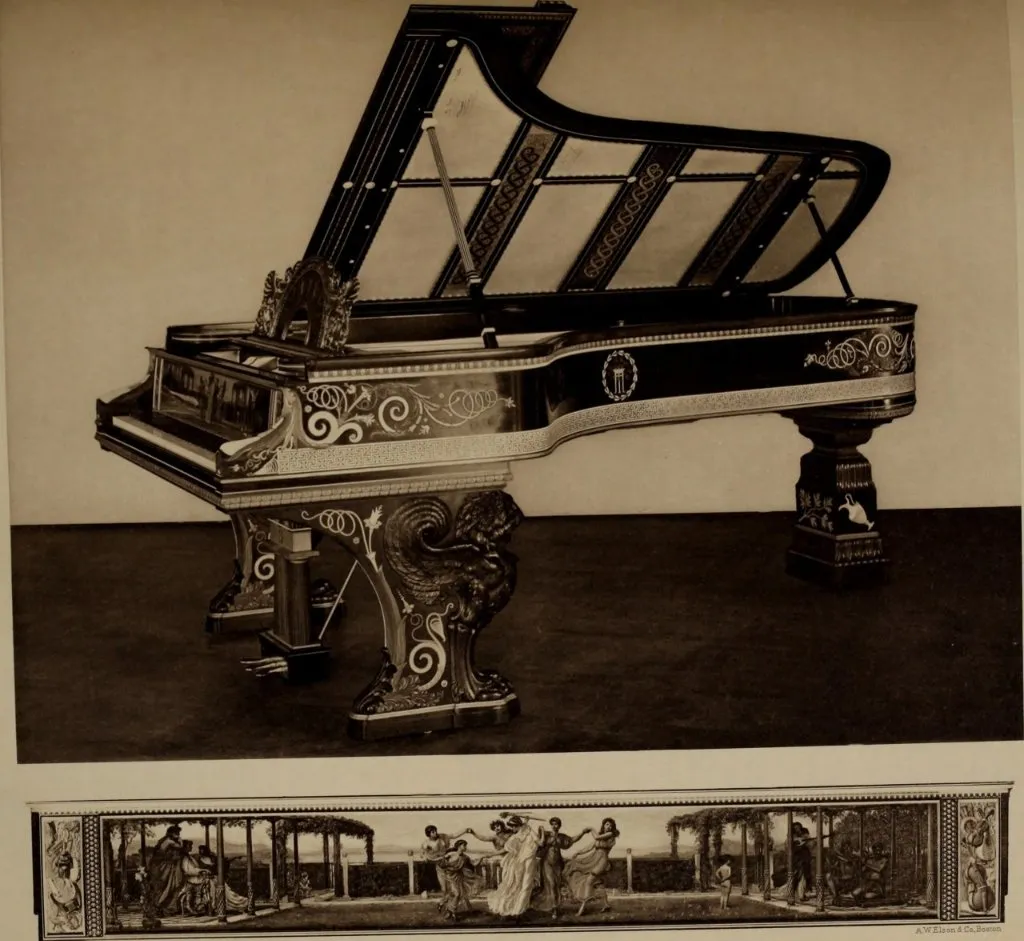
In 1884, Henry Gurdon Marquand committed an act of supreme audacity that would birth the legendary Alma-Tadema Steinway.
Marquand was a New York banker, a "Robber Baron" of the Gilded Age, and he was building a mansion on Fifth Avenue that was intended to silence his critics. He didn't just want luxury; he wanted immortality. To achieve it, he commissioned Sir Lawrence Alma-Tadema to design a "Greek Parlor" that would serve as the cultural heart of New York.
The centerpiece of this room was not a statue or a painting. It was a Steinway Model D Concert Grand Piano.
But this was no ordinary instrument. It would become the most expensive, the most elaborate, and eventually, the most lost piano in history.
The American Obsession
Why choose a Dutch painter living in London to design an American piano?
Because in 1884, Lawrence Alma-Tadema was not just an artist; he was a global brand. He was at the absolute zenith of his career. To owning a "Tadema" was the ultimate status symbol for the "New Money" elite of the Gilded Age. The Vanderbilts, the Carnegies, and the Walters all competed for his canvases.
His art—depicting a world of marble, luxury, and imperial power—perfectly mirrored how these American Robber Barons saw themselves. They were the new Romans, and Alma-Tadema was their court painter.
It is a historical irony that despite being the darling of Fifth Avenue, Alma-Tadema never visited America. He designed the entire Marquand Music Room, including this piano and the accompanying suite of furniture, from his studio in London. He conquered the New World without ever stepping off British soil.
The Design: An Altar to Apollo
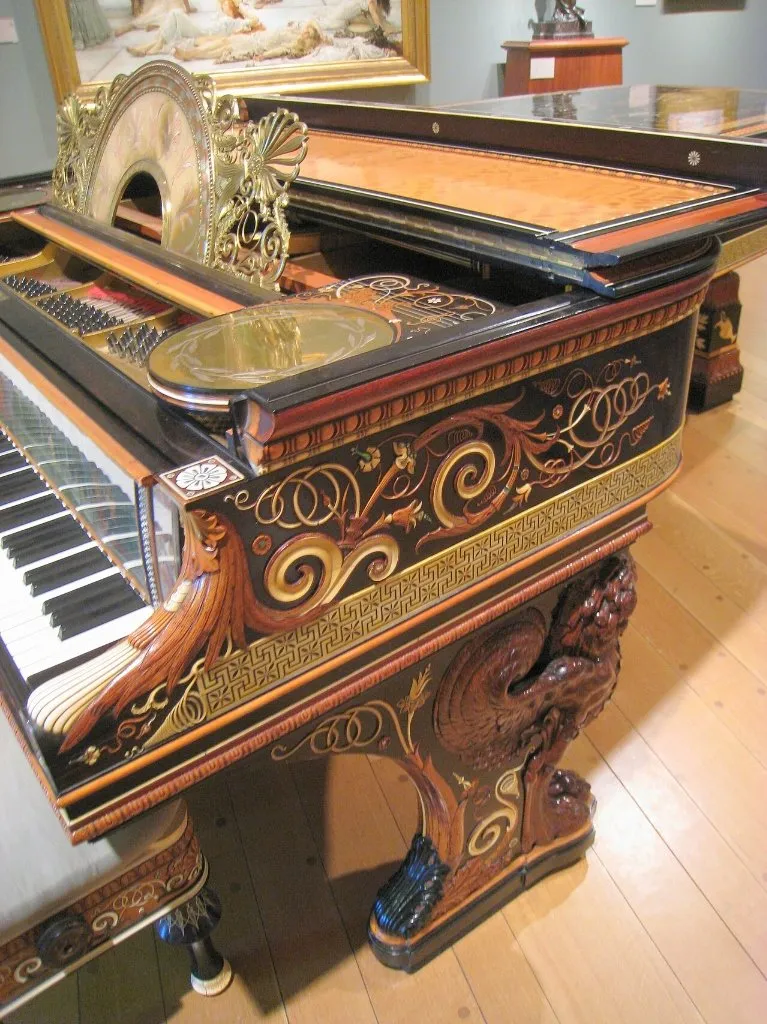
Alma-Tadema approached the commission with the obsession of an archaeologist. He refused to use standard Victorian mahogany. Instead, he demanded an exoskeleton of ebony, dark and lustrous, to serve as the background for a riot of color.
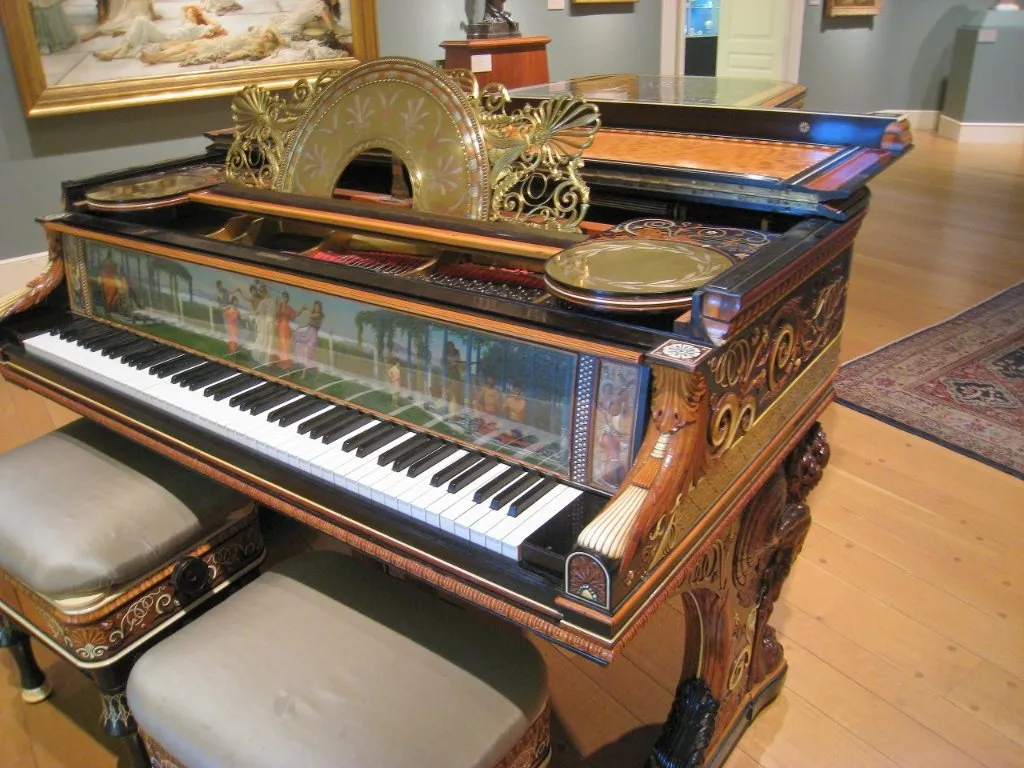
He didn't just sketch a design; he orchestrated a team of craftsmen in London to execute an inlay so complex it nearly bankrupted the timeline.
- The Materials: Thousands of pieces of mother-of-pearl, abalone, coral, and boxwood were cut by hand.
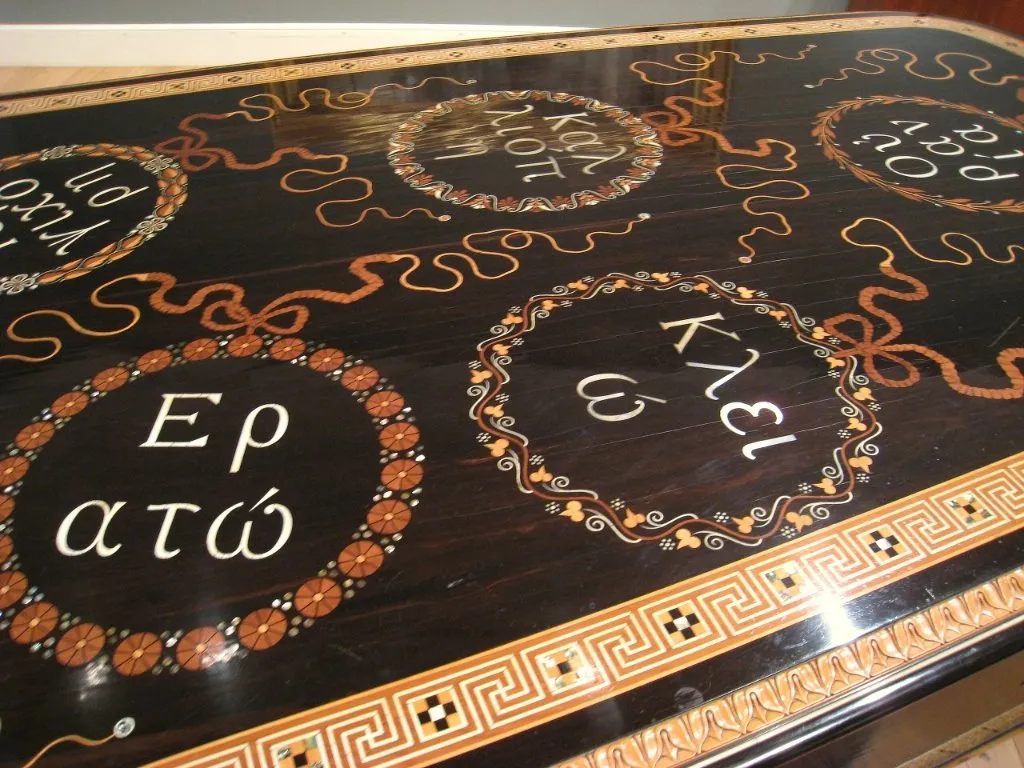
- The Iconography: This wasn't random decoration. It was a hymn to Music. The names of the nine Muses—Euterpe, Erato, Terpsichore—are inscribed in iridescent script across the case.
- The Legs: The standard piano legs were replaced by massive, carved lions, coated in silver and gold leaf, muscle-bound beasts holding the music aloft.
Inside the lid, where usually there is only black lacquer, Alma-Tadema commissioned Sir Edward Poynter to paint The Wandering Minstrels, a scene of ancient musicians playing by a Mediterranean sea, so that when the pianist lifted the lid, they were literally opening a window into the past.
The Lost Years: A Masterpiece in the Dark
When Marquand died in 1902, his collection was scattered. The piano, once the talk of London and New York, began a slow, tragic descent into obscurity.
It was purchased by a theater impresario and moved to the Martin Beck Theatre (now the Al Hirschfeld Theatre) in New York City.
For decades, this million-dollar masterpiece sat in the mezzanine lobby. It was not treated as a holy relic. It was a piece of furniture.
- Decades of cigarette smoke coated the mother-of-pearl in a layer of yellow grime.
- Layers of cheap varnish were applied over the intricate inlay to "spruce it up," suffocating the coral and ivory.
- Theatergoers rested their gin and tonics on the lid during intermission, unaware that their glasses were sweating rings onto a priceless Edward Poynter painting.
The "Alma-Tadema Steinway" had become a ghost, hiding in plain sight on 45th Street, dismissed as just another gaudy prop from a bygone era.
The Resurrection
In 1980, the piano came up for auction at Sotheby's. Steinway & Sons bought it back.
How did they know what it was underneath the grime? The secret was stamped on the iron frame: Serial Number 54,538.
Steinway keeps a "Bible"—a ledger of every instrument ever built. When they checked the number in their archives, the entry for 1884 was clear: this was the legendary Marquand Art Case. They rescued their own lost child.
They began a restoration process that was as grueling as the original construction. Conservators spent months carefully peeling away the layers of darkened varnish. As they worked, the blackened wood began to gleam. The dull grey inlay suddenly caught the light and flared with the iridescent pinks and greens of the abalone.
The "Greek Parlor" came back to life.
The Record-Breaking Hammer
On November 7, 1997, a gray autumn day in London, the restored piano was brought to Christie's.
The Art World was skeptical. Victorian art was still considered "kitsch" by many modernists. A piano covered in lions and coral? It sounded absurd.
But when the lot opened, the absurdity vanished. Under the auction house lights, the sheer craftsmanship commanded silence.
Bidding was fierce. When the gavel finally fell, the price was $1.2 million. It shattered the world record for a musical instrument. It sold for more than Mozart's piano. It sold for more than John Lennon's Steinway.
The Legacy
The winning bidder was the Sterling and Francine Clark Art Institute in Williamstown, Massachusetts.
Who is "The Clark"? It is one of America's finest museums, founded by Sterling Clark, an heir to the Singer Sewing Machine fortune. While the rest of the world was mocking Victorian art in the mid-20th century, Clark was quietly collecting it. He already owned Tadema's masterpiece The Women of Amphissa.
Buying the piano was a homecoming.
Today, the Alma-Tadema Steinway sits in the Clark's galleries, often displayed alongside the paintings it was designed to complement. It stands as the ultimate proof of Lawrence Alma-Tadema's genius. He was not just a painter of canvases. He was a designer who believed that every object—from a chair to a grand piano—should be vivid, beautiful, and absolutely perfect. He didn't just paint the dream; he built it.
The Piano in Action
To see the instrument is one thing. To hear it is another.
For decades, the keys were silent. The music was trapped inside the ebony and the mother-of-pearl, waiting for a touch that wouldn't damage the history.
Then, in 2017, the silence broke.
During a special exhibition at the Clark Art Institute, the pianist Jeewon Park sat down at the bench. She began to play Chopin.
Listen closely.
This is not just a performance. It is a resurrection.
For a few minutes, the modern gallery fades away. We are back in the Marquand Music Room on a winter night in 1888. The gaslights are warm. The silk dresses rustle. The Gilded Age is not a chapter in a history book; it is a living, breathing sound in the room.
The voice of the piano is finally awake.
section_order: 2 # Note: append might be messy if its in the middle, but Ill fix frontmatter properly.
Leave a Visiting Card
Consulting the visiting cards...