
In 1879, Alma Tadema did something new.
He had painted emperors. He had painted sculptors. He had painted his own family. But he had never painted a musician—not as a formal portrait, not as a subject worthy of an opus number.
Then he met George Henschel.
Henschel was twenty-nine years old. He was German, he was brilliant, and he was taking London by storm. He burst into the quiet, marble world of Alma Tadema with a force of personality that was irresistible.
He was the first. The first of the nine musical portraits that would eventually be created in that studio.
This is how the music began.
George Henschel and Alma Tadema
To be a friend of Alma Tadema, you had to be exceptional. Henschel was arguably the most versatile musician of the nineteenth century.
He was a baritone who sang to packed concert halls. He was a pianist who could accompany himself perfectly. He was a conductor who would go on to found the London Symphony Orchestra and lead the Boston Symphony Orchestra.
He could do everything. And he did it with a warmth and modesty that endeared him to everyone.
At Casa Tadema, Henschel wasn't just a guest; he was a catalyst. He brought energy. The artist, who loved the "sister art" of music but couldn't create it himself, found in Henschel a perfect counterpart.
They became close friends. They shared a love for the German Romantic tradition—Schumann, Brahms, Mendelssohn. And on those famous Tuesday evenings, it was often Henschel at the piano, filling the studio with song.
The First Portrait by Alma Tadema
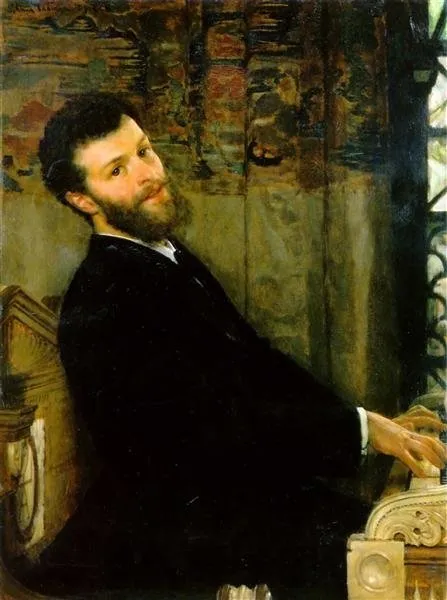
The portrait (Opus 202) is a study in active listening.
Alma Tadema didn't paint Henschel posing stiffly. He painted him doing.
Henschel sits at the piano, his hands resting on the keys or perhaps just finished playing. His body is turned slightly, as if he is about to speak—or sing. The sheet music is open before him.
The inscription on the painting reveals the depth of their bond. Alma Tadema wrote: "To the friend George Henschel."
It wasn't a commission. It was a gift.
By painting him, Alma Tadema was making a statement: This man belongs in the catalogue of my life's work. This music is as permanent as my marble.
What Alma Tadema Saw in Him
Why did Alma Tadema choose him as the first?
Perhaps because Henschel embodied the "Casa Tadema" spirit: excellence without pretension.
There is a famous story about Henschel and Johannes Brahms. Once, before a concert, Brahms realized he was missing a collar stud. Henschel immediately took off his own and gave it to the great composer, using a piece of string to tie his own collar.
Brahms was so touched he nearly cried.
That was Henschel. Generous. Practical. Unconcerned with dignity, deeply concerned with friendship.
The painter saw this. In the portrait, Henschel looks approachable. He doesn't look like a "Maestro." He looks like a man you would want to spend an evening with.
He looks like a friend.
The Legacy of the Friendship
Henschel's connection to Alma Tadema didn't end with the portrait.
Even when Henschel moved to America to become the first conductor of the Boston Symphony Orchestra, the friendship survived the Atlantic. They exchanged frequent letters. In November 1897, Alma Tadema wrote to his friend: "You are with us at every meal as your portrait hangs in our dining room."
The painting was not just art; it was presence.
Years later, when Alma Tadema's beloved wife Laura died in 1909, Henschel sent a wreath to decorate her portrait. Alma Tadema wrote back, sharing the heartbreak of "sorting his wife's things." They were friends in triumph and friends in tragedy.
And when the mysterious portrait of Jules de Soria (Opus 288) went up for sale, it was George Henschel who bought it. He understood the value of that "lost" painting because he lived in the world that created it.
He survived Alma Tadema by many years, living until 1934. He even recorded his voice in his seventies—one of the few singers from that golden age to leave us a recording.
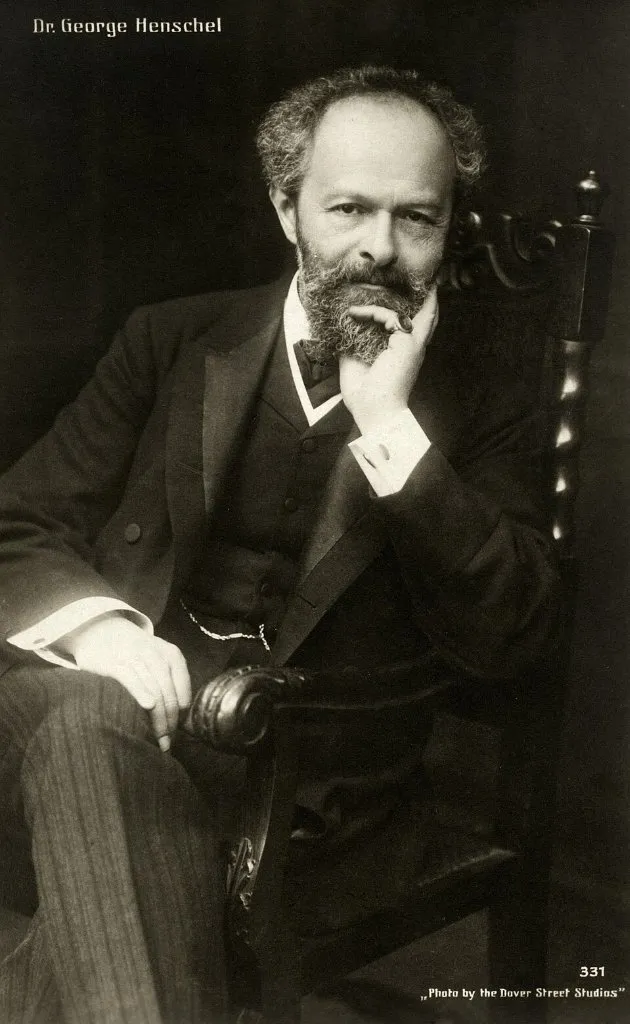
And you can hear him.
This is Henschel in 1913, singing Schumann's "Ich grolle nicht" (I bear no grudge). He was sixty-three years old—thirty-four years after Alma Tadema painted him at the piano.
Listen to the warmth. The control. The generosity of spirit that Brahms loved. This is the voice that filled the studio at St. John's Wood.
But his most lasting image remains the one painted in 1879.
The young man at the piano. The friend. The singing conductor who opened the door for all the musicians who would follow him up that golden staircase.
Leave a Visiting Card
Consulting the visiting cards...