
The golden staircase gleamed in the house of Alma Tadema. Ignacy Jan Paderewski climbed slowly, taking in the burnished brass, the exotic scents, the sense of stepping into another world.
At the top, Alma Tadema waited—warm smile, paint-stained hands.
The studio beyond was vast, filled with silvery light reflecting from the aluminum vaulted ceiling. This was where the portrait would be painted. But first, there was music to make.
It was 1890. Paderewski was thirty years old, and he was on the cusp of international superstardom.
During his first tour of England, he had already performed for Queen Victoria, but inside Casa Tadema, the roar of the crowd faded. There was only the piano, the painter, and the quiet recognition of one artist by another.
The Panic and the Poet
To understand this portrait, you must understand the year 1891.
In London, they called it "Paddymania."
Paderewski had taken the city by storm. Women fainted at his concerts. Crowds rushed the stage to touch his coattails. Critics raved about his "golden hair like a halo" and his "eyes full of dreams." He was the first modern superstar, a Romantic hero who looked exactly like a poet was supposed to look.
But beneath the halo was a man of steel.
He practiced seventeen hours a day. He had lost his young wife years earlier. He carried a deep, melancholy patriotism for his homeland, Poland, which had been erased from the map of Europe.
He wasn't just a pretty face. He was a force of nature. Queen Victoria heard him play and wrote in her diary: "He plays with such power, and such tender feeling... I really think he is quite equal to Rubinstein."
And yet, amidst this whirlwind of fame and noise, he found a quiet refuge.
He found Casa Tadema.
The Restless Sitting
Alma Tadema loved music. He didn't just enjoy it; he needed it. His home was built for sound as much as for sight.
In July 1891, the heat of the London summer was tempered by the thick marble walls of Casa Tadema. Inside the studio, a scene of polite chaos unfolded—a performance of a different kind.
Princess Louise, the daughter of Queen Victoria, sat at one easel. Lawrence Alma-Tadema sat at another. His wife, Laura—or perhaps his daughter Anna—occupied a third.
In the center stood Paderewski, being painted by three (and possibly four) people simultaneously. "Each one was constantly begging me to turn his way," he would later recall. "It was an amazing ordeal... it was not sitting, it was moving all the time."
Yet, through this restless dance of gazes, Lawrence captured the stillness at the heart of the storm.
Opus 311: Alma Tadema's Portrait
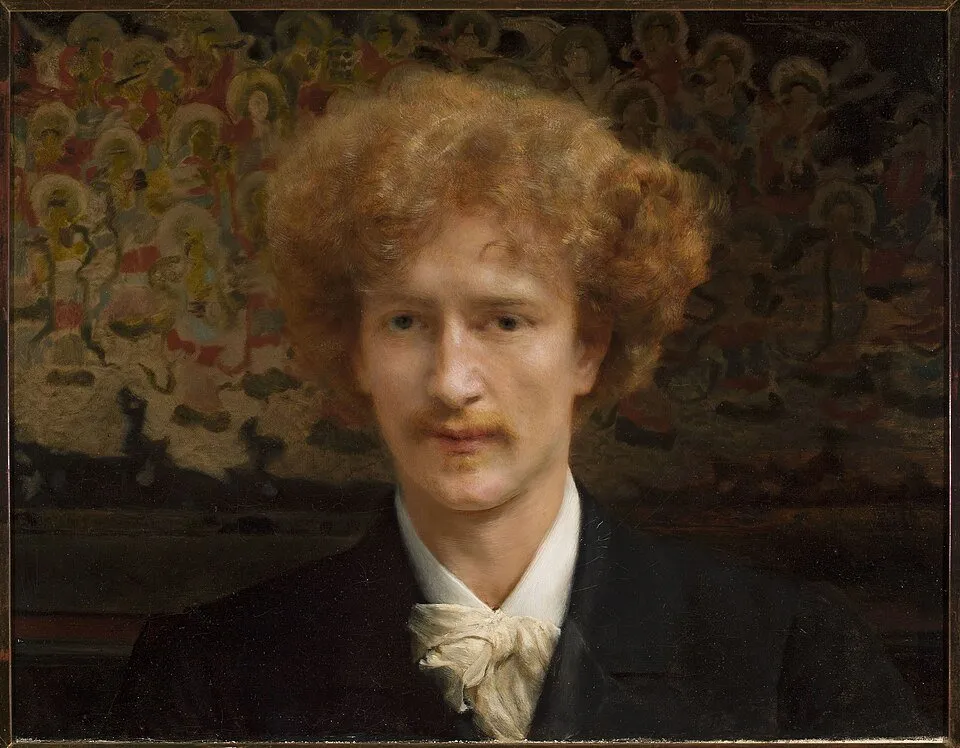
The portrait Alma Tadema painted (Opus 311) is unlike the public images of Paderewski.
He painted Paderewski staring straight ahead. Intense. Serious. Almost confronting the viewer.
Behind that "storm of rusty curls" is not merely a dark space, but a window into a different paradise. It is a six-fold Japanese temple screen, a 14th-century treasure from Alma-Tadema’s collection, depicting Buddha and the twenty-seven singers and dancers of heaven.
In the studio, this screen hung in a vaulted niche—an "apse" of art—directly behind the famous piano. When Paderewski played, he played against the golden shadows of what some contemporary critics called the "Genii of Music." They whispered that these were not just decorations, but the very spirits of harmony emerging, in allegory, from the pianist’s brain.
It captures the look of a musician listening to the silence before the first note. Or perhaps the silence after the last one.
Alma Tadema numbered it Opus 311. He gave his paintings opus numbers, just as composers gave numbers to their musical works. In painting Paderewski, he was acknowledging a colleague. A fellow creator.
"I paint with brushes," the portrait seems to say. "You paint with sound. We are brothers."
The Archangel and the Dreamer
Alma-Tadema was not the only artist in London caught in the "Paddymania" storm. A year earlier, Edward Burne-Jones had seen Paderewski in a London street and was so struck by his appearance that he ran home to draw him from memory, exclaiming that he had seen an "archangel."
Where Burne-Jones saw a celestial being in profile—spiritual, distant, and pure—Alma-Tadema saw a man.
In Opus 311, the pianist is not a distant saint; he is a dreamer who has just been woken. His face holds a touch of "irony," a flicker of intensity that the modern viewer might recognize as the look of a celebrity navigating the strange "false intimacy" of fame. While Burne-Jones captured the myth of the musician, Alma-Tadema captured the presence of the friend.
The Shared Passion: Japonisme
To the modern eye, the choice of a Japanese backdrop might seem like a mere decorative whim. But for Alma Tadema and Paderewski, it was a shared language.
Alma Tadema was a connoisseur and a pioneer of Japonisme in England. His fascination with Japanese art began as early as 1862, and by 1892, he would become a charter member of the Japan Society in London, eventually rising to Vice President.
Paderewski was equally captivated. During his relentless global tours, he amassed a rich collection of East Asian art, much of which he eventually bequeathed to the National Museum in Warsaw—the same institution that today guards this portrait.
When Paderewski sat in the "apse" of the studio, he was surrounded by the items both men cherished. It was a meeting of collectors as much as artists.
The Princess and the Prime Minister
The portrait has a curious history. Alma Tadema didn't keep it. He didn't sell it to a gallery.
Alma Tadema gave it to Princess Louise, the daughter of Queen Victoria.
Princess Louise was an artist herself (a sculptor) and a frequent guest at Casa Tadema. She was also a talented pianist who deeply admired Ignacy Jan Paderewski. Giving her the portrait of the man they all admired was a gesture of supreme friendship—and perhaps a shared secret. A memory of the music they had heard together in that studio.
But the story of the sitter was far from over.
Twenty-eight years later, the world broke apart in World War I. Empires fell. And from the wreckage, Poland rose again.
The man to lead it was not a general. Not a politician.
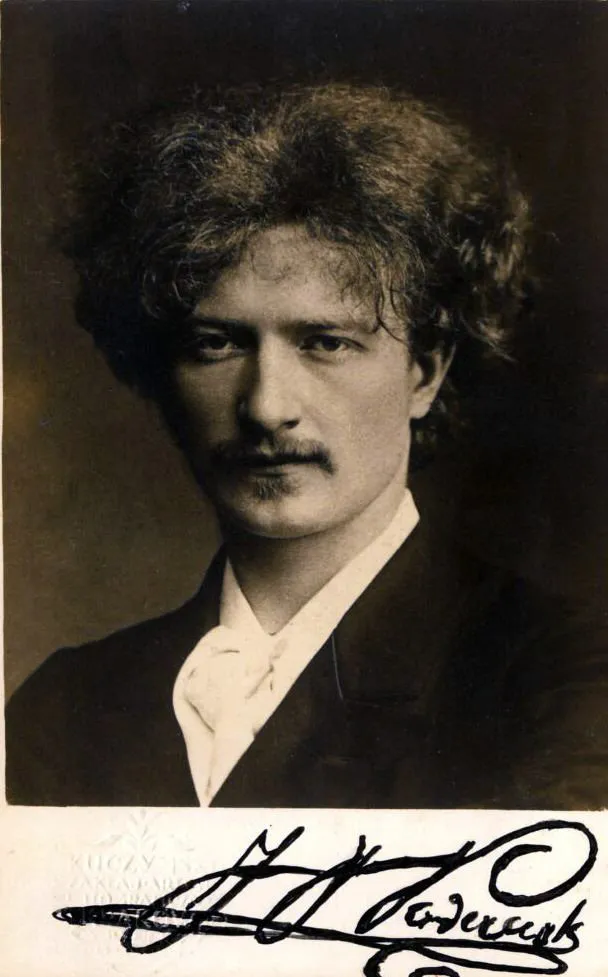
It was Ignacy Jan Paderewski.
In 1919, the pianist became the Prime Minister of Poland. He signed the Treaty of Versailles. He used his fame, his eloquence, and his "golden hair" to win freedom for his country.
Alma Tadema did not live to see it (he died in 1912). But looking at Opus 311 now, you can almost see the statesman in the musician's eyes. The steel beneath the poetry. The resolve that would one day rebuild a nation.
What Alma Tadema Saw
Why does this matter?
Because it reminds us that art is not frivolous.
To the Victorian crowds, Paderewski was a sensation, a crush, a fad. But Alma Tadema saw the depth. He saw the discipline. He saw the fire that would eventually lead a country.
He invited this young man into his sanctuary, away from the screaming fans, and gave him a place to just be. To be an artist among artists.
That is what a sanctuary does. It sees the truth in people. It gives them space to breathe.
Today, we are surrounded by our own versions of "Paddymania"—viral stars, fleeting fame, constant noise. We rarely stop to look into the eyes of the people behind the images.
But we can look at Opus 311 and meet Ignacy Jan Paderewski.
We can see the golden-haired young man, frozen in a moment of quiet intensity. We can imagine the last chord of Chopin fading in the studio air.
And we can remember that beauty, whether made of paint or sound, is serious business.
It can change a room. It can build a friendship.
And sometimes, it can even change the world.
The Man, Alive
Forty-six years after Alma Tadema painted him, Paderewski appeared in a 1937 film, playing his famous "Menuet in G" while dancers moved to his music.
This is the same man. The golden-haired pianist who climbed the brass staircase in 1891, now an elder statesman, still playing.
Watch his hands. Listen to the rhythm. This is not a recording. This is a window into 1891, kept alive in motion and sound.
Leave a Visiting Card
Consulting the visiting cards...