There are violinists who play with fire. But Alma Tadema was drawn to the one who played with truth: Joseph Joachim.
He was the "high priest" of the violin. The man Johannes Brahms trusted above all others. The man who wrote the cadenzas for the Beethoven concerto that are still played today.
When he walked into the studio of Alma Tadema, he brought with him a lifetime of history. He had known Mendelssohn. He had known Schumann. He was a living link to the greatest era of German music.
And Alma Tadema knew exactly how to paint him.
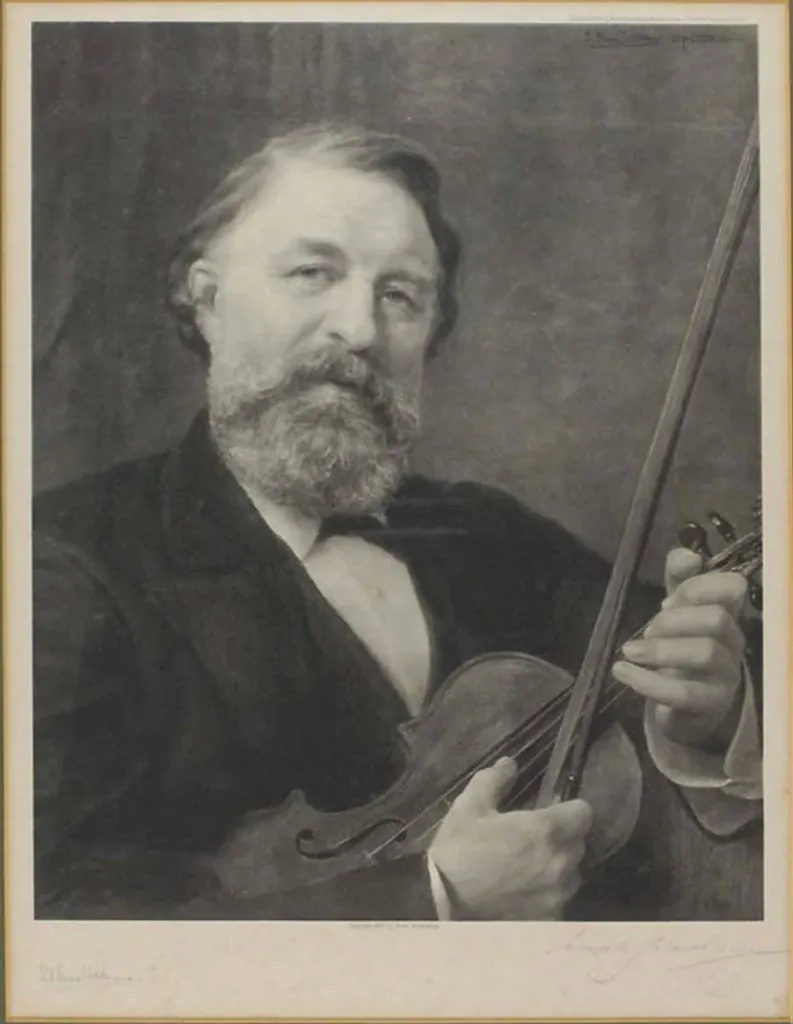
He didn't paint the virtuoso. He painted the thinker.
When Alma Tadema Met the High Priest
To call Joachim a "violinist" is like calling Alma Tadema a "decorator." It misses the point.
Joachim was an intellectual. He read history, philosophy, and poetry. He could discuss Goethe as easily as he could discuss a violin string. A friend described his secret as "the listening soul"—he didn't just hear the notes; he heard the ideas behind them.
This appealed deeply to Alma Tadema.
The painter was also an intellectual artist. He researched every Roman coin, every inscription, every fold of toga. He believed that art should be true, not just pretty.
At the Tuesday gatherings, Joachim was a revered guest. He wasn't the "life of the party" like the exuberant Henschel. He was the sage.
Imagine him sitting on the marble bench, his white beard flowing, listening to a young pianist with that intense, critical, kindly attention. That is the moment the artist wanted to capture.
The Portrait: Alma Tadema's Vision
In 1893, when Joachim was sixty-two, Alma Tadema painted him (Opus 318). By then, Joachim was a living legend. He was the founding Director of the Berlin Hochschule (Royal Academy of Music), the leader of the world’s most famous quartet, and arguably the most respected musician in Europe.
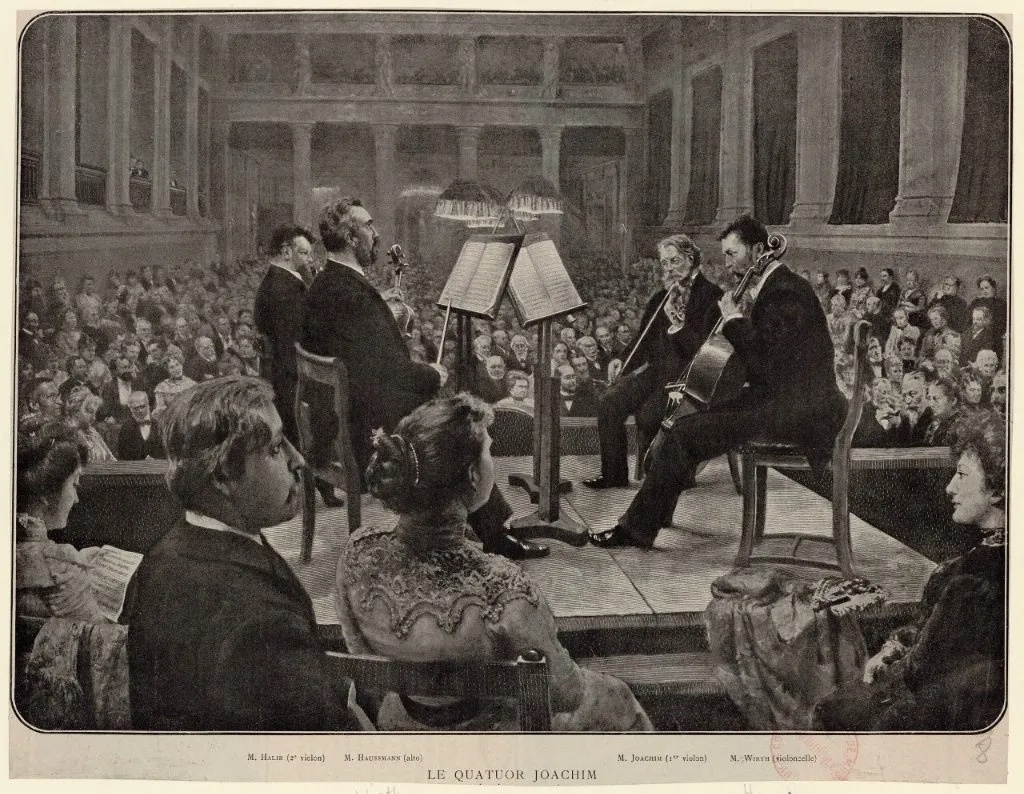
This was almost certainly not a commercial commission. It was a tribute. A recognition of one master by another.
It is a portrait of quiet authority.
Joachim stands holding his violin, but he is not playing. He is looking out at us with eyes that have seen everything. He looks momentous. Solid. Like a statue of a prophet that has come to life.
By painting him this way, Alma Tadema was making a statement about music.
He was saying that the violin is not just a toy for entertainment. It is an instrument of thought. And the man holding it is not just a performer. He is a philosopher.
The Brahms Connection
You cannot speak of Joachim without speaking of Brahms. And you cannot speak of Alma Tadema without speaking of friendship.
Joachim was the man for whom Brahms wrote his only Violin Concerto. He didn't just play it; he helped write it. He advised on the technique, he argued about the bowing, he wrote the cadenza. They were partners.
This resonated with Alma Tadema. He understood collaboration. He often invited friends to paint small details in his own pictures, or painted backgrounds for theirs. He saw art not as a lonely mountain, but as a conversation.
When Joachim played Brahms in the studio at St. John's Wood, he wasn't just performing notes. He was performing a friendship. He was bringing the spirit of the composer into the room.
For Alma Tadema, capturing Joachim was a way of capturing that entire world—the world of German Romanticism, of deep loyalty, of art created between friends.
Hearing the Friendship
And you can hear that friendship.
In 1903, Joachim recorded Brahms' Hungarian Dance No. 1—a piece he had arranged himself. Brahms had died six years earlier. Joachim was seventy-two, playing his dead friend's music.
Listen to the fire beneath the control. The passion beneath the intellect. This is what Alma Tadema heard in the studio—not just technique, but a friendship made audible.
A Day in the Life of Joachim
To understand the energy of the man Alma Tadema painted, consider a single day in Joachim's life in London.
One Monday, he rehearsed for two hours in the morning. Then he played a full concert at St. James's Hall. Then he walked to a dinner party, where he led two string quartets for the guests. Then, not finished, he drove to an embassy reception and performed again.
He was inexhaustible. Not because he had endless physical energy, but because he was fed by the music.
Alma Tadema understood this obsession. He, too, worked tirelessly, often painting until the light failed, fueled by an absolute belief in the importance of beauty.
They were brothers in work.
What Alma Tadema Captured
The portrait of Joachim is one of the most respectful images in the entire Opus catalogue.
It is not flashy. It is not dramatic. It is respectful.
It captures the dignity of a man who has spent fifty years serving the highest art. It connects the "frozen music" of Alma Tadema's architecture with the "liquid architecture" of Joachim's Bach.
Today, looking at Opus 318, we don't hear sound. We encounter silence.
But it is a pregnant silence. The silence of a great mind listening. The silence of the "listening soul" that Alma Tadema saw and preserved for us.
The Listening Soul, Speaking
But we can break that silence.
In 1903, ten years after Alma Tadema painted him, Joachim walked into a recording studio in Berlin. He was seventy-two years old. He picked up his violin and played Bach.
This is what you hear:
Listen to the phrasing. The restraint. The way he lets each note breathe. This is not virtuosity for show. This is thought made audible.
This is the "listening soul" that Alma Tadema saw.
Leave a Visiting Card
Consulting the visiting cards...