
The murder was done. Geta was dead, stabbed in his mother's arms. The floor of the palace had been scrubbed clean.
But Caracalla had a problem. You can wipe blood off marble, but you cannot wipe the memory of fratricide from the minds of the Roman people. He was now the sole Emperor, but he was also a monster. He needed a way to buy their love, or at least their silence.
He didn't choose a war. He chose architecture.
In the second act of the Alma Tadema Caracalla trilogy, we explore the greatest "apology gift" in history: the Thermae Antoninianae.
The Alma Tadema Caracalla Palace
In 212 AD, just months after the murder, construction began on a complex so vast it defies modern comprehension. The Baths of Caracalla were not just a swimming pool; they were a cathedral of leisure.
Covering 25 hectares, the complex could hold 1,600 bathers at once. It had libraries (one Greek, one Latin), gyms, gardens, art galleries, and shops. The walls were covered in miles of marble; the floors were paved with mosaics of athletes and sea monsters.
And the genius of it? It was free.
Any Roman citizen, no matter how poor, could walk through these bronze doors and live like an Emperor for an afternoon. It was the ultimate distraction. Who cares about a dead brother when you are soaking in warm water surrounded by porphyry columns?
The Alma Tadema Caracalla Triptych
But in the Alma Tadema Caracalla process, the artist wasn't interested in romantic ruins. He wanted the reality. And reality looked like this.
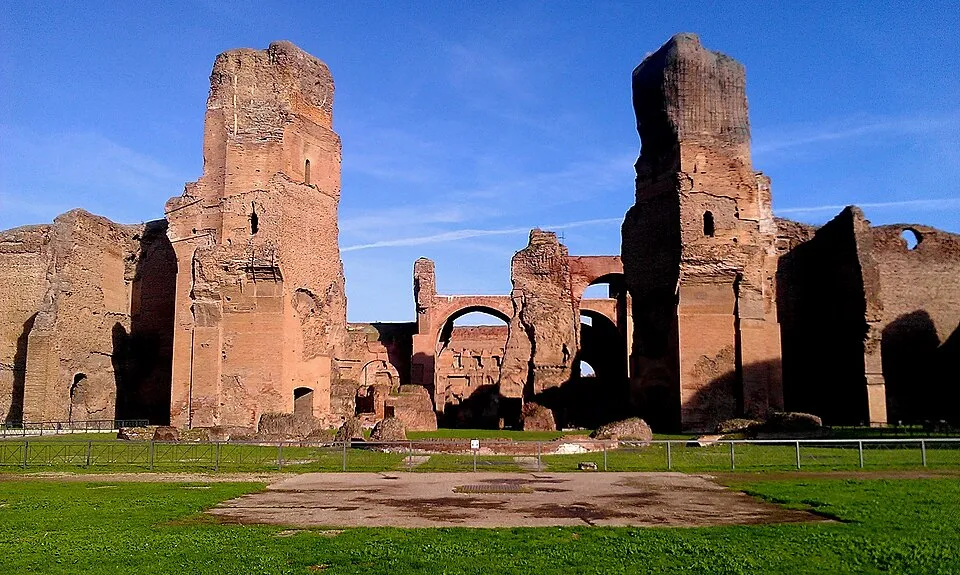
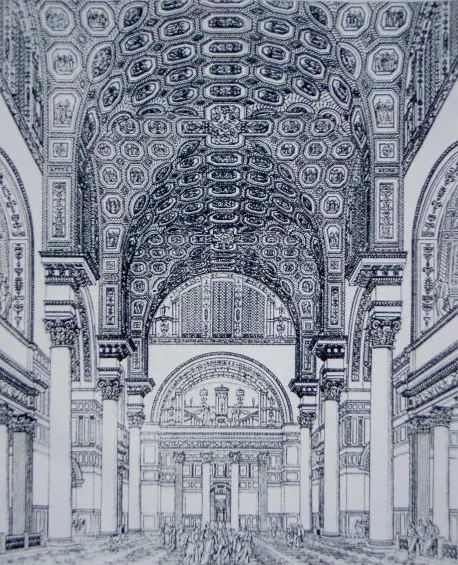
He looked at the stripped brick skeleton of the Frigidarium, knowing that underneath the decay lay the ghost of a masterpiece. He studied the latest archaeological reconstructions to understand the original scale.
He didn't just paint a Alma Tadema Caracalla background; he performed a forensic reconstruction with paint. He took the grey skull of the ruin and put the flesh back on its face.
The Painting: A Refined Dream
In The Baths of Caracalla (Opus 356), painted in 1899, Tadema takes us inside the vast Frigidarium (the cold room).
The perspective is deliberately dwarfing. In the foreground, a massive grey granite column dominates the composition, emphasizing the crushing scale of the imperial architecture. We are small; the Emperor's building is huge.
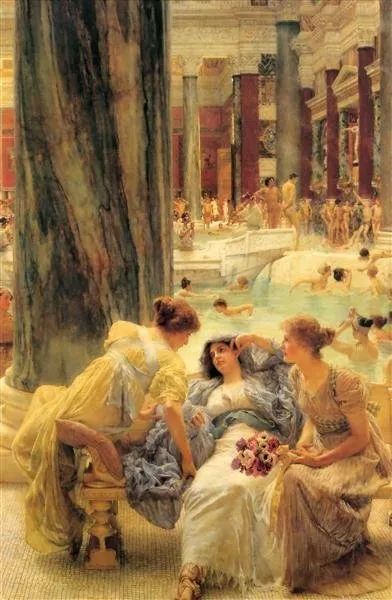
But look at the people.
In the foreground, three women are chatting. They aren't discussing politics or murder. They are gossiping, fixing their hair, adjusting their robes. In the background, swimmers are splashing in the pool. It is a scene of utter banality.
This is the Architecture of Distraction working perfectly. The people are happy. They are clean. They are entertained. The massive marble walls have successfully walled out the reality of the tyrant who built them.
The Invisible Blood
This is the irony that makes the Alma Tadema Caracalla narrative so dark.
We know, as viewers, that this beauty was paid for by the massacre of Geta and 20,000 of his supporters. We know that while these women chat, the Praetorian Guard is purging the Senate. We know that the water in that pool is metaphorically turned to wine—or blood.
But in the painting, the sun shines. The marble gleams. The distraction is complete.
The Alma Tadema Caracalla lesson is simple: You can kill anyone you want, as long as you give the people somewhere beautiful to wash.
In Act III, the Triptych concludes. The distraction fails, the marble cannot protect him, and the Emperor meets the only fate a monster can: The Flowers and the Knife.
Leave a Visiting Card
Consulting the visiting cards...