
We tend to think of the Roman Empire as a structure made of stone. But in the Alma Tadema Caracalla paintings, the Empire is something much more fragile. It is made of blood.
In 203 AD, the entire stability of the civilized world rested on a single, terrifying question: Can these two brothers sit in a room without killing each other?
This is the story of the most dysfunctional family in Roman history, and the painting that captured the exact moment their world began to crack.
The "Succession" of the Severans
To understand the tension in the Alma Tadema Caracalla masterpiece (Opus 382), you first have to understand the family dinner table.
The father was Septimius Severus, the "African Emperor." Born in Libya, he was a hard, pragmatic soldier who had seized the throne through civil war. He was a man who believed in force. On his deathbed, he would famously give his two sons only three pieces of advice: "Be harmonious, enrich the soldiers, and scorn all other men."
They would follow the last two instructions perfectly. They would fail the first one immediately.
His sons were Caracalla (the elder) and Geta (the younger). They didn't just dislike each other; they possessed a chemical, biological hatred that baffled even their contemporaries. The Roman historian Cassius Dio records that they argued over everything—quails, cocks, wrestling matches. As they grew older, the arguments turned into factions. Rome itself began to split, with senators, soldiers, and servants forced to pick a side: Team Caracalla or Team Geta.
By 203 AD, the year of our scene, the situation was critical. Septimius Severus, trying to force unity, had just elevated the younger Geta to the rank of "Augustus." It was meant to be a gesture of equality.
To Caracalla, it was a declaration of war.
The Alma Tadema Caracalla Arena
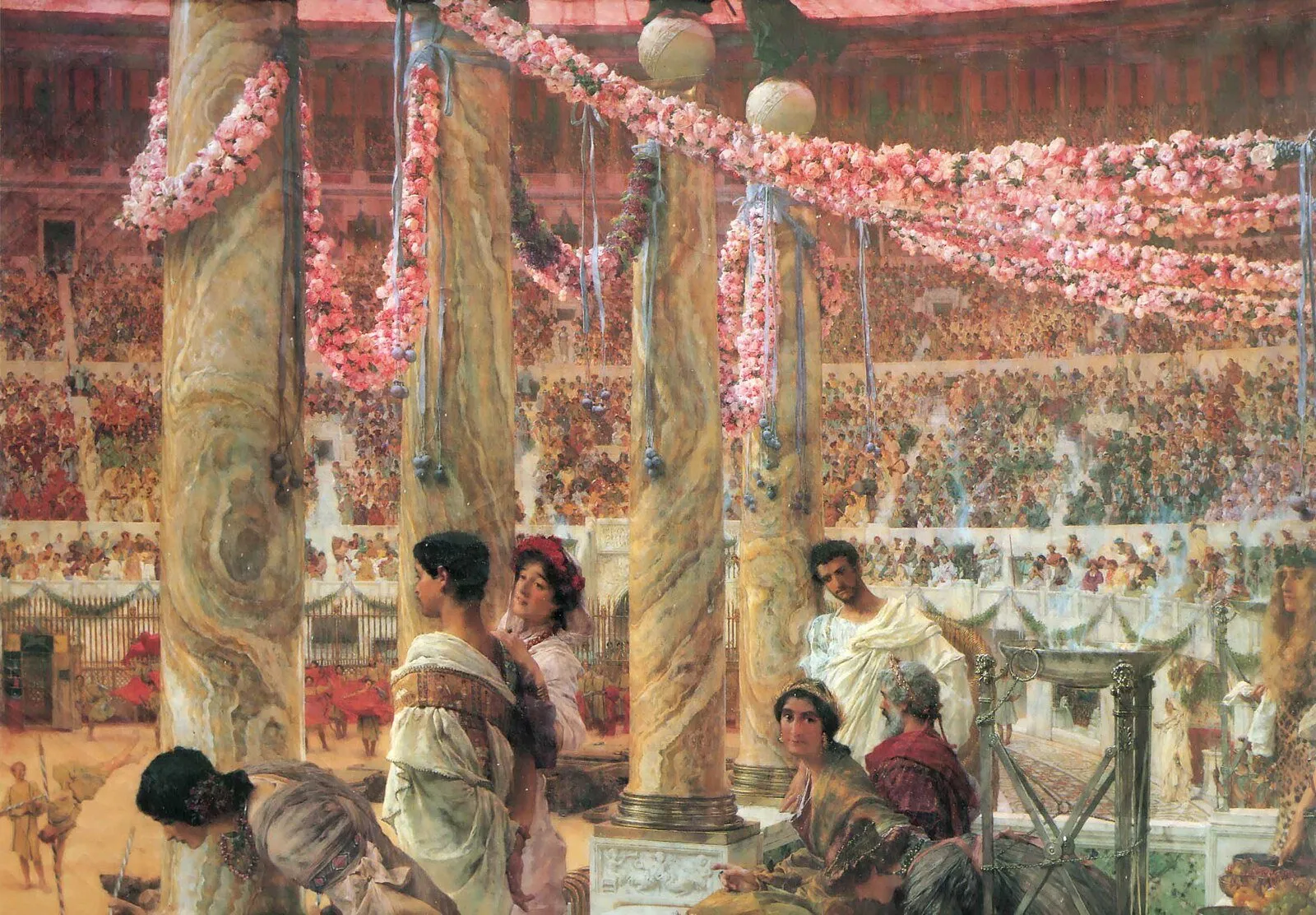
Considered the centerpiece of the Alma Tadema Caracalla works, this 1907 painting was his "last important subject painting"—a final, sumptuous vision of imperial intrigue. It was commissioned by the dealer Arthur Tooth for the princely sum of £10,000 (over £1 million today).
He didn't choose a battle or a coronation. He chose a day at the games.
We are in the Imperial Box of the Colosseum. The perspective is claustrophobic, pressing us right up against the marble rail with the most powerful people on earth. Below them, in the arena (mostly off-screen), a bear fight is taking place.
But in the Alma Tadema Caracalla vision, the real "wild beasts" are in the box.
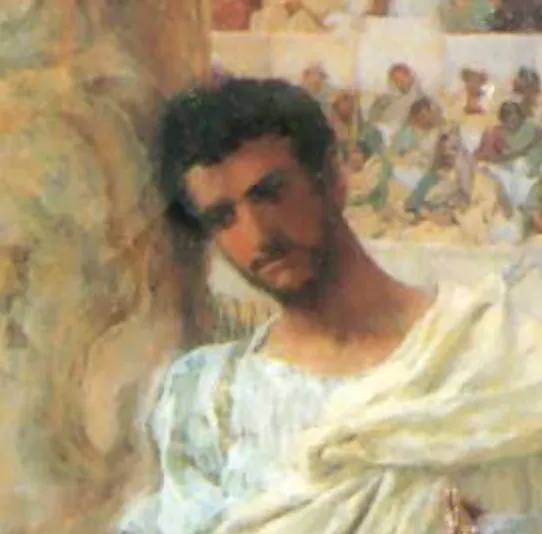
Look at Caracalla. In this defining image of the Alma Tadema Caracalla series, he "lounges broodily against a pillar" on the right.
The Alma Tadema Caracalla Sisters
But the tragedy of this Alma Tadema Caracalla composition extends beyond the sons. If we look closer at the women flanking Geta, we see a lineage that shouldn't exist.
For years, art historians have struggled to identify these figures, often guessing they are cousins or Geta's wife, Plautilla. But there is a more compelling theory—one that fits Alma-Tadema's obsessive reading of ancient texts.
They are Geta's sisters.
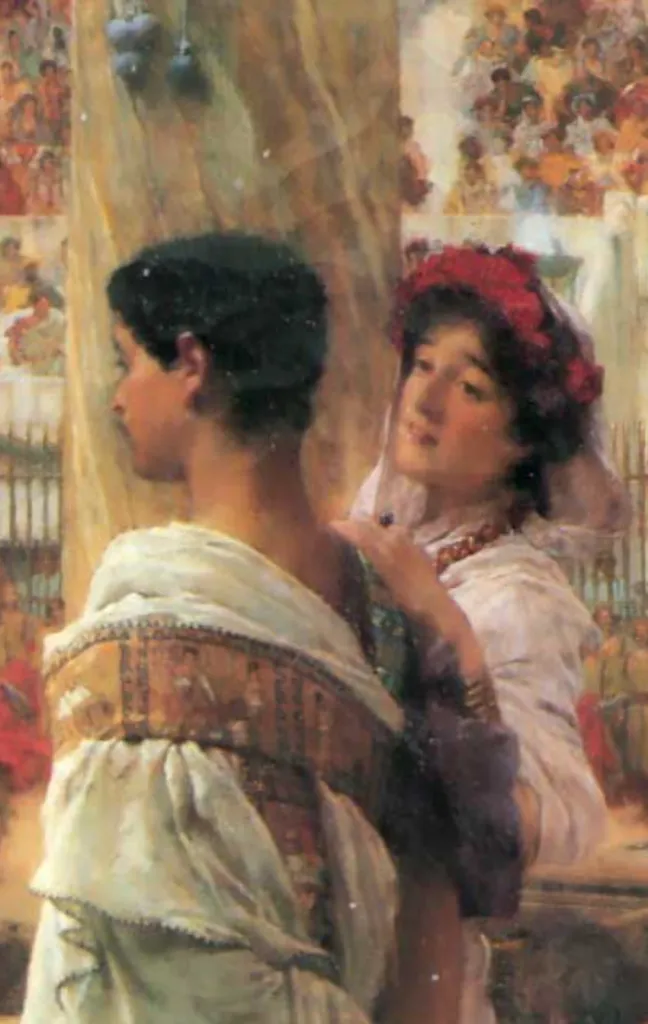
According to modern history, Caracalla and Geta had no sisters. But Alma-Tadema was a Victorian scholar, and his primary source was likely the Historia Augusta, a collection of Roman biographies that was treated as gospel in the 19th century (though now considered unreliable). The Historia Augusta explicitly claims that Septimius Severus had two daughters by his first wife, Paccia Marciana.
Tadema believed this text. And he painted it.
The painting immediately preceding this masterpiece in his catalogue is Opus 381, titled Geta and his sister. That lost work was almost certainly a study for the large canvas we see here.
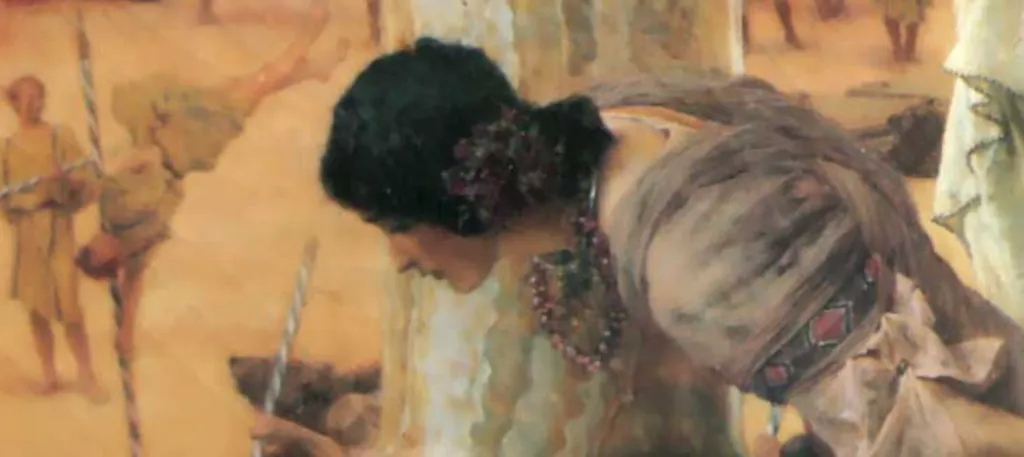
This theory explains their youth. They are not older aunts; they are contemporaries of the princes. By including them, Tadema deepens the tragedy. He surrounds Geta not just with a crowd, but with his own siblings—the "Phantom Sisters" who, like Geta himself, would be erased from history.
It is a specific Alma Tadema Caracalla truth painted over a modern fact.
In the Alma Tadema Caracalla world, everyone in this box is marked for death or erasure. The only difference is the timeline.
The Mother's Gambit
Between these two warring sons sits the tragic hero of the Alma Tadema Caracalla story: Julia Domna.
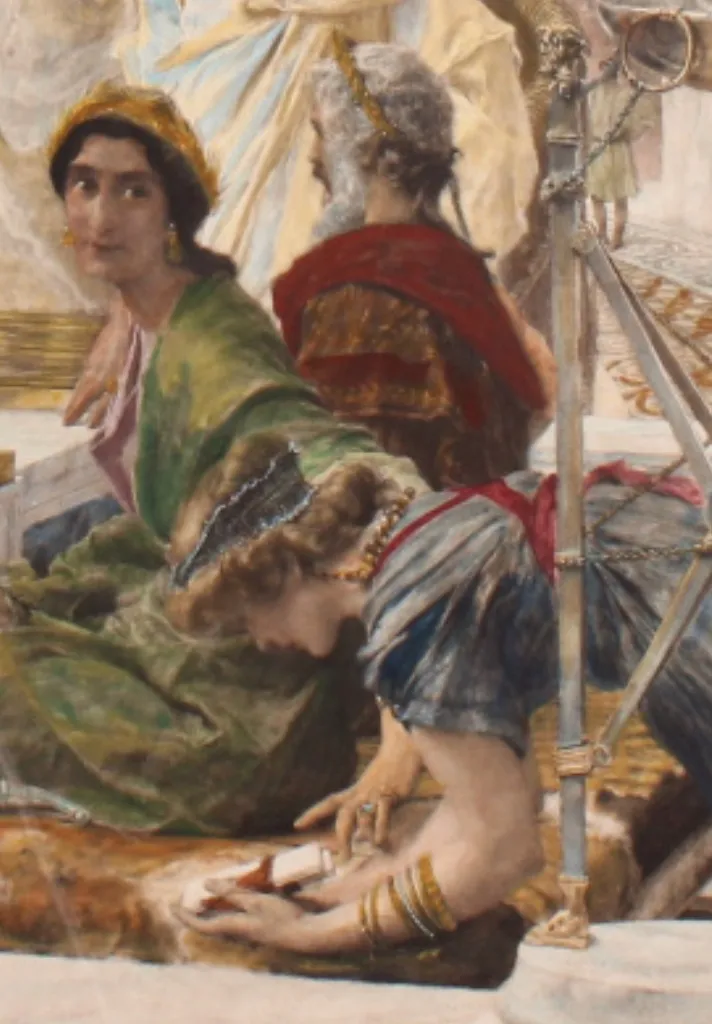
In the painting, Tadema gives her a subtle, almost invisible action: she is seen passing a letter or a note to a female attendant. Is it a warning? A plea? Is she managing the spies that infest the palace? It is a brilliant detail of espionage in plain sight. She is the only thing holding the dynasty together, working frantically behind the scenes.
And the tension is entirely one-sided. While Caracalla stares daggers at his brother, Geta is too busy soaking up the adulation of the crowd to notice he is being hunted.
The 2,500 Witnesses
The genius of this Alma Tadema Caracalla painting is not just in the foreground tension, but in the background indifference.
Behind this silent family drama, Alma-Tadema painted the Roman public. He famously claimed to have painted 2,500 individual heads in this canvas. His calculation was mathematical: he determined the capacity of the visible Colosseum sections and ensured the crowd density would match the actual figure of 35,000 spectators.
Why go to such trouble?
To create a contrast. The crowd is cheering, distracted, obsessed with the bear fight below. Tadema was obsessive about the social hierarchy even in the background: he depicts the specific rows for senior officials, the Vestal Virgins in white, the knights, and finally the poor crowded into the portico above.
It was this level of detail that caused the Nottingham Daily Guardian to write a backhanded compliment at the time:
"Spirit of a scientist and archaeologist but not an artist!"
They missed the point. The "science" of the crowd emphasizes the art of the isolation. They are watching a spectacle of violence in the arena, oblivious to the fact that the man leaning against the Cippolino marble pillar—Caracalla—will soon unleash a reign of terror that will make the bears look tame.
The setting itself is a sensory overload: silver tripods wafting incense, garlands of violets and full-blown roses. It is, as Barrow notes, a "sumptuous details" that "conceals a lurid potential for violence."
The Aftermath: A Prophecy in Paint
We look at this painting with the benefit of hindsight. We know what happens next.
Eight years after this scene, the father, Septimius Severus, dies. The brothers inherit the empire jointly. They immediately divide the imperial palace in half, walling up communicating doors and posting guards to prevent assassination.
It doesn't work.
In December 211 AD, under the pretense of a "reconciliation meeting," Caracalla agrees to meet Geta in their mother's private apartments. It is a trap. When Geta arrives, Caracalla's centurions burst from hiding.
Geta runs to his mother. He clings to her neck, screaming, "Mother, my mother, I am being murdered! Help me!"
They stab him to death in her arms.
Julia Domna is left covered in the blood of her younger son, while her elder son stands over them with a smoking blade. To add the final psychological twist, Caracalla forbids her from weeping or mourning Geta, on pain of death. She is forced to smile, to continue her duties, to wipe the blood off her dress and pretend the family is whole.
The Silence Before the Scream
This is why the Alma Tadema Caracalla and Geta painting is a masterpiece of the "Psychological Thriller" genre. The artist doesn't show us the blood. He doesn't show the knife.
He shows us the waiting.
He shows us a family sitting in a luxury box, draped in silk and surrounded by flowers, while the hate slowly rises around them. The bear fight below is just a distraction. The real brutality is the silence between two brothers who know, with absolute certainty, that only one of them will survive the throne.
In Act II of the Alma Tadema Caracalla trilogy, we explore how the survivor of this family tragedy tried to wash away his sins by building the most beautiful spa in the world.
Leave a Visiting Card
Consulting the visiting cards...