
He is the ghost of the collection.
If you walk into the archives of Alma Tadema, you will find records of seven musicians. Six of the portraits hang in museums or private collections. We can see them sitting in the studio, holding their violins, touching the piano keys.
But the seventh portrait is missing.
His name was Jules de Soria. We have photographs of him. We know what he looked like in black and white—a dapper man with a mustache. But we don't know how Alma Tadema saw him in paint.
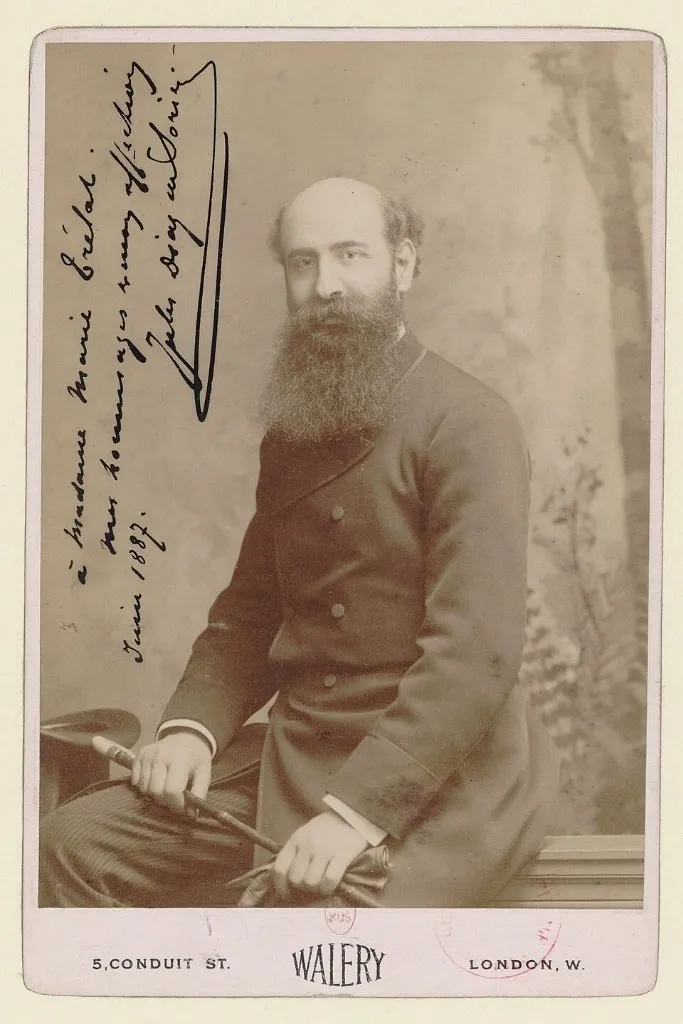
And somewhere, perhaps in a dusty attic or a forgotten private collection, that vision is waiting to be found.
The Wine Merchant Who Sang
Jules de Soria was a contradiction.
By day, he was a wine merchant from Bordeaux. He dealt in claret and commerce. He was a man of business.
But by night, he was something else entirely.
He was a baritone with a voice so exquisite that the greatest composers of the nineteenth century wrote music specifically for him. Massenet dedicated songs to him. Gounod accompanied him on the piano. Fauré wrote for his voice.
He wasn't a professional in the strict sense—he didn't sing for money. He sang for love. And he sang for the most exclusive audiences in Europe. Kings, queens, and the artistic elite of Paris and London clamored to hear him.
When he visited London, he didn't stay in a hotel. He stayed with friends. And one of those friends was Alma Tadema.
Alma Tadema and the Unexpected Guest
The artist loved excellence. It didn't matter to him whether you were a professional or an amateur. If you were a master, you were welcome at Casa Tadema.
De Soria was a master.
We can imagine him at the Tuesday gatherings. A slight, elegant man (described by contemporaries as "short and ugly," but with a voice that made him beautiful). He would stand by the great Steinway piano, perhaps with Alma Tadema listening intently from a marble bench.
And when he sang, the room would transform.
He was famous for his interpretation of Massenet's Élégie. When he sang it, listeners said it felt like a personal confession. It was intimate. Heartbreaking.
In 1888, Alma Tadema decided to paint him.
The Mystery of Opus 288
The portrait is listed in the catalogue as Opus 288.
We know it existed. It was exhibited. It was praised.
But today, it is gone.
Unlike the monumental portraits of Richter or the intense study of Paderewski, this specific vision of Jules de Soria has vanished. There is no photograph of the painting in the public domain. No museum claims it.
It was last seen at a sale in 1891, possibly bought by the musician George Henschel (another friend of Alma Tadema). After that, the trail goes cold.
Is it hanging in a hallway in London, its owner unaware of its history? Is it in a vault in Paris? Or was it destroyed long ago?
For a sanctuary dedicated to memory, this empty space is painful. It is a silence where there should be song.
Why Alma Tadema Painted Him
Why did the great painter choose a wine merchant for his subject?
Because Alma Tadema understood that art is not about titles. It is about soul.
De Soria represented the pure love of music. He didn't sing for a paycheck. He sang because he had to. He balanced the practical world of business with the ethereal world of art—just as Alma Tadema balanced the mechanics of painting with the poetry of his vision.
They were kindred spirits. Both perfectionists. Both devoted to beauty.
The portrait likely captured this duality. The businessman's suit, perhaps, but the artist's eyes. The darkness of the wine cellar and the light of the song.
A Call to the Sanctuary
We are looking for him.
Somewhere, Opus 288 is waiting.
If you have seen a portrait of a man, painted in 1888, signed by Alma Tadema... look closely.
He painted two men that year. One portrait (of the Reverend Adama van Scheltema) was destroyed in World War II. The other—Jules de Soria—is missing.
Check the canvas for the number Opus CCLXXXVIII (288).
You might be looking at the lost singer.
Until he is found, Jules de Soria remains the ghost of Casa Tadema. A voice without a face. A melody we can almost hear, echoing in the empty frame.
Help Us Find Him: Do you have information about Opus 288? Contact the Alma Tadema Sanctuary.
Leave a Visiting Card
Consulting the visiting cards...