
Some musicians play notes. Hans Richter played monuments. When Alma Tadema painted him, he captured a force of nature in a moment of stillness.
Richter was a giant of the nineteenth century. He was the man who conducted the first complete Ring Cycle at Bayreuth. The man Richard Wagner trusted with his life's work. The man who brought the thunder of the German gods to Victorian London.
But in the Sanctuary of St. John's Wood, the Titan softened.
This is the story of two masters who built cathedrals—one of sound, one of paint—and the quiet friendship that thrived in the "Hall of Panels."
When the Conducter Met the Architect
It is easy to see why Alma Tadema was drawn to Richter. They were brothers in construction.
Alma Tadema built his Roman temples on canvas, stone by stone, varying the textures of marble and bronze until they felt real enough to touch. Richter built symphonies layer by layer, until the architecture of Wagner or Beethoven towered over the audience.
Both men were obsessed with the Gesamtkunstwerk—the total work of art. For Richter, it was the opera house where drama, music, and design fused. For Tadema, it was Casa Tadema itself—a home where every chair, every panel, every beam of light was part of a unified aesthetic vision.
Richter was a regular at the "Famous Tuesdays," the legendary weekly salons where London's artistic elite gathered.
Imagine him there: a massive, bearded figure with a "red beard flowing," filling the delicate, marble-lined Hall of Panels with his booming laugh. While others might have discussed the weather, Richter and Tadema likely discussed the structural integrity of Parsifal.
The Portrait: A Silence in the Storm
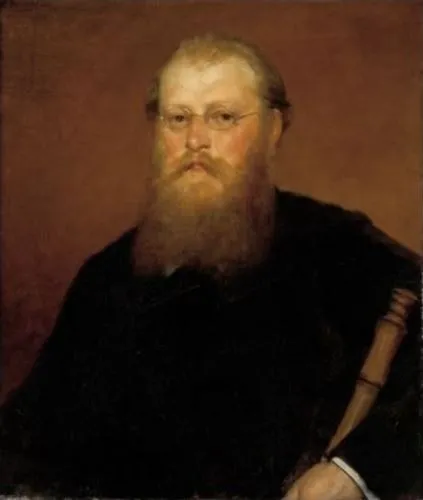
In 1881, four years after Richter arrived in London to change its musical landscape forever, Alma Tadema painted him (Opus 227).
The portrait is striking for what it lacks.
There is no orchestra. There is no baton. There is no audience.
Richter stands alone, his red beard vivid against the dark background. He looks off to the side, his eyes focused on something invisible. He looks like a prophet listening to a voice in the wilderness.
By stripping away the concert hall, Alma Tadema revealed the essence of the man. He showed us that the music didn't come from the waving of arms; it came from the stillness of the mind. It is a portrait of internal conducting.
The Sound of the Sanctuary
Richter’s presence in the house adds a sensory layer to our understanding of Casa Tadema.
We know the visual splendor of the studio—the aluminum dome, the onyx windows. But Richter brings the sound.
He championed the heavy, rich textures of Wagner and Brahms. When he visited, the house wasn't just a museum of Roman artifacts; it echoed with the complex, monumental harmonies of the late Romantic era.
Tadema’s paintings are famous for their solidity; you feel you could lean against the marble. Richter’s conducting had the same quality. He made music feel solid.
The Legacy of the Immigrant Masters
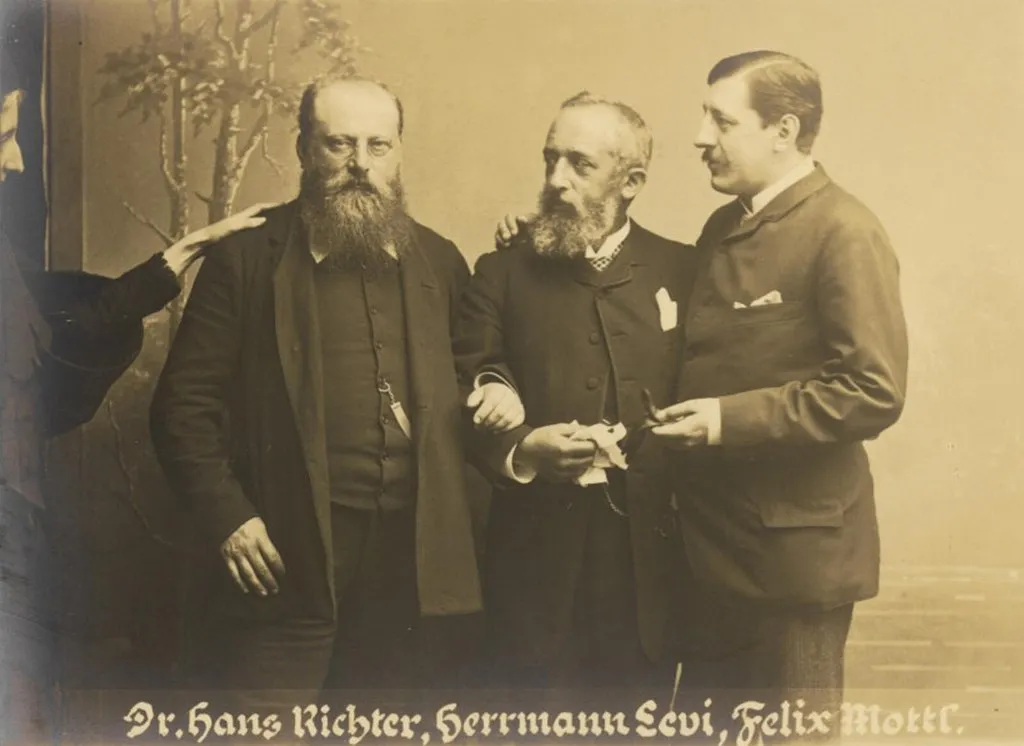
There is a deeper bond between them. Both men were immigrants who came to define the culture of their adopted home.
Alma Tadema came from the Netherlands and taught the British how to dream of Rome. Richter came from Hungary (via Vienna) and taught the British how to listen to Wagner.
They arrived as outsiders and became pillars of the establishment. Richter eventually conducted the premiere of Elgar's Enigma Variations, proving that England finally had a composer of world-class stature. Elgar called him a "true artist and true friend."
In the end, the portrait is a testament to this shared journey. It is one master nodding to another across the silence of the studio.
"I see what you are building," the artist seems to say. "And it will last."
Leave a Visiting Card
Consulting the visiting cards...