
We have followed her through the crowded, crimson friction of the salon, where she was an "It Girl" eyeing an obsessive poet. We have sat with her in the vacant, bored silence of her covered patio, where a dead sparrow was just another trinket she had already forgotten.
But in the final act of our trilogy, Lawrence Alma-Tadema takes the mask of "Lesbia" and elevates it into something immortal.
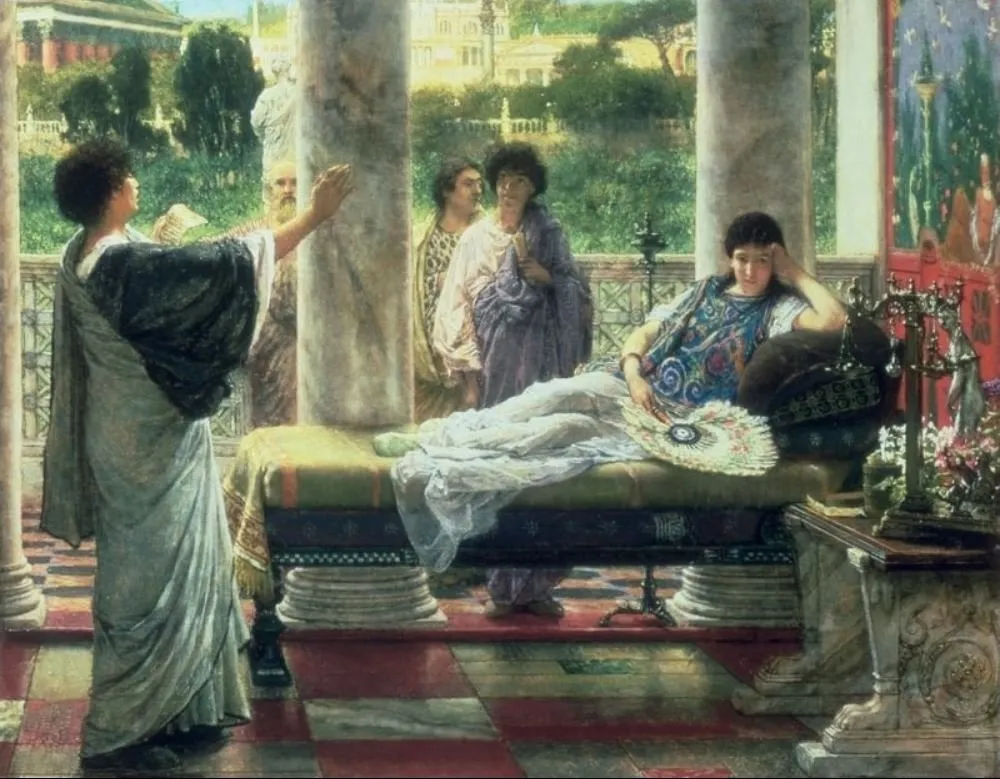
Welcome to Opus LXXX. It is 1870, and the artist has reached the finale of the cycle that carried him from Opus XXVII and Opus XL. He has moved from his dark, crimson studio in Brussels to a light-filled life in London. The heavy shadows of his early work have been swept away. In their place is a light so bright and golden that the entire balcony seems to breathe with the garden behind it. The world of the Republic is gone; the world of the Muse has begun.
The Aesthetic Graduation
In this scene, the walls have fallen away. We are on a magnificent marble terrace, overlooking a sun-drenched landscape. A woman—our Lesbia—reclines on a long, ornate couch, draped in vibrant blue and silver. Standing before her, arm outstretched as he reads from a scroll, is Catullus.
Look closely at their appearance. The heavy Roman togas of the first two paintings are gone. Instead, both are dressed in the light, flowing garments of Ancient Greece.
For Lawrence Alma-Tadema, the "Greek Ideal" represented the highest form of beauty. By dressing his Roman lovers in Greek clothes, he is showing that they have finally graduated from the noise and scandals of their time. They have "emigrated" from the messy politics of 1st-century Rome into the eternal, golden peace of the Greek tradition.
The Failed Vengeance
This transformation is the ultimate answer to the "vengeance" we saw in the previous acts.
In our first act, Catullus was the obsessive poet who turned into a bitter enemy. When the real Clodia Metelli moved on, he tried to "delete" her reputation. In his final, unlovely message (Catullus 11), he famously wrote that she was like a "broken flower" at the edge of a meadow, crushed by a passing plow. He wanted history to remember her as discarded, broken, and small.
Look at the painting again.
The artist has performed the final "Save." He has rescued her from the dirt and placed her on this golden terrace.
Catullus, too, has evolved. He is no longer the "bitter ex" clutching a dead bird; he is the Refined Poet who has found the words that actually matter. He is no longer reading to win her attention; he is reading to celebrate her existence. The "plow" of his earlier anger has passed by, and instead of crushing the flower, it has tilled the soil for this golden immortality.
The Two Muses: A Biographical Echo
There is one final layer to this transition—a personal one.
When Lawrence Alma-Tadema painted the first two acts of this story (The Mask and The Silence), he was living in Brussels with his first wife, Pauline. Those early paintings, with their heavy walls and trapped emotions, reflect a man still building his world. But by 1870, his life had shifted. Pauline had passed away, and Tadema had moved to London—the move that would make him a superstar.
It was during this "hinge" year that he met Laura, the woman who would become his second wife and his ultimate muse. The shift we see in Lesbia—from the "Bored Socialite" caught in a room to the "Universal Muse" reclining in eternal light—perfectly mirrors Tadema’s own path. He moved from the enclosed, crimson shadows of his Belgian past into the open, golden terrace of his English future.
The girl behind the mask became the vessel for Tadema to transition from his own grief into the light.
The Resolution of the Trilogy
Throughout this journey, we have seen a woman evolve from a target into a sanctuary.
- The Mask (Opus XXVII): The public friction of the salon.
- The Silence (Opus XL): The private reality of her indifference.
- The Light (Opus LXXX): The ultimate victory of art over anger.
The dead bird is long forgotten. The vengeful lines of Catullus have been stilled by centuries of golden sun. Alma-Tadema shows us that while the "Real Clodia" was a woman of a thousand scandals, the "Lesbia" of the Sanctuary is the reason we still value the art. She is the eternal listener, the one who survived the "passing plow" of anger to become a home for every beautiful line of verse.
The mask has become the reality. The girl behind it has become the light itself.
A Note on the Reader: Scholars and auction houses often title this work "Anacreon Reading his Poems at Lesbia’s House," identifying the figure as the Greek lyric poet. However, within the context of the Lesbia Cycle, the Sanctuary views this as the final "Greek Transformation" of Catullus himself—the moment the Roman poet finally shed his Republican skin to join his Muse in the eternal Greek ideal.
Leave a Visiting Card
Consulting the visiting cards...