
The golden age of the Roman Republic was not all triumphs and oratory. For every grand speech in the Senate, there was a quiet afternoon in a shaded atrium; for every military conquest, a private, unmeasured loss. While the history books focus on the movements of legions, the poets of the time were often focused on something far smaller—the movement of a single heart.
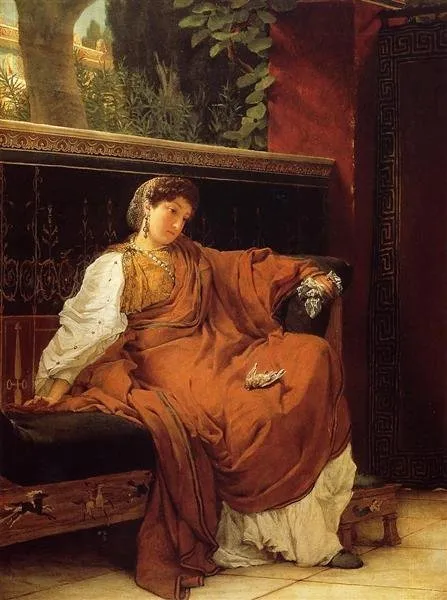
In the first act of our trilogy, we saw Clodia Metelli in the middle of her crowded salon, eyeing Catullus with a curious, assessing look as he offered his "mask" of devotion. But in 1866, Lawrence Alma-Tadema takes that same woman—now reclining in the silence of her own home—and places the legendary sparrow on her lap.
Welcome to Opus XL. This work sits at the center of the Lesbia Cycle—the trilogy that began with Opus XXVII and concluded with Opus LXXX. But look closely: while the titles and the scholars speak of "weeping," the image itself tells a far more complicated story of a woman who has moved on while the bird is still warm.
The View over the Low Wall
In this second act, the crowded noise of the first salon has faded. From the covered patio where she rests, we can see over a low wall into a bright Roman garden. Vines, trees, and tall shrubs catch the afternoon sunlight. The world outside is full of life and movement, completely unaware of the tiny, dead bird lying on the bench.
Lesbia is a picture of total relaxation. She sits draped in a heavy, rust-red toga that pools around her on the dark stone bench. In her lap sits the passer—the sparrow. In the eyes of the poet Catullus, this tiny creature was the ultimate rival. He had watched it peck her fingertips and nestle in her lap, and he had envied the bird for a physical intimacy he could only dream of.
The Mystery of the Passer
To understand the bird, we must understand the word. Passer is the Latin word for sparrow, but in the upper-class villas of Rome, it was more than just a common garden visitor. For the elite, the passer was a high-status pet, a "little luxury" kept in ornate cages or allowed to fly freely through the covered enclosures of the atrium.
However, historians have spent centuries arguing over what a passer actually was. Some argue it was a Blue Rock Thrush, a bird with a beautiful, haunting song befitting a woman of Clodia's standing.

Others suggest the "sparrow" was never a bird at all, but a thinly veiled sexual metaphor for Catullus’s own physical desires.
In Alma-Tadema’s hands, however, the mystery is stilled. He chooses the literal path, painting a bird so physically real you can almost sense its "gray-green and downy" weight. He turns the poet’s potential metaphor back into a tangible creature, making this "Million-Dollar Sparrow" a centerpiece of Roman domestic reality.
The Performance of Preoccupation
Traditional Victorian reception often leans heavily into the "sentimental grief" of this scene. They see a woman mourning a pet. But the eye of a modern visitor tells a different story.
Lesbia is reclining, her body language one of relaxed, almost detached indifference. In one hand, she clutches a crumpled handkerchief—the "prop" of a mourner—yet her eyes are not on the bird. Instead, she is looking diagonally toward the ground, her expression vacant and far away. There are no tears to be found. She isn't sad; she is simply elsewhere, perhaps already calculating her next political maneuver.
To Clodia Metelli, this bird might have been a "peace offering" from the intense poet Catullus—a courtesy gift she accepted but never truly valued. The sparrow is a trinket of a love she has already outgrown, a small silence she is waiting to be done with so she can return to the real power-games of the city.
The Berlin Controversy: Can a Roman Cry?
When this painting was first shown, it caused a minor riot among the scholars of Berlin. A prominent critic mocked the scene, arguing that Alma-Tadema had committed a historical error. “A Roman woman,” he claimed, “would never pity an animal. They were too cruel, too stoic, too hardened by the arena to weep over a bird.”
The critic saw the Romans as caricatures—marble-hearted giants who only understood power. Alma-Tadema's defense was to point to the text of Catullus 3, where the poet begged the heavens to weep:
“Now it goes along the shadowy path
To that place from which they say no one returns.
But a curse on you, evil shadows of the Underworld,
Which devour all beautiful things...”
Yet the "cheeky" genius of Tadema is that he may have been winking at both sides. He gives the public the accessories of grief—the dead bird, the handkerchief, the solitary setting—but he leaves the face of the woman as a blank canvas of distraction. He shows us exactly what the Berlin critic feared: a woman who is theoretically "weeping," but who is actually just checking the mental clock until her next appointment.
The Solitary Myth
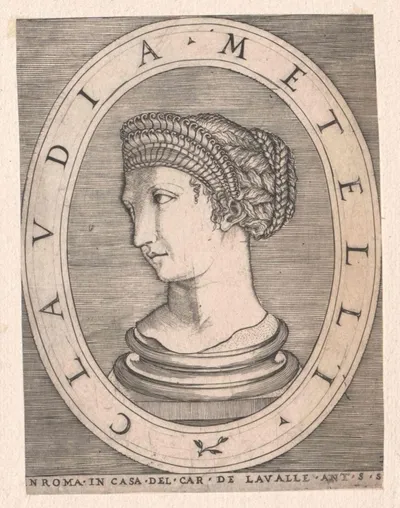
In this second act, the "Idea of Lesbia" becomes truly Roman. In the first painting, she was a symbol—the socialite of the crimson salon, caught in the friction of her public life. Here, she is Clodia Metelli at her most authentic: independent, unsentimental, and utterly unaffected by a poet's metaphors.
Even if we believe that Lesbia was just a pseudonym used for a woman who was too busy managing a political empire to care for a provincial poet, Alma-Tadema captures that gap perfectly. He takes a poet's ink-and-page grief and places it in the lap of a woman who is already thinking about something else.
Part II is a reminder that while Catullus was writing about the "shadowy path," Clodia was likely already looking at the sun. The socialite has found that there is no one left to entertain her now, and the silence of the bird is not a source of grief, but a source of boredom. She is the real Clodia behind the myth of Lesbia, and it is her indifference that makes her feel most alive.
But history is longer than a single afternoon, and the indifference of a socialite will eventually be transformed into the golden immortality of a Muse.
Next: The Universal Muse: Catallus (or Anacreon) at the House of Lesbia
Leave a Visiting Card
Consulting the visiting cards...