
The museum is cold at dawn.
Long before the crowds arrive to marvel at the "Colchester Vase," a man sits in the shadow of the glass cases. He does not hold a palette of Mediterranean blues or the shimmering whites of marble. Instead, he holds a ruler, a compass, and a drafting pen.
His name is James John Gaul.
To the world, Sir Lawrence Alma-Tadema was a lone genius who conjured the Roman Empire out of oil and ego. But to the men who worked within the golden walls of 17 Grove End Road, the truth was far more collaborative. Gaul was the bone and muscle behind the dream.
The Invisible Architect
Gaul was born in Ireland in 1859, a time when the world was beginning to measure its history with an unblinking, mathematical grace. A man of strict angles and perfect vanishing points, he joined the Alma-Tadema studio in the early 1880s.
He was not there to paint the poetry; he was there to provide the sturdy prose.
In the quiet stacks of the Cadbury Research Library, his legacy is not just present—it is the very foundation of the archive. While Tadema’s name is on the door, we find Gaul’s name explicitly recorded 84 times in the studio’s primary inventory. He is the ghost who ensured the past wouldn't crumble, the one who calculated the weight of every stone floor and the exact taper of every column.
The Italian Mission: May 1883
In May 1883, Gaul was dispatched to Italy. While the sun was high over the ruins of Pompeii, he was at work documenting what the cameras of the time could not—the true colors and the hard geometry of the stones.
He moved through the ruins like a ghost, capturing the curve of a fountainE1012 and the shadow of a brick column outside a shop frontE1027. He knelt to measure the base of a pilasterE1041 and traced the delicate geometry of a window paneE1060.
Even the most mundane details did not escape him; he recorded the precise, overlapping pattern of ancient roof tilesE1061 with the same reverence one might give a saint’s relic. These weren't mere studies; they were the building blocks of Tadema's Roman dream.
The Naturalist and the Researcher
His research was not confined to Italy. Gaul was the roving eye of the studio, traveling to find the small, forgotten echoes of the past in the Colchester Museum, Maidstone Museum, and Trinity College, Cambridge. He sketched the clay of Roman Britain that would ground Tadema's later English subjects—searching through museum specimens and the private cabinets of collectors alikeE2800-02.
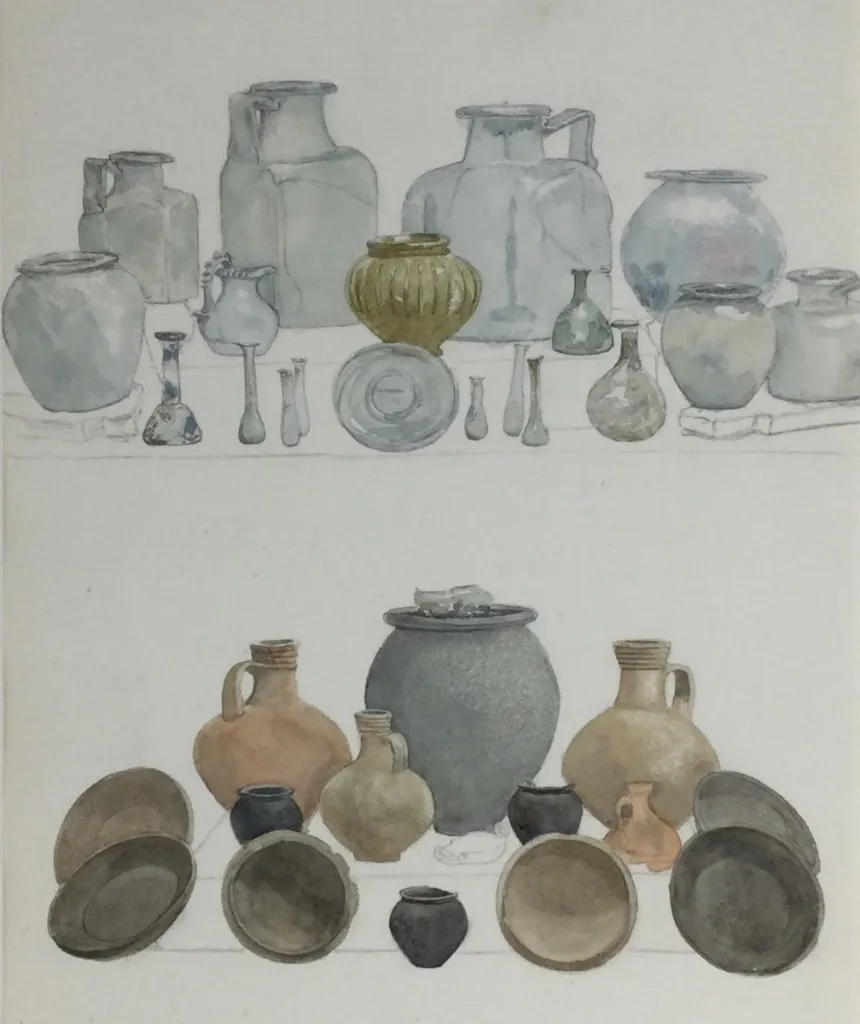
This study of potteryE2797 is rendered with a lifelike clarity that captured not just the form, but the "feel" of the clay. This documentation would prove essential for Tadema's later English subjects, anchoring the artist's imagination in the tangible earth of Roman Britain.
His most celebrated technical hunt, however, centered on a singular, world-class artifact: the Colchester Vase.
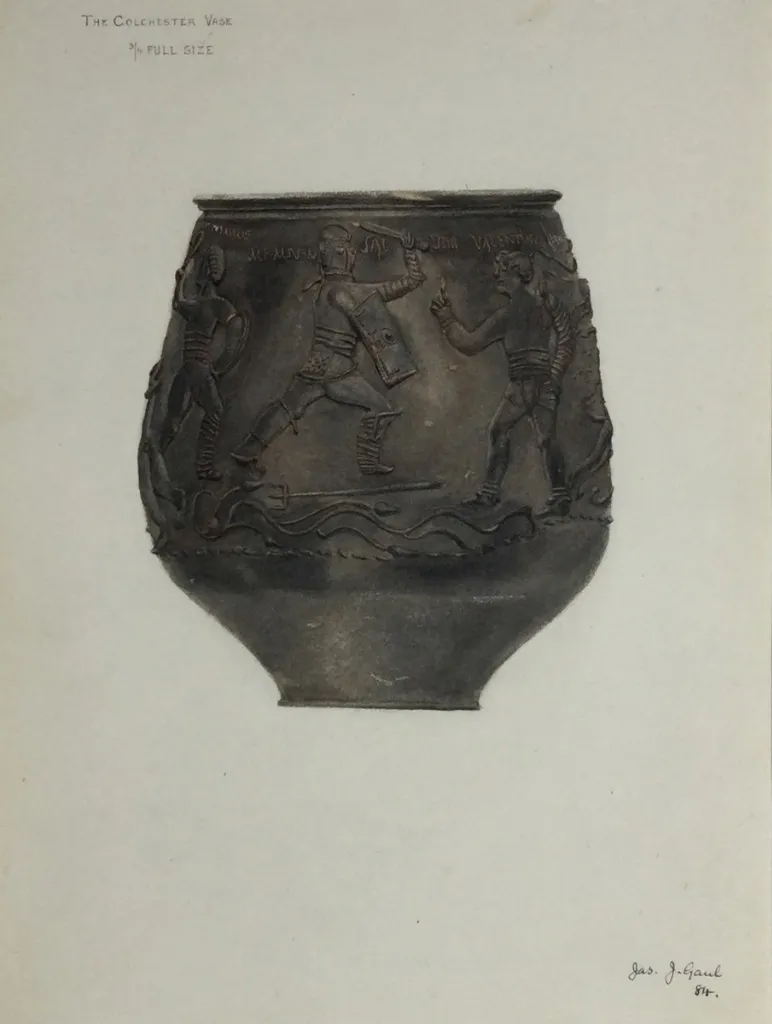
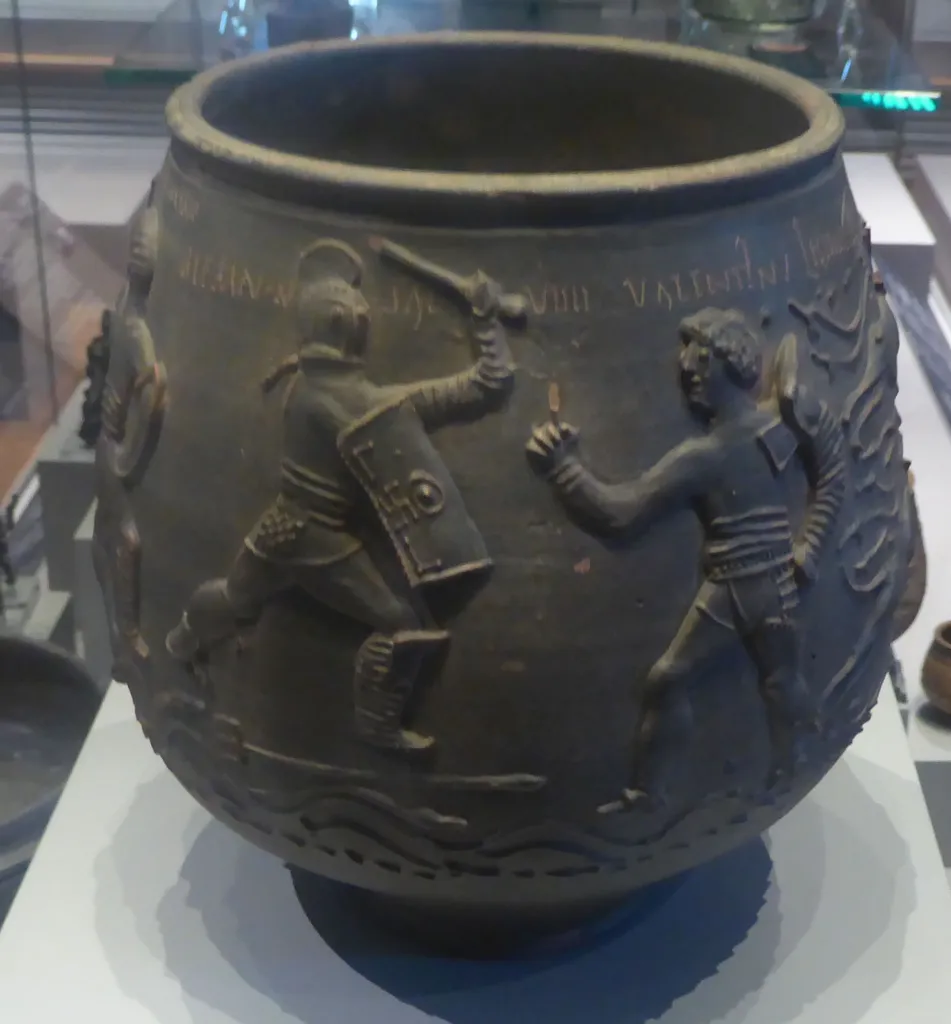
The Colchester VaseE2794 is more than pottery; it is the unique, locally-made evidence that the Roman arena—with all its professional violence and celebrity—actually existed on British soil.
Found in 1853 in a grave just outside Colchester, the vase is the ultimate piece of "Roman-British sports memorabilia." For decades, historians assumed such a sophisticated piece must have been imported from Italy or Gaul. But we now know it was crafted from the very clay of Camulodunum (Colchester). It depicts a specific, local event: a life-and-death struggle between two named gladiators, Memnon and Valentinus. This wasn't a generic myth; it was a record of a fight that happened in a British arena.
For Gaul and Tadema, this was the "smoking gun" of authenticity. It proved that Roman Britain wasn't just a remote outpost, but a fully integrated part of the Empire’s cultural heart. The museum where Gaul sat to draw it—housed within the Norman Castle—is built directly onto the foundations of the Temple of Claudius, the very site where those gladiators would have walked.
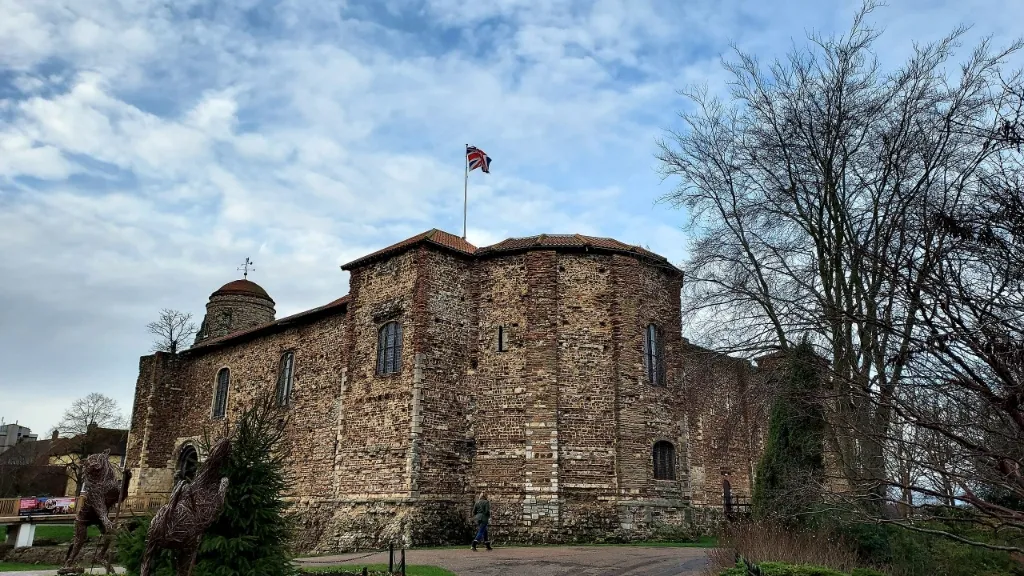
For Gaul, this wasn't a local stroll; it was a grueling test of devotion. To reach the museum for a single day's study, he would leave the leafy sanctuary of St. John’s Wood before dawn, taking a rattling hansom cab across the city to Liverpool Street Station. From there, the steam-belching engines of the Great Eastern Railway would labor through the Essex countryside—a journey of some fifty miles that, in 1884, cost him over two hours of soot and vibration each way.
From Measurement to Masterpiece
The culmination of these hours in the museum is realized in Tadema's finished canvas, "A Roman-British Pottery" (Opus CCLXIV/261A).
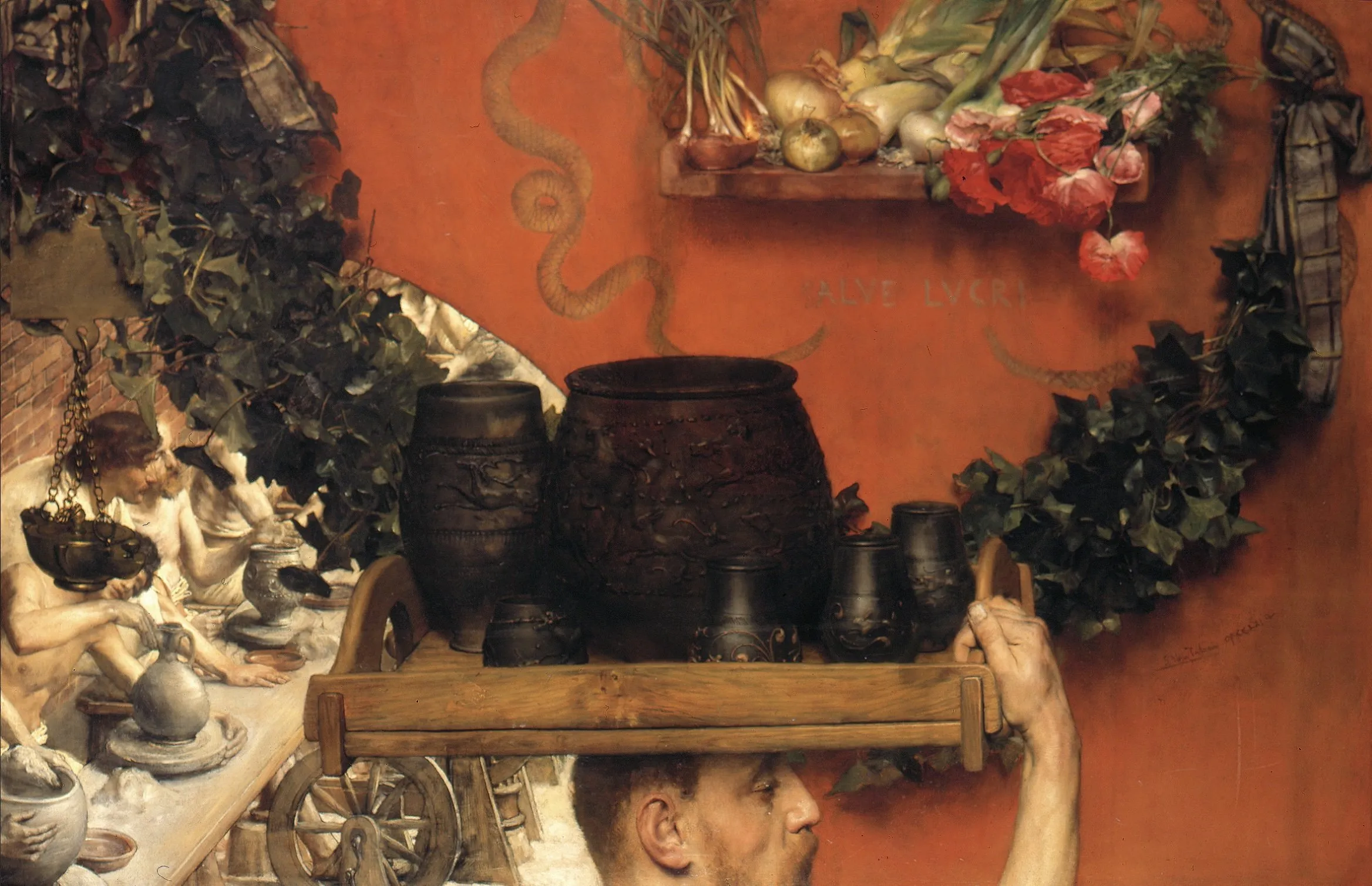
Here, the careful architectural prose of J.J. Gaul is transformed into the golden poetry of the Roman world. The precise taper of the vase and the exact hue of the clay allow Tadema to place the observer not in a Victorian museum, but in the heat and dust of Camulodunum (the ancient name for Colchester, and the first capital of Roman Britain).
In an era where 19th-century photography was limited to shades of grey and silver, Gaul’s watercolors provided the secrets of ancient color—the warmth of terra sigillataE2794, the specific oxidation of bronze—that Tadema required to make his marble breathe. Without the architect's measurement, the painter's light would have no floor to fall upon.
The Specimen Portfolios
The archive reveals a man with a hunger for the small, hard details of the world. Gaul was not just a measurer of stone; he was a master of the artifact.
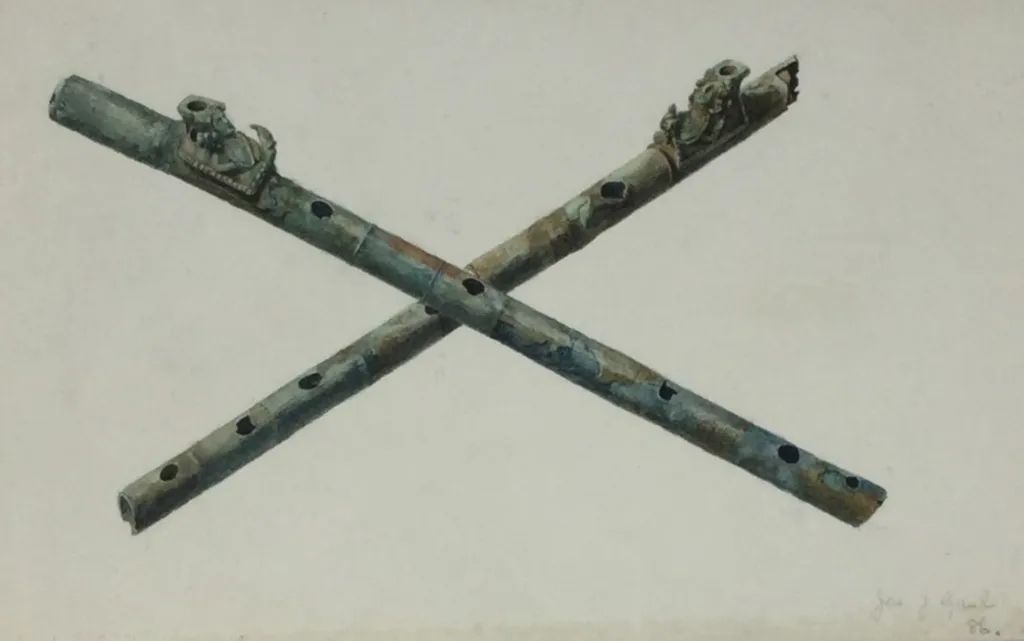
His study of ancient flutesE2603 captures the subtle oxidation of bronze and the precise placement of finger holes—the knowledge that allowed Tadema to "sound" the music of the past in his Dionysian festivals.
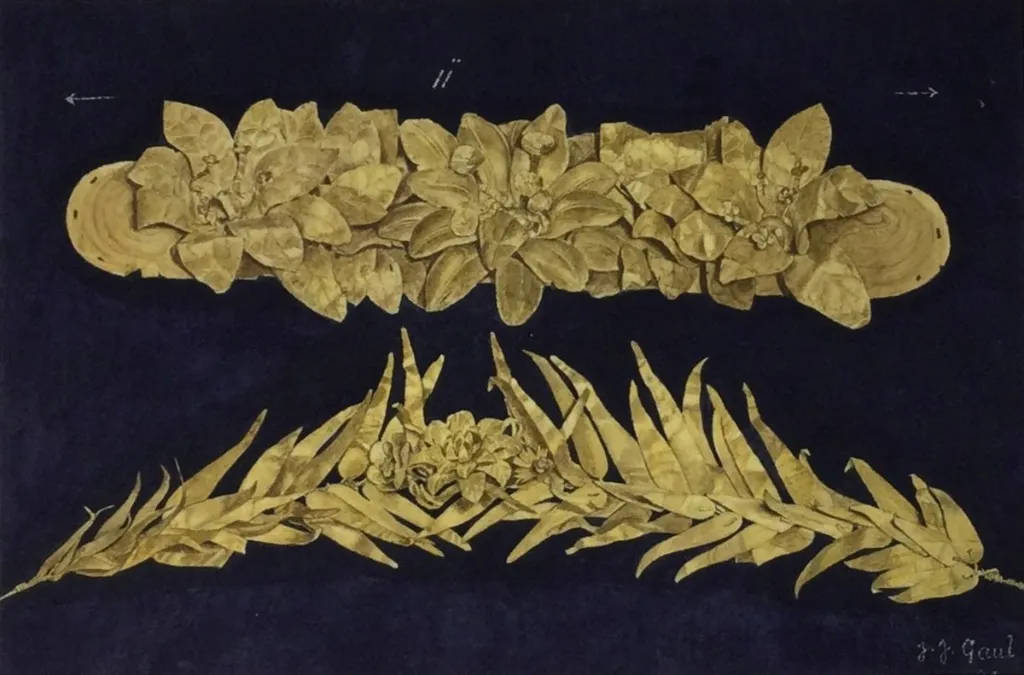
Gaul’s documentation of gold jewelleryE2235 served as the secret guide for the shimmering accessories worn by Tadema’s Roman matrons. These studies allowed the master to see exactly how ancient gold should catch the light before he ever touched his brush to the canvas. The deep indigo background of the mounting sheet makes the gold "pop," providing an instant color key that Tadema could lift straight from the page.
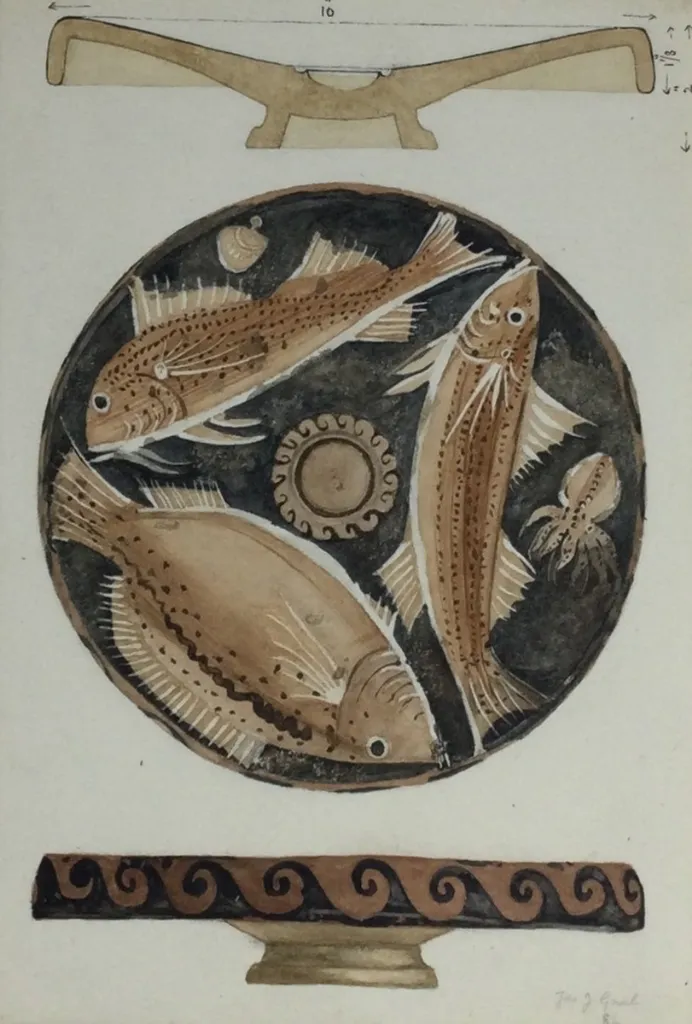
Finally, he turned his eye to the delicate glaze of a Roman bowl adorned with fish decorationE2310. Here, the architect’s strict eye meets the painter’s love for the natural world, showing us both the cross-section of the vessel and the shimmering life painted upon it. It is this marriage of precision and quiet beauty that defines Gaul's contribution to the Sanctuary.
A Legacy of Symmetry
The bond between the master and the draughtsman was profound. In a quiet testament to their connection, Gaul named his children Lawrence and Pauline—the namesakes of the artist and his first wife, Marie Pauline.
When Gaul died in 1899, in the greenery of Richmond, Surrey, the loss was catastrophic for the studio. He was only forty years old, leaving behind his wife Nettie and his two young children.
While Tadema’s name is the one etched into the marble of history, the curators of the Alma-Tadema Memorial Library note that it is Gaul’s quiet, precise lines that are often the "stars of the show." They are the survivors of a vanished world—the painstaking scratching of a pen that made an empire real.
The Invisible Draughtsman
Despite eighteen years at the heart of the world's most famous studio, James John Gaul remains a ghost. We have searched every album, studio scrap, and family record, yet no photograph of him has ever been found. It is a profound silence; the man who built the very floors Tadema walked upon survives only as a signature and a set of perfect angles.
When Gaul died in 1899, the "architectural soul" of the studio died with him. While others like the naturalist J.A. Cull would carry on the biological details, the era of obsessive measurement had reached its limit. Perhaps it is fitting: a man who dedicated his life to making the past visible chose to remain invisible himself.
The Echo
We are taught to worship the name on the frame, but we forget the hand that mapped the shadows on the marble floor. Gaul built the world so that Tadema could populate it with poetry. Without the architect's measurement, the painter's light would have no floor to fall upon.
Next time you stand before a view of the ancient world, look past the beautiful faces. Look at the stones. Someone measured them. Someone loved the geometry of the past enough to vanish into it.
The Archival Ledger
The primary research cited in this article is held within the Alma-Tadema Archive at the Cadbury Research Library, University of Birmingham. Technical references as follows:
- E1012: Fountain in Pompeii (Portfolio 11).
- E1027: Brick Column at Pompeii (Portfolio 14).
- E1041: Base of Pilaster, Pompeii (Portfolio 15).
- E1060: Detail of Window Pane (Portfolio 17).
- E1061: Pattern of Roof Tiles (Portfolio 17).
- E2797: Roman British Pottery, Portfolio 138.
- E2794: The Colchester Vase, Portfolio 138.
- E2802: Westendarp Collection, Portfolio 138.
- E2603: Flutes from Antiquity, Portfolio 115.
- E2235: Gold Jewellery, Portfolio 81.
- E2310: Roman Bowl (Fish Decoration), Portfolio 84.
Leave a Visiting Card
Consulting the visiting cards...