
There is mud under his fingernails. Not the polite, chalky dust of a sculpture gallery, nor the charcoal smudge of an artist’s studio, but the heavy, wet, prehistoric river-mud of the Nile.
Sir John Aird stands on the edge of the desert in December 1902. He is watching the waters of the longest river in the world stop. He has just finished the Aswan Dam, a feat of engineering so colossal it was compared to the Pyramids. He has commanded twenty thousand men; he has moved millions of tons of granite; he has altered the geography of a continent.
And standing next to him, blinking in the Egyptian sunlight, is a sixty-six-year-old Dutch painter in a straw hat.
They are the unlikeliest of friends. One is a man of earth and iron, a contractor who speaks in the language of sluice gates and cubic meters. The other is Sir Lawrence Alma-Tadema, a man of silk and marble, who speaks in the language of light.
Yet, it was John Aird—the "British Pharaoh"—who became the most vital patron of Alma-Tadema’s golden years. He was the man who looked at the grim, grey reality of industrial Britain and decided that he needed to buy a dream.
The Master Builder
To understand why Sir John Aird needed Alma-Tadema, you must first understand the noise of his life.
Aird was born into the dust of the stonemason’s yard. He was not an aristocrat who inherited a gallery of ancestors; he was a "Master Builder," a title that sounds almost mythological but involved a great deal of sweat. His firm, John Aird & Co., was responsible for the heavy lifting of the Victorian Empire. When the Crystal Palace needed to be dismantled and marched across London to Sydenham, it was Aird who moved it. When the ships of the world needed to dock in London, it was Aird who dug the Royal Albert Docks out of the marshes.
He was a man of the physical world. His reality was one of clanging metal, shouting foremen, and the relentless, grinding pressure of contracts and deadlines. He lived in a world of hard edges and soot.
Perhaps that is why, when he returned to his home at 14 Hyde Park Terrace, he demanded something else entirely.
He did not want paintings of factories. He did not want gritty realism. He wanted a window through which he could escape.
The Avalance of Roses
In 1888, Aird visited Alma-Tadema’s studio in St John’s Wood. He was looking for a centerpiece for his dining room. What he commissioned remains one of the most audacious acts of patronage in the nineteenth century.
He did not ask for a portrait of himself. He asked for The Roses of Heliogabalus.
Consider the image. It depicts the debauched Roman Emperor Elagabalus playing a deadly prank on his dinner guests, smothering them under a cascading false ceiling of rose petals. It is a painting of suffocating excess. The pinks and reds vibrate with a dizzying intensity; you can almost smell the cloying perfume of a million dying flowers.
For this single window into madness, Aird wrote a cheque for £4,000.
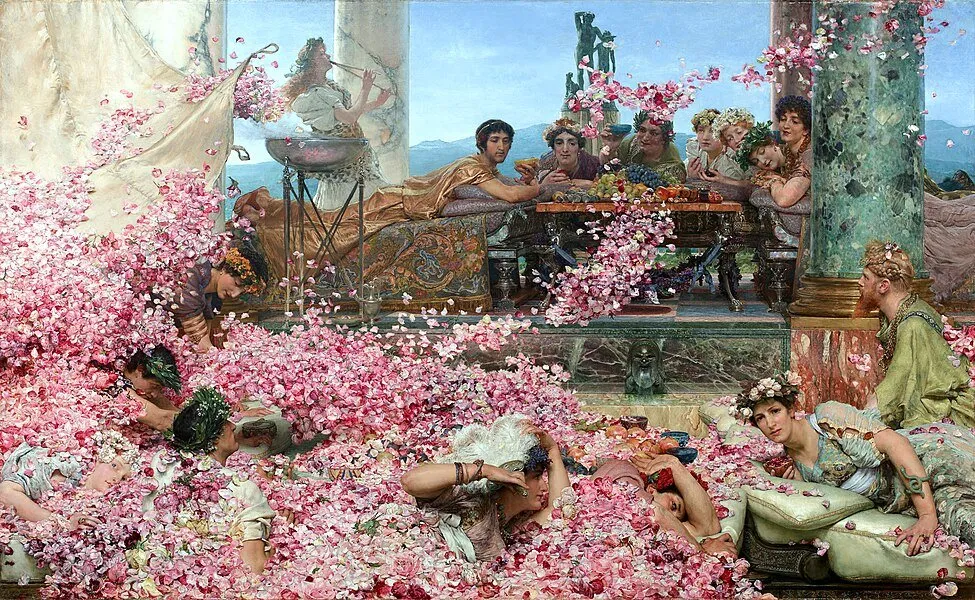
In today’s currency, that is a fortune. But the money is less interesting than the psychology. Why would a pragmatic engineer, a man of "earth and stone," want to eat his dinner beneath a scene of such lethal indulgence?
Perhaps it was because Aird saw a reflection of his own power. Like the Romans, he was an empire-builder. He understood the scale of Rome because he was building the scale of London. But unlike the Romans, his world was grey. The Roses of Heliogabalus was a purchase of pure sensory overload—a drug for the eyes, bought by a man who spent his days staring at granite.
The Pilgrimage to the Nile
The relationship between the Builder and the Painter culminated fourteen years later, on that riverbank in Aswan.
When the great dam was finally finished in 1902, Aird did not invite a politician to stand beside him. He invited Alma-Tadema. It was a gesture of profound respect, an acknowledgment that the engineering of the present deserved the eye of the past.
For six weeks, the two old men traveled Egypt. They were not alone in their desert progress; the party was a curated assembly of the Edwardian elite, including a young Winston Churchill. His presence reinforced the high-society atmosphere of the journey, a reminder that the taming of the Nile was a peak moment of Imperial confidence.
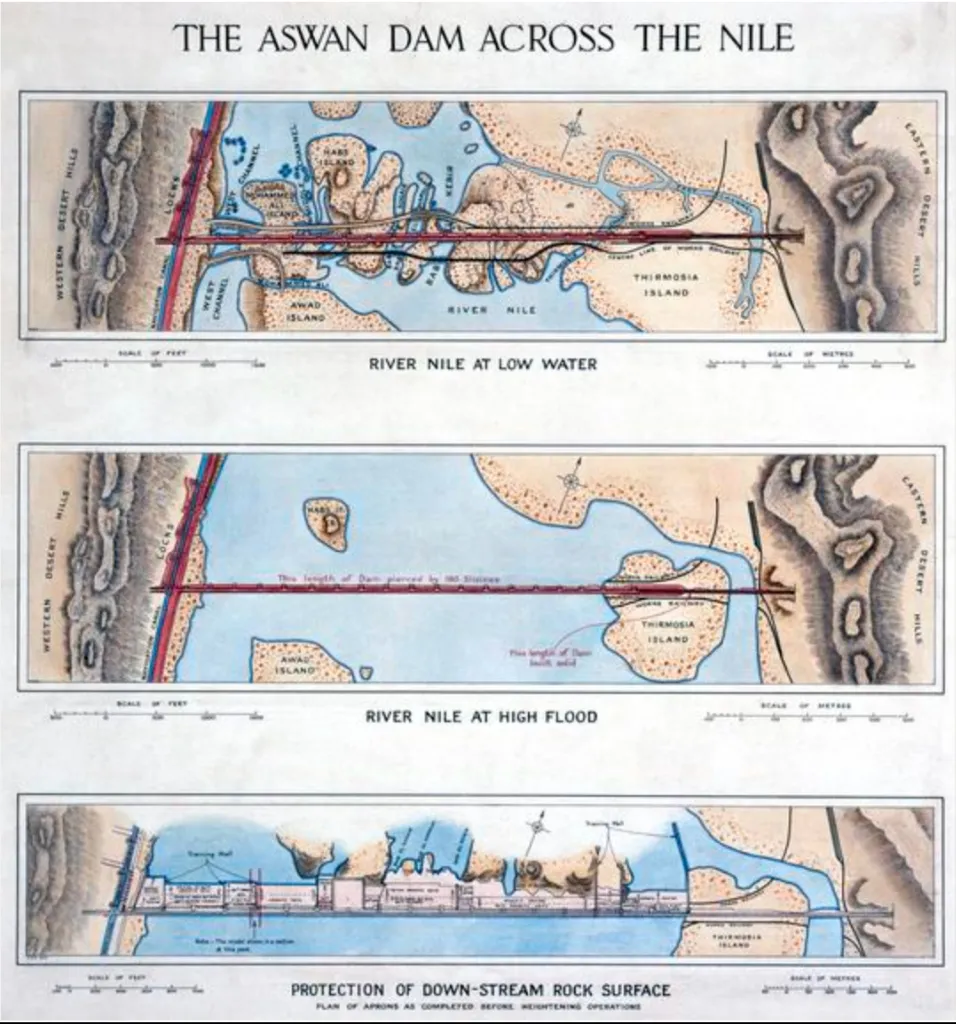
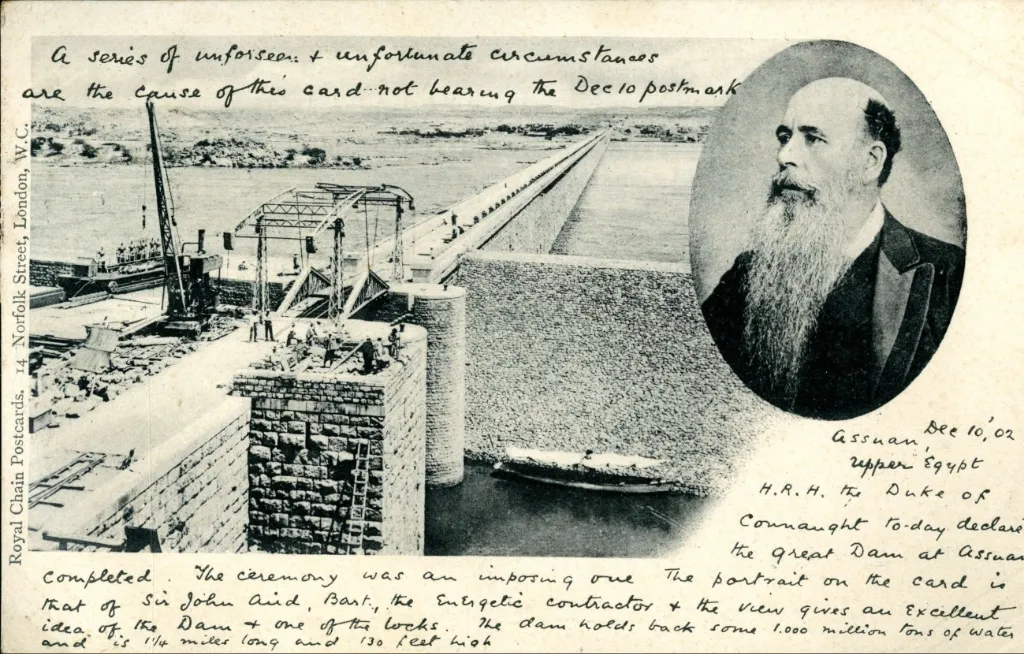
For Alma-Tadema, the trip was a revelation. He had painted Rome from his imagination and his library books, but here was the heat, the dust, the blinding white light of the desert. He filled sketchbooks with drawings of the local flora, the hieroglyphs, the way the light hit the ancient stone.
For Aird, it was a victory lap. He was the new Caesar, showing his court painter the extent of his dominion.
The Finding of Moses
When they returned to the grey skies of London, Aird commissioned one final masterpiece. He gave Alma-Tadema a choice of subjects, but the engineer’s heart must have skipped a beat when the artist proposed The Finding of Moses.
It was perfect.
The painting, completed in 1904 for the staggering sum of 5,000 guineas (£5,250), is a technical marvel. It shows the infant Moses being carried in a basket, not by a humble slave, but in a procession of royal splendor.
The Pharaonic princess sits aloft, aloof and beautiful. There is a hidden intimacy in her gaze; historical records suggest she was modeled after Aird’s own daughter, a personal touch that anchored the Master Builder’s family to the monumental work. Behind her, the Nile—blue and teeming with life—flows in a perpetual cycle of renewal.
But look closer. Notice the granite.
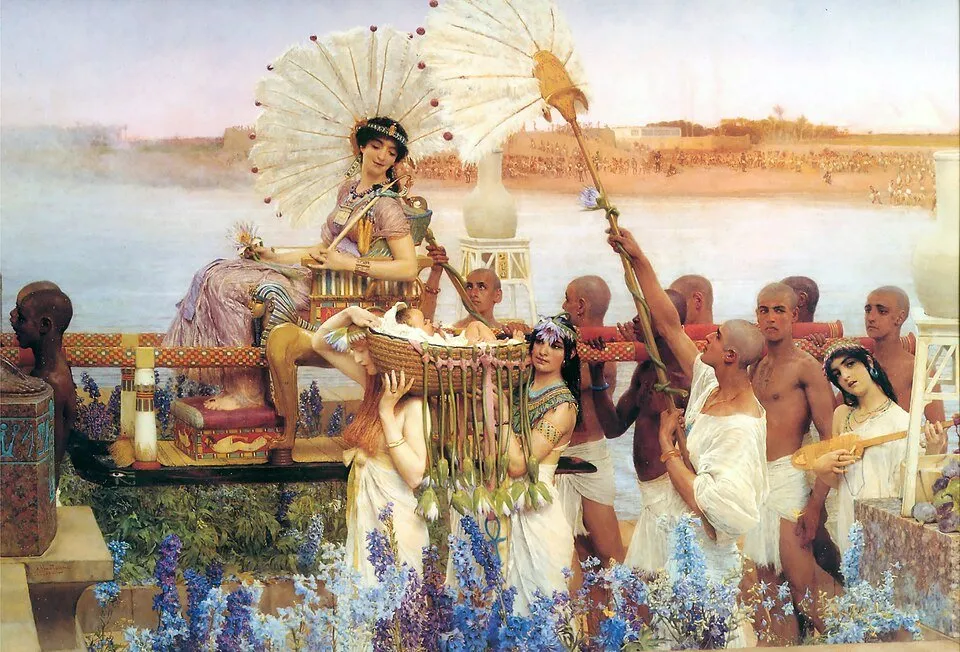
The painting is filled with the specific, textured realism of Egyptian stone. The flowers in the foreground are the very ones Tadema sketched while Aird watched. The cramping of the slaves, the weight of the carrying poles, the sheer engineering of the procession—it is a painting by an artist who has finally seen the real thing.
But for Aird, it meant something more. He had just tamed the Nile. He had placed a harness of stone across the river that had flowed freely for millennia. By owning The Finding of Moses—a scene depicting the very moment the river gave up its greatest treasure—Aird was claiming the Nile for himself. He was placing himself in the lineage of the Pharaohs.
He hung it in his home, a reminder that while he might build with concrete, his legacy was written in gold.
The Silence of the Stone
Sir John Aird died in 1911, just a year before Alma-Tadema.
The Aswan Dam has since been superseded, rebuilt, and raised. The Crystal Palace burned to the ground. The physical monuments of Aird’s life have largely crumbled or changed. The mud has reclaimed the docks; the smoke of his trains has long dissipated.
But the paintings remain.
The Roses of Heliogabalus still suffocates usually cynicism with its beauty. The Finding of Moses still glows with the light of that 1902 winter. These works, commissioned by a man of earth to capture the texture of dreams, have outlasted the iron and the steel.
In the end, the Contractor made a wise investment. He paid for roses, but he bought immortality.
Leave a Visiting Card
Consulting the visiting cards...