
The walls were the color of dried blood, or perhaps the deep, sun-baked clay of a Pompeian villa.
In 1865, Lawrence Tadema and his wife, Marie-Pauline Gressin-Dumoulin de Boisgirard, stood in their new Brussels studio and made a choice. They would not paint it the polite cream or grey of the Belgian bourgeoisie. They painted it red.
It was a manifesto. A declaration that inside these walls, the grey northern sky did not exist. Here, they were building a temple to the Mediterranean sun, a sanctuary of art and memory.
But this room, designed for creation, would soon become a space of profound silence.
This is the story of Pauline, the woman who helped build the dream, but did not live to see it flourish.
The Daughter of the Salon
Marie-Pauline was born in September 1836, into the hum of Brussels' intellectual life. Her father was a French journalist, her mother a woman of culture. The hyphenated name—Gressin-Dumoulin de Boisgirard—speaks of a family aware of its heritage, moving comfortably in the circles of writers and artists.
She was not merely a passive observer of the arts; she was woven into them. When she met the young Lawrence Tadema in the early 1860s, he was a painter of immense technical skill but still searching for his soul. She was twenty-seven, his equal in age and perhaps in intellect.
They married on September 24, 1863, at the Antwerp City Hall. It was a union marked by a certain haste, a joining of hands before a tide that would not wait. Within months, their first child would be born, a reality that the polite society of 1860s Belgium would have viewed through a narrow lens of judgment.
It was the beginning of a partnership that would fundamentally alter the direction of Lawrence's art, though it began under the weight of a secret.
The Journey to the South
Their honeymoon was not a retreat, but a pilgrimage.
They traveled south, crossing the Alps to Italy. Florence, Rome, Naples. And finally, the dust and silence of Pompeii.
For Lawrence Tadema, this was the moment of awakening. But he did not walk those excavation sites alone. Pauline was there, stepping over the same ruts left by chariot wheels, touching the same frescoed walls. They saw a domestic world frozen in time—intimate, colorful, and shockingly human.
And as they walked, Pauline carried a secret of her own. She was already pregnant with their firstborn, a child conceived before the wedding vows. As she looked upon the ruins of an ancient civilization, she was nurturing the beginning of their own. This journey was a double revelation: of the world that was, and the life that was to come. It is impossible to separate Pauline from this discovery; she was the living bridge between the classical past and their precarious future.
The Shadow
They returned to Belgium carrying the light of Italy, but they were soon met with darkness.
Their first child, a son whose name was never recorded in the family history, was born in late 1863—only months after the wedding. In the rigid moral landscape of the mid-19th century, his arrival was a miracle draped in a shadow. The circumstances of his birth represented a breach of the very order and respectability that Lawrence would later cultivate so carefully in London.
But the joy was fragile. In mid-1864, a smallpox epidemic swept through the Low Countries. The infant, who had both hastened their union and come to define their first year of marriage, was taken.
For the full story of this lost child, read "The Lost Son: Alma-Tadema's Hidden Tragedy" →
This tragedy struck early in their marriage, casting a long shadow over the years that followed. One can only imagine the quiet that settled over the house. The loss of a firstborn is a wound that changes the very air of a home. For Pauline, it may have been the beginning of a physical and emotional fragility that she would carry for the rest of her life.
The Life in the Red Studio
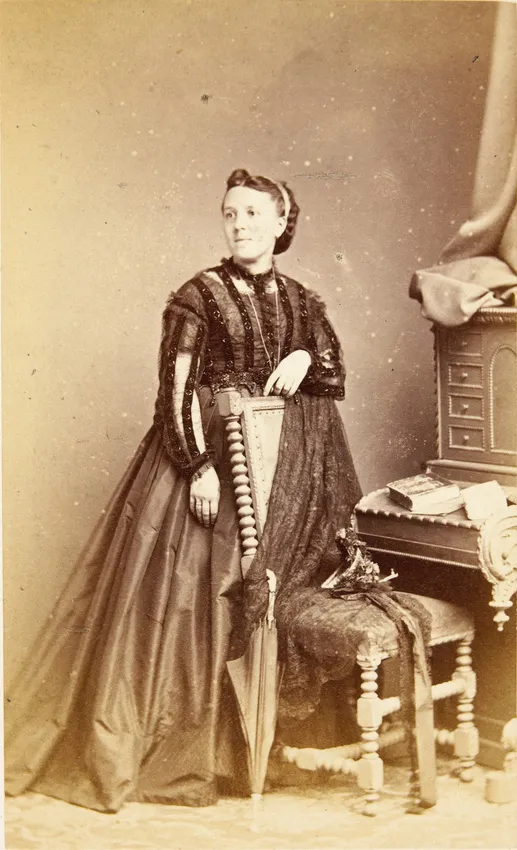
Despite the grief, life insisted on moving forward. In 1865, they moved to Brussels and created the famous studio with red walls—Pauline's domain as much as his.
She became the quiet center of his artistic world. Though Lawrence Tadema would later paint his second wife, Laura, with prolific frequency, Pauline appears more rarely, often as a figure of quiet contemplation.
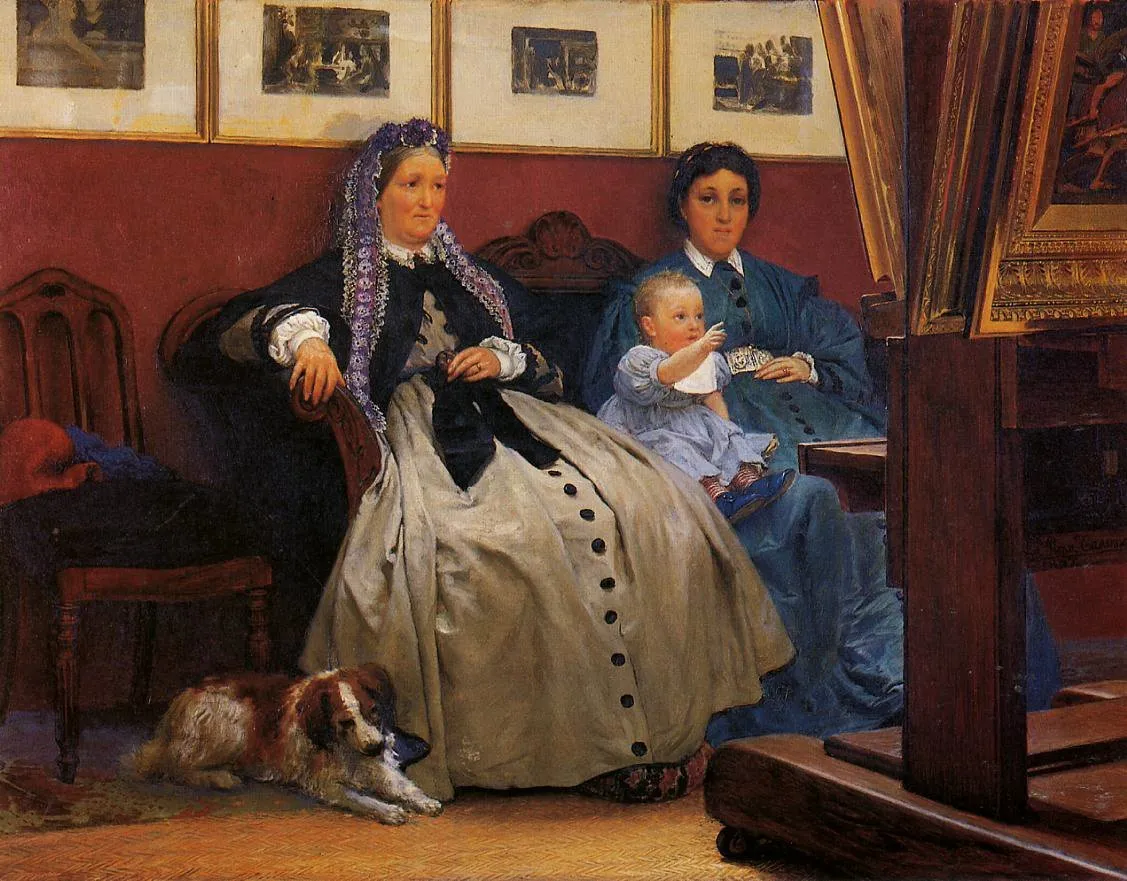
In My Studio (1867), we see the only visual record of their life within those red walls. Pauline sits, arguably pregnant with their daughter Anna, while her mother sits beside her and their toddler, Laurense, plays nearby. It is a scene of domesticity, but it feels enclosed, protected from the world outside.
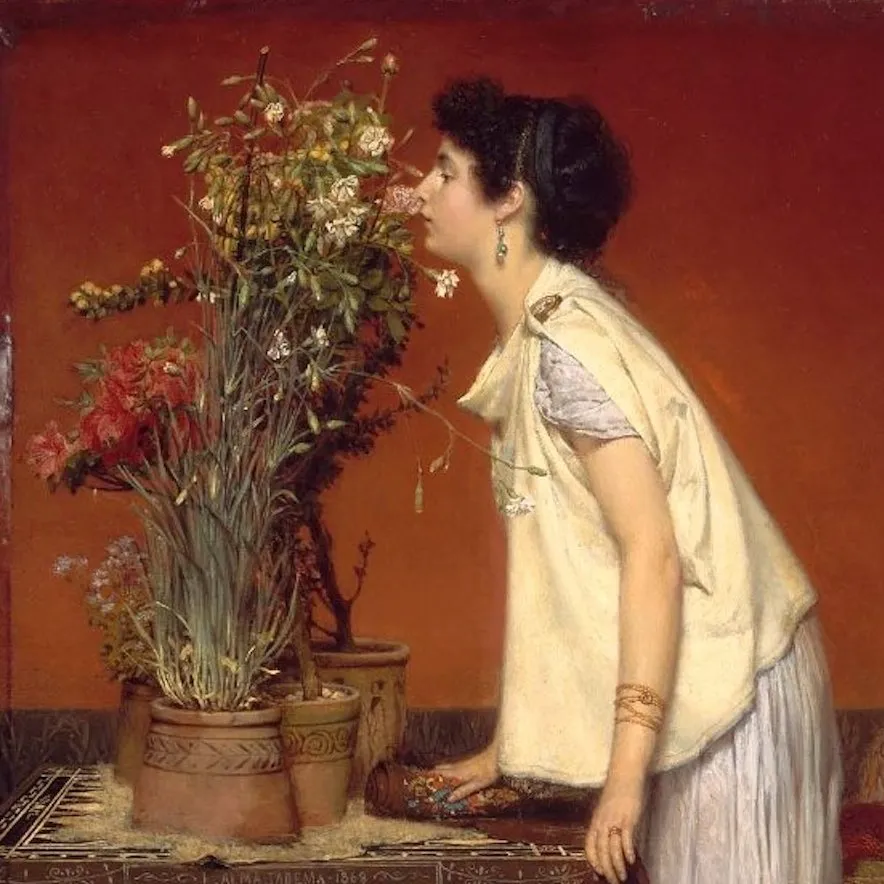
She also served as his model. In Boating (1868), she is the Roman woman, her face capturing a classical stillness. She was the original muse for his Pompeian dreams, the living link to the world they had explored.
During these years, she gave birth to two daughters:
- Laurense (1865), who would grow up to be a writer.
- Anna (1867), who would become a painter herself.
But the mother who bore them was fading.
The Departure
Pauline’s health had been delicate for years—perhaps weakened by the difficult births, perhaps by the lingering grief of her first son, or simply by a constitution that could not withstand the rigors of the age.
In 1869, the shadow returned. Smallpox, the same merciless thief that had taken her son, came for her.
She died on May 28, 1869, in Schaerbeek. She was thirty-two years old.
The devastation was absolute. Lawrence Tadema, a man who usually worked with clockwork regularity, stopped painting for four months. His health collapsed. Doctors feared for him. The studio with the red walls, once a place of shared dreams, was now a tomb.
The Lingering Silence
Lawrence eventually recovered. He moved to London, remarried, and became the most famous painter of his era. He built new studios, grander and more opulent than the one in Brussels.
But Pauline remained in the red studio.
She belongs to the "Tadema" era, before the "Alma" was fully adopted, before the knighthood and the Royal Academy. She belongs to the years of struggle and discovery.
It is said that Lawrence rarely spoke of her in later years. Some interpret this as erasure, but perhaps it was protection—not just of his own heart, but of the curated life he had built. To speak of Pauline was to speak of a different version of himself: a young man whose life had begun with "untidy" starts, a rushed marriage, and the heavy social price of a child born too soon.
Some griefs are too heavy or too complex to be spoken aloud; they are kept in a quiet room of the heart, the door closed, the walls painted red, preserving the memory exactly as it was—beautiful, tragic, and entirely their own.
In the faces of his daughters—Laurense with her literary mind, and Anna with her artistic hand—Pauline lived on. And in every Roman scene where a woman sits quietly in a domestic interior, gazing into the distance, we see the ghost of the woman who first walked the streets of Pompeii by his side.
Leave a Visiting Card
Consulting the visiting cards...