
The Roman philosopher Seneca once lived above a bathhouse. He wrote about the noise: the grunts of weightlifters, the shouts of ball-players, and the shrill, distinctive cry of the hair-plucker who only stopped yelling when he found a client to make yell instead. But there was one sound Seneca never mentioned—the sound of the bath attendants themselves.
They were silent. And that silence was dangerous.
Because in the steam of the Roman baths, where Senators whispered conspiracies and merchants made deals, the bath attendants heard everything. They were the invisible empire within the Empire, the keepers of secrets that could topple thrones. And yet, in the historical record, they barely exist.
Sir Lawrence Alma-Tadema understood this paradox. In his paintings of Roman bath attendants, he gives us what history denied them: a face, a body, a presence. These are not background figures. They are the protagonists of a story that Rome tried to forget.
The Silent Curators
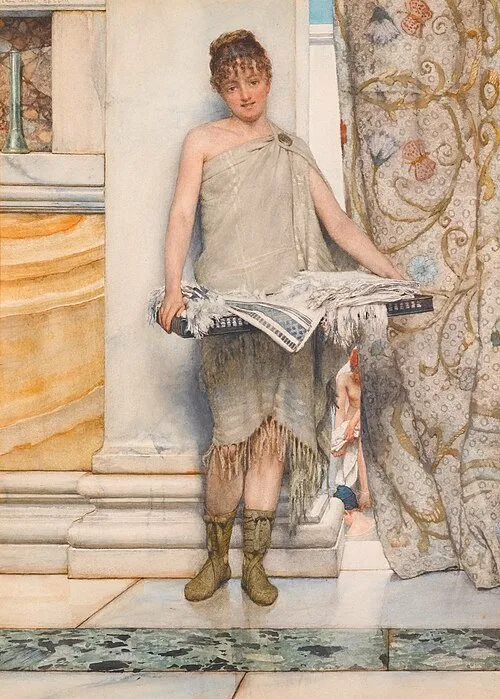
In A Balneatrix (Opus 169), Tadema shows us a woman with a slight smile, standing on duty with a tray piled with unfolded towels—used, not fresh. She waits for the next bather to dump their towel on her pile. There is nothing dramatic about the image. She is simply doing her job.
This was the social paradox of the Roman bath attendants: they were enslaved or low-status, yet they moved through the most intimate spaces of the elite. The very word balneatrix comes from balneum (bath) combined with the feminine agent suffix -trix—literally, "she who creates the bath." But in practice, she created much more than that.
They touched the bodies of Senators. They overheard the whispered plans of generals. They knew who was sick, who was unfaithful, who was plotting. And they were expected to forget it all.

In A Balneator (Opus 176), we see the male counterpart: a man standing with a large sponge and a score of strigils—the curved metal scrapers used to clean oil and sweat from the skin.
But memory, unlike marble, cannot be controlled.
The balneatores (male attendants) and balneatrices (female attendants) were not just laborers. They were the invisible infrastructure of Roman social life. Without them, the baths would have been chaos. With them, the baths became a machine—efficient, beautiful, and utterly dependent on the silence of those who ran it.
The Labor of Beauty
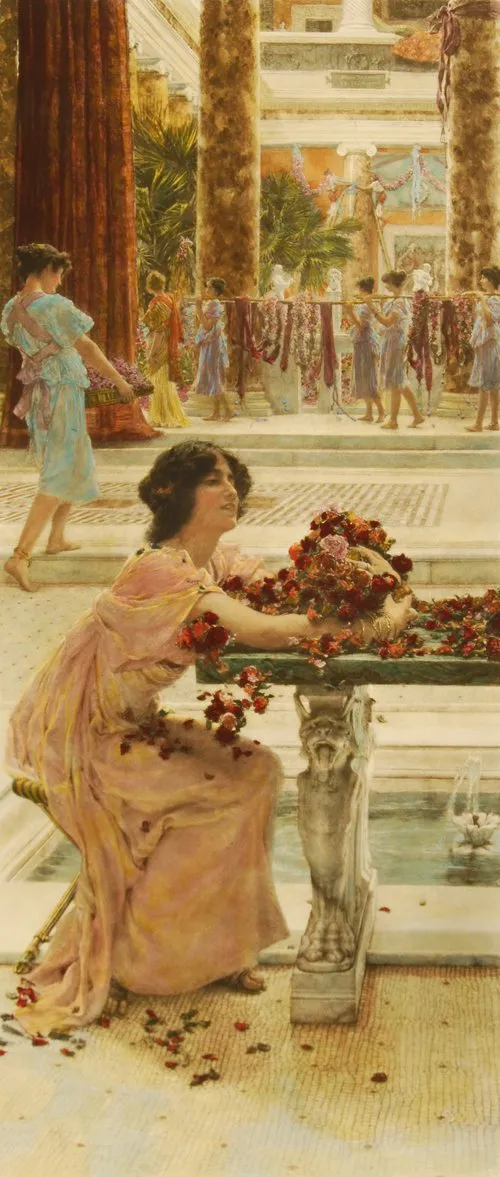
But the work of the bath attendants was not just physical. It was aesthetic. In Roses, Love's Delight (Opus 348), Tadema shows us a Roman lady sitting at a table overflowing with roses, gathering them in her arms with pure delight. She is dressed in a long, elegant gown. Behind her, in the background, you can see the balneatrices in their knee-length working dresses—the ones who actually arranged these garlands, who hauled the crates, who replaced the wilted petals.
This was aesthetic labor—the invisible work of making luxury feel effortless. The lady experiences beauty as if it were natural, as if the roses simply appeared. She does not see the hands that made it possible. Public baths were crowded and sweaty, and the smell of a thousand bodies in steam was overwhelming. To mask it, balneatrices were tasked with creating constant floral arrangements. Roses were shipped by the ton from Egypt to Rome to ensure the baths always smelled like a garden, not a gymnasium.
This painting was so prestigious that it was purchased by Tsar Nicholas II in 1897. It now hangs in a Russian palace, a reminder that even emperors understood the value of those who made beauty possible.
The Keyhole Perspective
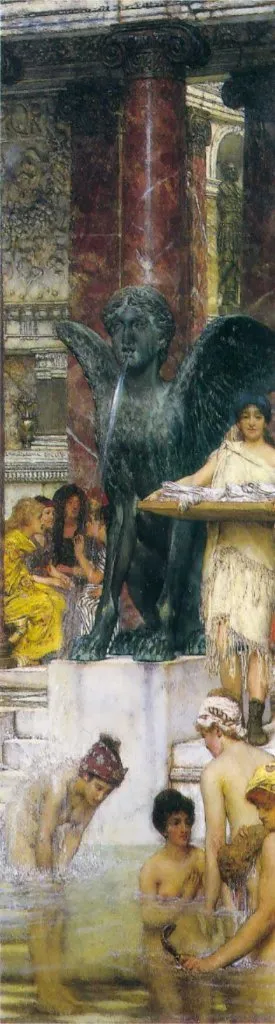
Tadema often used what Dutch scholars call a "sleutelgat" (keyhole) perspective in his bath scenes. In An Antique Custom (Opus 165), we peer through columns and curtains, catching a glimpse of a private ritual. The painting is tiny—just 28 by 8 centimeters—because Tadema found full-sized Roman nudity "daring" for Victorian audiences. But the intimacy of the composition makes it more powerful, not less.
We are not meant to be here. We are voyeurs, intruders in a space that belongs to someone else. And that someone else is the bath attendant, the figure who controls access to this world. She decides who enters, who leaves, who is allowed to linger. In the hierarchy of the baths, she is invisible. But in the architecture of power, she is the gatekeeper.
This is the genius of Tadema's Roman bath attendants: he shows us that invisibility is not the same as powerlessness. The balneatrices may have been enslaved, but they were also essential. And in a world built on secrets, the person who hears them all is never truly powerless.
The Hidden Cost
Beneath the serene surface of the marble lay a brutal industrial reality. To keep the baths at their peak temperature, a hidden army of workers labored in a maze of underground furnaces, feeding fires that sent hot air circulating through hollow floors and walls. While the bathers above discussed philosophy, the slaves below moved in a world of soot and searing heat.
This was the bargain at the heart of the Roman baths: comfort for the many, suffering for the few. The bath attendants we see in Tadema's paintings—the ones arranging roses, the ones standing in the half-light—were the visible tip of an invisible workforce. For every balneatrix in the steam, there were ten more in the furnace room, their names unrecorded, their faces unseen.
But Tadema gives them a monument. In painting after painting, he insists that we see them, that we acknowledge their presence. The baths are ruins now. The furnaces are cold. But the bath attendants remain, frozen in paint, watching us with the same calm, knowing eyes.
They have outlasted the Emperors. They have outlasted the Empire itself.
Next in the Trilogy: A Day at the Roman Baths: The Four-Hour Ritual
Leave a Visiting Card
Consulting the visiting cards...