
When Alma Tadema came to London, he was an outsider. He spoke with a heavy accent. He painted strange, silent scenes of a world long dead.
But Lawrence Alma-Tadema understood something important. Talent is not enough. To truly succeed in Victorian England, you needed a home. You needed a fortress.
For him, that fortress was the Royal Academy.
The relationship between the Royal Academy and Alma Tadema was not just about art. It was about survival. It was about a Dutch immigrant proving, paint stroke by paint stroke, that he belonged in the very center of the British Empire.
The First Step: 1869
In 1869, he showed his first paintings there. One was called A Pyrrhic Dance. It was not a polite English landscape. It was fierce ancient warriors, moving in rhythm. Another was Pheidias and the Frieze of the Parthenon—a painting about art itself.
The critics were confused, but they watched. Who was this Dutchman? Why were his skies so blue? Why did his marble look so cold and hard?
He did not wait for them to decide. He kept painting. He kept showing them the marble, the blue skies, the sunlight that seemed to warm the gallery walls. He brought the Mediterranean to gray London. He offered them an escape they didn't know they needed.
And slowly, London opened its doors.
The Lightning Rise
The Royal Academy was more than a school or a gallery. It was the gatekeeper. If you belonged there, you mattered. If you didn't, you were just a craftsman.
Most artists waited decades to get in. They knocked on the door until their knuckles bled. Alma Tadema did not have to wait long.
In January 1876, seven years after his first show, he became an Associate (ARA). In June 1879—just three years later—he became a full Royal Academician (RA).
It was a lightning rise. The outsider was now at the center of the circle. He had the power to vote. He had the right to hang his best work in the best spots on the line. He was no longer a guest. He was one of the hosts.
This rapid ascent says everything about his ambition. The institution needed him as much as he needed them. He brought a technical brilliance that rivaled the Old Masters. He brought a fresh vision. In return, they gave him the stamp of absolute approval.
The Hanging Committee
Membership had its privileges. As an Academician, he served on the "Hanging Committee." This was the powerful group that decided which paintings would be shown at the Summer Exhibition and—crucially—where they would hang.
To be "on the line" (at eye level) was to be made. To be "skied" (hung high up near the ceiling) was to be ignored.
Alma Tadema took this duty seriously. He was known for his fairness, but also for his exacting standards. He knew what it meant to be an outsider looking in, but now he was the one holding the keys. He shaped the taste of the nation.
The Inner Circle
He didn’t just join the club; he became its heart.
We have records from 1888 showing him sketching during committee meetings. He wasn't just a name on a wall; he was in the room where decisions were made. He helped shape what British art looked like for a generation.
His friends were the giants of the age, and they were all Academy men.
Frederic Leighton, the President of the Academy, was his close companion. They were brothers in beauty. They both built palace-like studios where art and life blurred together. Leighton House and Casa Tadema were the two poles of the aesthetic world—one filled with gold and silence, the other with marble and light.
He knew Edward Poynter and John Everett Millais. They sat on committees together. They judged other artists together. They smoked cigars and argued about color and composition.
Imagine them walking the halls of Burlington House. The smoke of their cigars, the rustle of papers, the quiet confidence of men who knew they were making history. They were the establishment. And Alma Tadema, the boy from Friesland, walked among them as an equal.
The Social Whirl
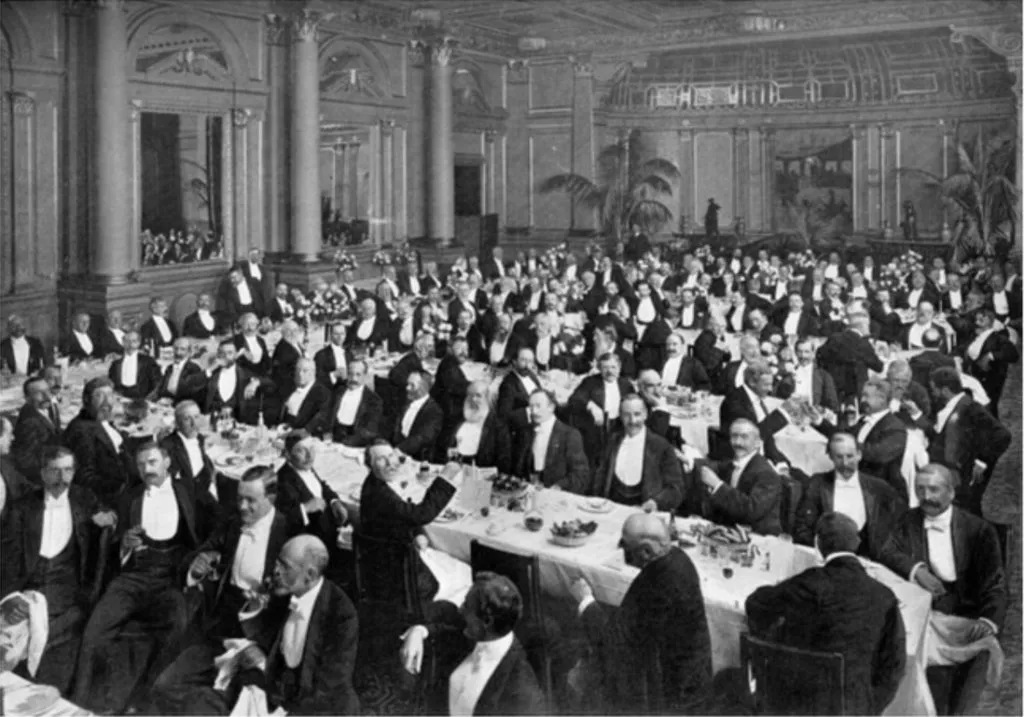
The Academy was also a social engine. The annual Royal Academy Banquet was one of the highlights of the London season. Princes, politicians, and generals sat with the artists to toast the power of British culture.
Alma Tadema thrived in this world. He was a natural host. His own parties at Grove End Road were legendary, but the Academy gave him an official stage. He was no longer just a painter; he was a public figure.
A Validated Life
Why does this matter? Why do we care about a Victorian club in the 21st century?
Because art can be a lonely path. Doubts creep in. Am I good enough? Does anyone see what I see? Is this worth anything?
The relationship between the institution and Alma Tadema was the answer to those questions. It was England saying, "Yes. We see you. You belong."
It gave him the security to build his vision. It gave him the platform to show the world the beauty of the ancient past. Without the Academy, he might have remained a talented curiosity. With it, he became a national treasure.
The Legacy of the Academy
When he died, it was the Royal Academy that paid for his memorial. They did not forget their own.
Today, looking back, we see the Academy as a symbol of old-fashioned art. We think of rebels like the Impressionists breaking away from it. But for Alma Tadema, checking the box of "Royal Academician" was the ultimate rebellion. It was the immigrant proving he could beat the natives at their own game.
He mastered their rules. He painted better than their masters. He wore their laurels.
He gave the Academy his brilliance. They gave him a home. And in that exchange, they built a legacy that still stands, solid as the marble he loved to paint.
Leave a Visiting Card
Consulting the visiting cards...