
In the first two acts of our history, we watched the axes strike and the royal curtains part. We saw the nursery of Queen Clotilde and the bloody palace of King Chilperic. Now, we reach the final act of this Alma-Tadema Merovingians series—the moment when the "Servant Queen" faces the one power she could not silence with a blade: the Church.
By the end of her life, Fredegonda had outlived almost everyone. Her husband was dead, and her greatest enemies were gone. She had become the grandmother of the dynasty, a woman who had survived forty years of war, mostly by starting them herself.
The Attack on the Altar (A Final Act of Violence)
Fredegonda's last major enemy was not a rival Queen, but a man of God. Bishop Praetextatus of Rouen had dared to defy her. He had blessed a shocking marriage between Fredegonda’s stepson, Merovech, and her greatest rival, Brunhilda.
Yes, it was the same Brunhilda from the earlier acts. This marriage was a scandal because Brunhilda was Merovech's aunt (his dead uncle's wife), and the Church usually forbade such unions. More importantly, it was a massive political threat. If her stepson teamed up with her worst enemy, Fredegonda’s own power would be destroyed.
In the Merovingian world, the response to defiance was usually the axe. Fredegonda had the Bishop stabbed during the Easter Mass inside his own cathedral. It was a crime that shocked the entire kingdom.
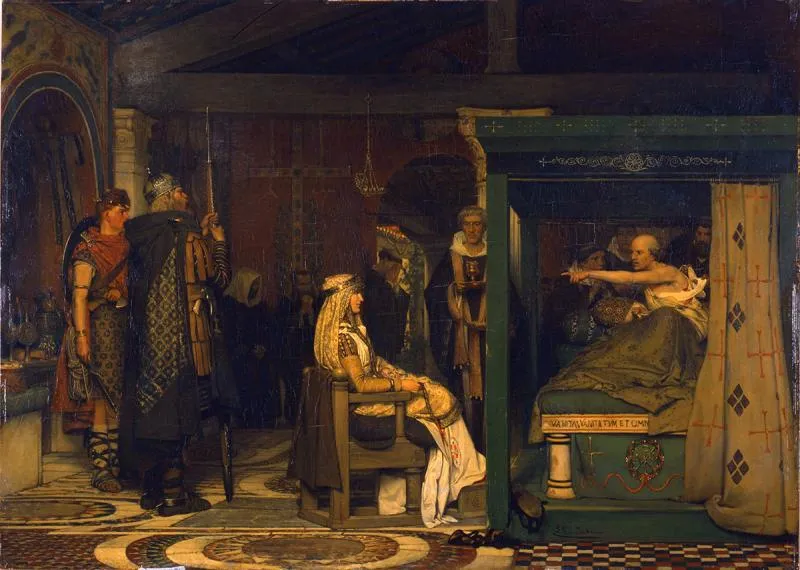
But the most chilling part of the story is what happened next. Fredegonda visited the dying Bishop in his bedroom. She pretended to be kind, offering him "medical help" and comfort, even though she was the one who had ordered the attack. It was an act of staggering hypocrisy. As the Bishop lay dying, he looked at her and said: "You can help by repenting, for you are the one who caused my death."
Fredegonda didn't care. She was a woman who believed that staying alive and keeping power were the only things that mattered.
The Return of the Word (The Age of the Poet)
As Fredegonda grew older, a change was coming to the Merovingian world. The "Age of the Axe" was slowly ending. People were starting to value the written word and the arts again, just like they had in the old Roman days.
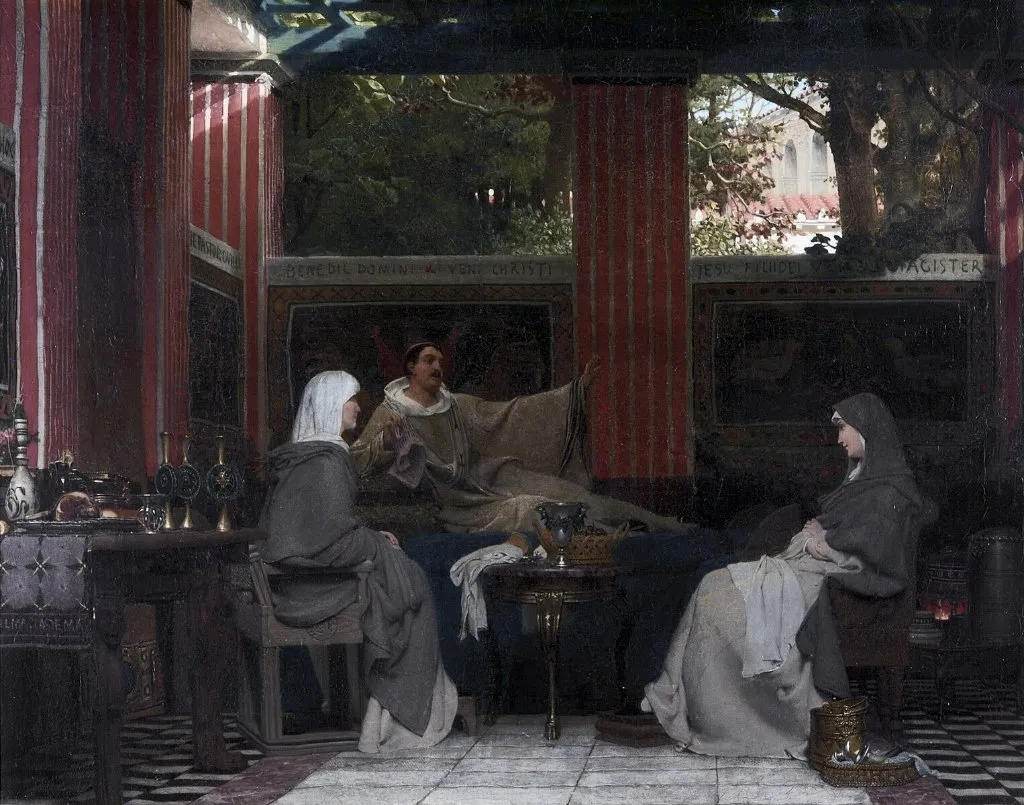
In this painting, we encounter Venantius Fortunatus, a celebrated poet of the era. He is shown before Queen Radegunda, a legendary figure who represented a very different path for Merovingian royalty. Radegunda was married to Chlothar I—the same youngest son we saw clinging to Queen Clotilde’s robes in the first act.
While Chlothar was a powerful ruler who famously kept multiple wives at the same time, Radegunda’s status was never in question. As a royal princess by birth and a legally wedded consort, she held the title of Queen alongside several other women. In the Merovingian world, the title was shared among the King’s favorites.
Because she was married to the King's father but was not the biological mother of his successors, Radegunda occupied the role of Fredegonda’s step-mother-in-law. Yet, while Fredegonda spent her life pursuing power through violence, Radegunda famously chose to leave the court for the peace of a convent. As the poet reads his verses, we see the "Long-Haired Kings" finally beginning to value the words of the poet over the blades of the assassin. This shift marked the dawn of a new culture that would eventually lead to the Middle Ages.
The Great Irony: A Peaceful Death
The most surprising part of Fredegonda’s story is the end. After a life of murder and war, she did not die in battle. She died peacefully in her bed in Paris, a grandmother in her fifties. She had secured the throne for her son and outlasted all her enemies.
She won.
This is the real tragedy of the story. She didn't pay for her crimes; she lived to see them succeed. She proved that in a world of ruins and violence, the skills of survival were more powerful than the laws of the past.
The Historian’s Debrief: The End of the Dark Phase
1. Moving Toward the Light
This final act in the Alma-Tadema Merovingians series was also a turning point for the artist. After painting these dark, bloody stories in Belgium, Tadema moved to London. His paintings became brighter and more sunny as he started painting the marble world of Rome.
2. The Power of Details
In these final works, Tadema captures the "switch" from one age to another. He shows the heavy incense of the Cathedral and the thin parchment of the poet’s scroll. By getting these small details right, he proved he was a master of history before he became the world's most famous painter of ancient life.
Leave a Visiting Card
Consulting the visiting cards...