
In the mid-6th century, the Frankish Empire was a "Nest of Scorpions." The Merovingian kings had traded their wild forests for Roman palaces, surrounding themselves with plundered gold and stolen silks. But behind the silk curtains, a deadly cycle of family civil war was unfolding.
Act I: The Power Move and the Shadow Queen
The year is 567 AD. The Frankish empire was split between brothers locked in a brutal contest for dominance. King Sigebert had just scored a major political victory by marrying Brunhilda, a Spanish Visigoth princess. In the sixth century, a royal marriage wasn't romance—it was a business transaction that brought gold, territory, and the sheen of Roman "civilization" to barbarian warlords still wearing their ancestors' battle scars.
King Chilperic I, Sigebert's brother, couldn't let this stand. Burning with jealousy, he demanded Brunhilda's sister, Galswintha, as his bride. To win her hand, he made a solemn vow to her powerful family: he would cast aside all his other wives and mistresses. Galswintha would be his one true Queen.
It was a lie that would set the kingdom on fire for forty years.
On the wedding day, the great hall of Chilperic's palace blazed with torchlight and ceremony. Galswintha stood beside her new husband in the public spectacle, draped in silks, surrounded by the trappings of imperial grandeur. But in the shadows at the edge of the room sat a woman who had not been dismissed at all.
Fredegonda—former slave, current mistress, and the king's true obsession—watched the ceremony with calculating eyes. She had not been sent away. She had simply been told to wait. And as the wedding rites unfolded in the bright ceremonial center of the hall, Fredegonda sat in the darkness at the threshold, already planning the destruction of the woman who thought she had won.
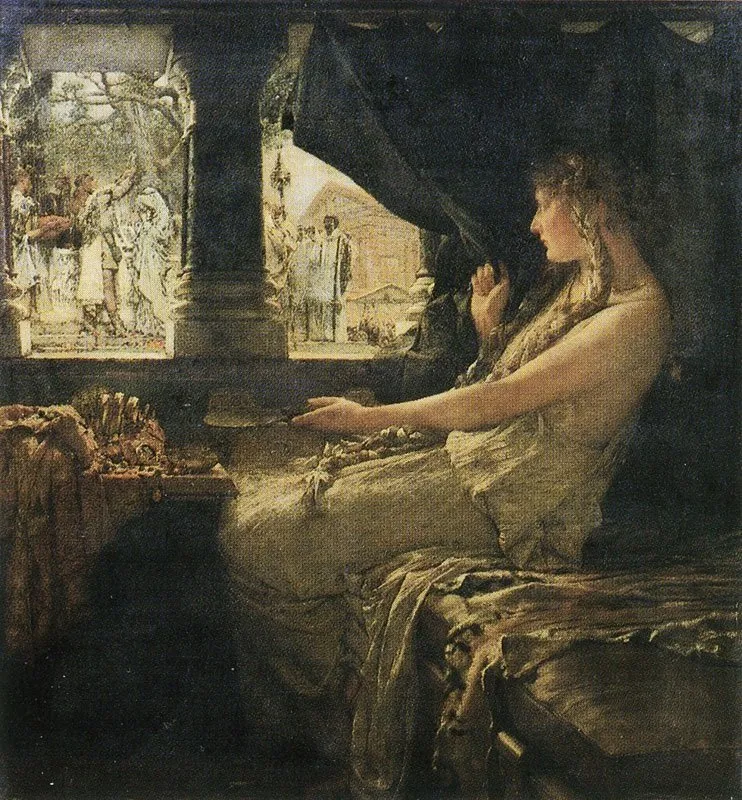
This is the moment Alma-Tadema captured: not the wedding, but the watcher in the shadows. Through a dramatic archway, the brightly lit marriage ceremony unfolds in the distance—all pageantry and false promises. But dominating the foreground, seated in darkness, is Fredegonda. Her expression is pure calculation. The composition tells the truth: the real power in this room isn't standing at the altar. It's sitting in the shadows, waiting.
Act II: The Price of Honesty
The marriage was a sham from the beginning. Within weeks, Galswintha discovered the truth: Fredegonda had never left. She was still in the king's bed, still whispering in his ear, still the real queen in everything but name. Galswintha was royalty by blood, but she was utterly powerless.
Desperate and humiliated, she made a choice that would seal her fate. She became the "Honest Wife"—a woman who refused to play the game of scorpions. She went to Chilperic and begged for mercy: let me go home to Spain. You can keep everything—the gold, the treasure, all of it. Just let me leave with my dignity.
It was the plea of someone who still believed in honor. In the Merovingian court, that kind of honesty was a death sentence.
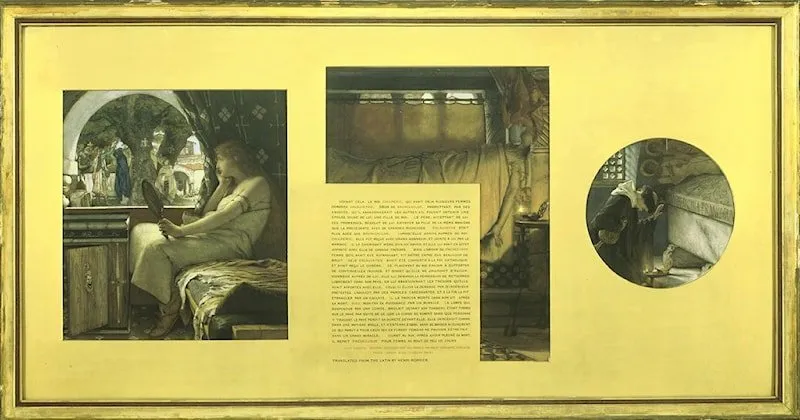
Alma-Tadema painted her tragedy as a triptych: arrival at court full of hope, lying dead in her bed, and the miracle that would vindicate her innocence. The three panels tell the arc of a woman who entered a nest of scorpions and never made it out alive.
Act III: The Strangled Queen and the Miracle
Chilperic was trapped. If he let Galswintha return to Spain, her powerful family would eventually demand the return of her enormous dowry. The gold had already been spent, distributed, woven into the fabric of his power. He couldn't afford to give it back. But he also couldn't afford to keep a wife who openly despised him and made his court look weak.
Greed won over mercy.
One night, Chilperic came to Galswintha's chamber with soft words and false affection. He soothed her, spoke gently, acted the part of the concerned husband. And while she listened, a slave entered the room and strangled her in her bed.
The next morning, Chilperic "discovered" her body. He wept theatrically. He ordered a grand funeral. And a few days later, he publicly remarried Fredegonda, making official what had always been true.
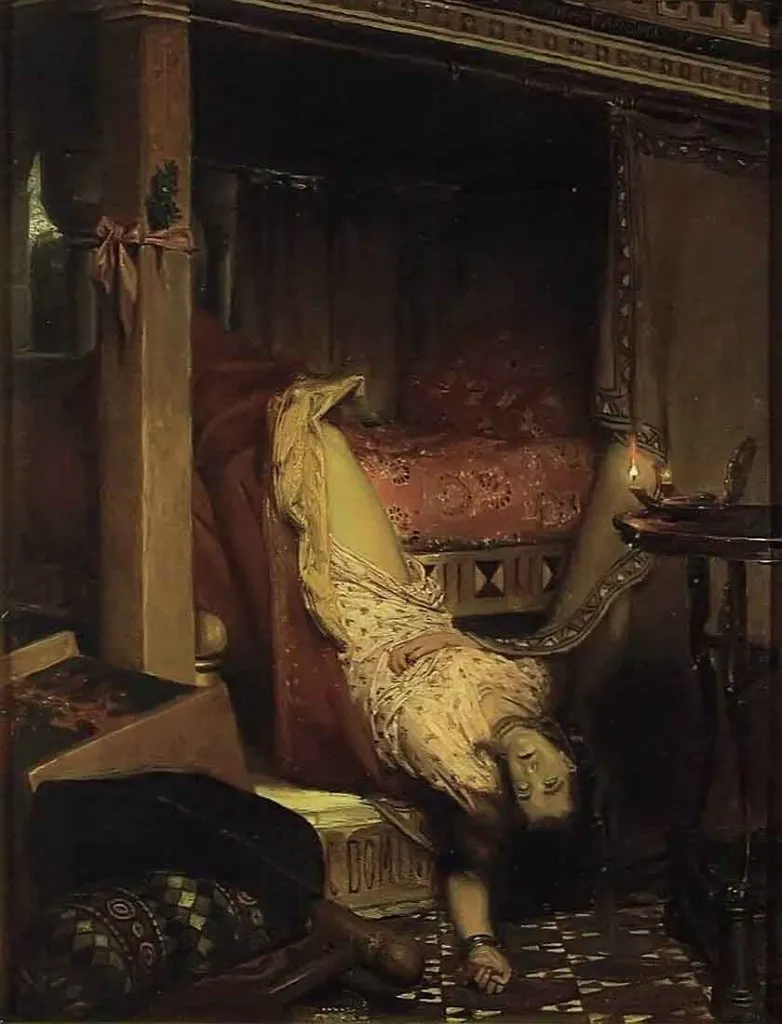
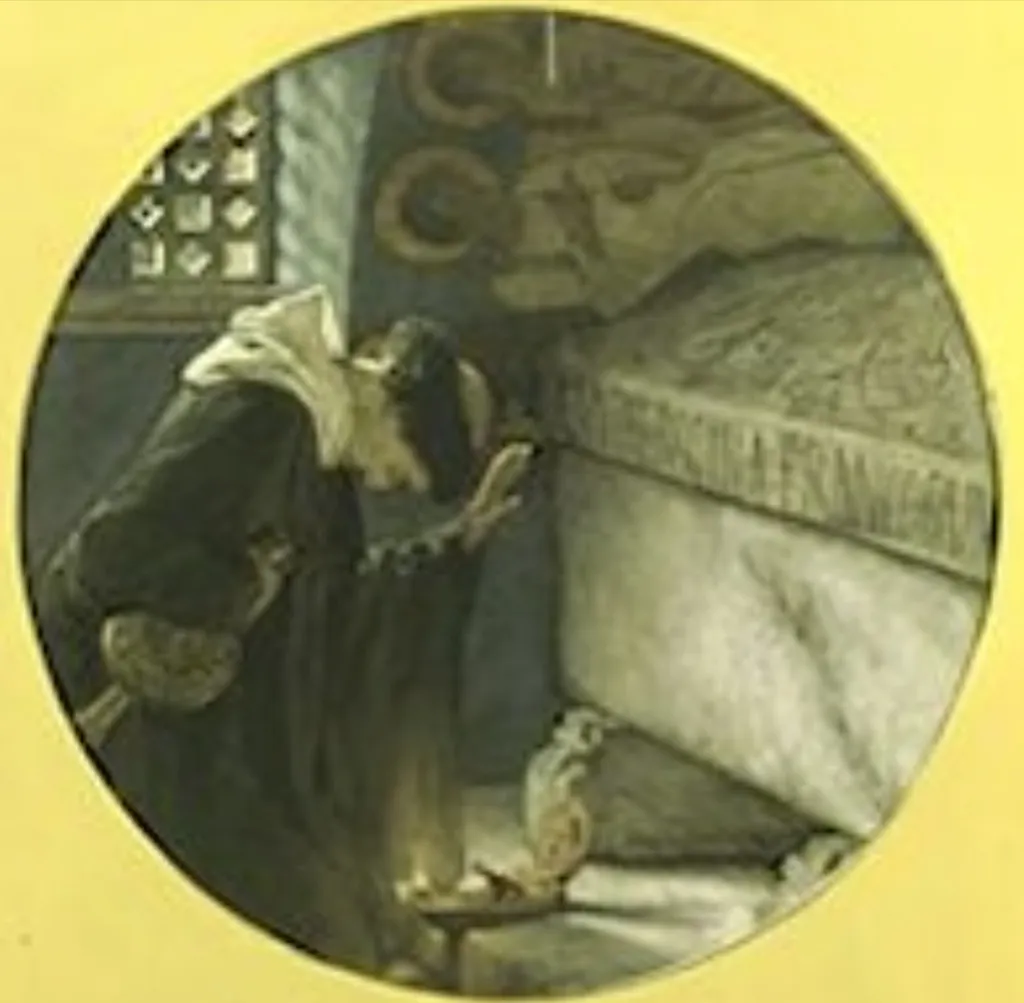
But Galswintha's story didn't end with murder. According to the account Alma-Tadema inscribed in Latin directly onto his watercolor, God himself intervened. At her tomb, a lamp hanging by a cord suddenly fell—but instead of shattering on the stone floor, the pavement softened like wax to receive it. The lamp sank halfway into the stone without breaking, witnessed by a crowd of stunned observers.
The following is a translation of the Latin inscription Tadema painted onto the work:
Translation of the Inscription on the Frame
"Seeing this, King Chilperic, who already had several wives, asked for Galswintha, sister of Brunhilda, promising, through his envoys, that he would abandon the others if he could obtain a spouse worthy of him, a king's daughter. The father, accepting these promises from him, resolved to send him his daughter in the same manner as the previous one, with great riches.
Galswintha was older than Brunhilda. When she arrived to King Chilperic, she was received with great honor, and joined to him by marriage. He even cherished her with a lively love, and she had indeed brought with her great treasures. But the love of Fredegonda, a woman whom he had had previously, caused much noise to arise between them.
Already Galswintha had been converted to the Catholic faith and had received the chrism. Complaining to the King about having to endure continual insults, and saying that she enjoyed no honor with him, she asked him for permission to return freely to her country, leaving him the treasures she had brought with her.
He evaded the request with ingenious pretexts, softened her with caressing words, and in the end had her strangled by a slave. He found her dead in her bed.
After her death, God showed his power by a miracle. The lamp which, suspended by a cord, burned before her tomb, having fallen onto the pavement because the cord broke without anyone touching it, the pavement lost its hardness before it; it descended as if into a soft material, and half-buried itself without breaking at all; which appeared to all those who witnessed it not to have been able to happen without a great miracle.
As for the King, after having wept for her death, he took Fredegonda back as his wife after a few days."
Extract from the Ecclesiastical History of the Franks by Saint Gregory, Bishop of Tours (539-594). Translated from the Latin by Henri Bordier.
This miracle was the only justice Galswintha would receive—a supernatural verdict on her murder that even a king couldn't silence. While Chilperic stood frozen before the tomb, staring at the stone that had turned to wax, the political consequences of his crime were already beginning to burn across the kingdom.
Act IV: The Cycle of Violence (The Ambuscade)
The murder of the "Strangled Queen" wasn't just a domestic tragedy. It was a geopolitical earthquake.
Galswintha's sister, Brunhilda, heard the news in her own royal court. She knew immediately what had happened. And she swore a blood oath of vengeance against Chilperic and Fredegonda that would consume the Frankish empire for forty years. This wasn't a feud—it was total war. The kingdom became a battlefield where every road was dangerous, every alliance temporary, and every crown came with a target on your head.
In this new "Age of the Axe," the boundaries of civilized life dissolved. The safety of the home, the sanctity of the church, the security of the road—all erased. It became a world where you slept with a dagger under your pillow and traveled with your hand on your sword.
In 572 AD—just five years after Galswintha's murder—Duke Gunthram Bose was fleeing for his life. He had been a commander in King Sigebert's army, but after Sigebert was poisoned, Bose found himself caught between warring factions. When he learned of a plot by King Chilperic to harm his daughters, he embarked with desperate haste to protect them, traveling through the dense forests of Aquitaine.
The forest was silent. Then it wasn't.
Suddenly, figures emerged from the trees. Weapons flashed. Horses screamed. Gunthram Bose reached for his sword, his face twisted in primal focus as he fought to defend his children. But his daughters weren't warriors—they were collateral damage in a war started by kings. One was caught mid-scream, her mouth open in raw, unidealized terror.
This was the ultimate expression of the "Nest of Scorpions." The poison of the palace had seeped into the very soil of the kingdom. The murder of one honest woman in a bedroom had unleashed a wave of violence that reached deep into the forests, where even a father's sword might not be enough to save his children.
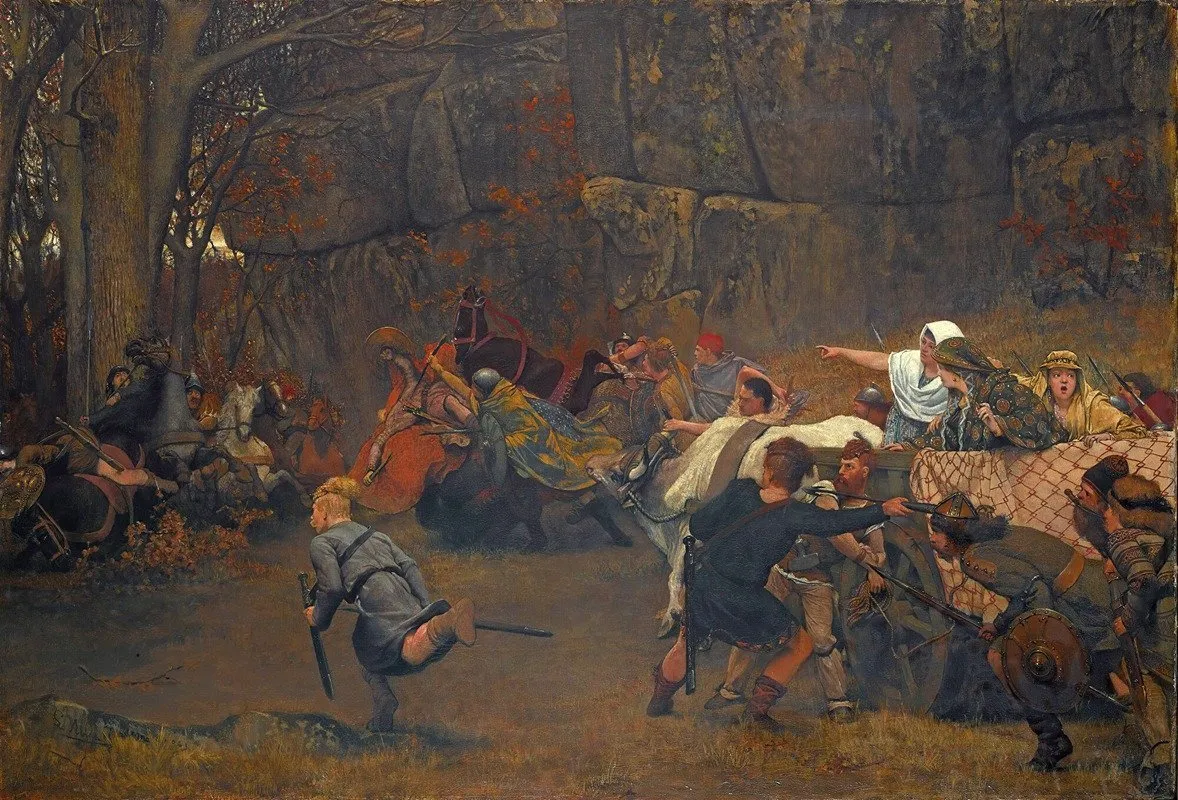
Alma-Tadema painted this scene early in his career, and it's radically different from the sun-drenched marble terraces he would later become famous for. Here, ancient trees press in from all sides, cutting off escape. The composition is claustrophobic, shadowed, violent—a world away from Roman luxury. This is the Merovingian reality: a civilization built on plunder, drowning in its own blood.
The Historian's Debrief: Why This Story Still Matters
1. Scavengers Wearing Silk: The Merovingian Paradox
The Merovingian kings were cultural scavengers living in the ruins of Rome. They occupied Roman palaces, sat on Roman thrones, wore Roman jewelry, and minted coins with Latin inscriptions. But underneath the imperial costume, they were still tribal warlords who solved problems with axes and assassination.
This is what makes the Merovingian period so psychologically fascinating: it's a civilization caught between two worlds. They wanted the prestige of Rome—the gold, the architecture, the sense of being "civilized"—but they governed through raw violence. Chilperic could commission beautiful churches and then strangle his wife in the same week. Fredegonda could host elaborate court ceremonies and order political murders with equal ease.
It's the collision of these two realities—Roman refinement and Germanic brutality—that gives these stories their disturbing power. The silk curtains don't hide the blood. They frame it.
2. Victorian Audiences and "Respectable" Violence
The wealthy Victorians who bought Alma-Tadema's paintings weren't just buying art—they were buying cultural capital disguised as moral education.
On the surface, these were history lessons: cautionary tales about the dangers of barbarism, the triumph of Christianity, the cost of moral corruption. Victorian buyers could display these paintings in their drawing rooms and claim they were educating their families about the past.
But look closer at what Tadema actually painted: a woman plotting murder in the shadows. A queen strangled in her bed. A father and his daughters ambushed in the forest. These are dark, violent, psychologically complex scenes—exactly the kind of material that would be considered scandalous if set in contemporary Victorian England.
Tadema gave his audience a way to consume violence, betrayal, and sexual intrigue while maintaining their respectability. The historical setting created a safe distance. The meticulous archaeological accuracy provided intellectual legitimacy. You weren't looking at sensationalism—you were studying history.
3. The Scholar's Flex: How Victorian Buyers Showed Off
Alma-Tadema was obsessive about historical accuracy, and his educated buyers knew it. Every architectural detail, every piece of furniture, every costume was researched. For Victorian collectors, recognizing these details was a way to publicly demonstrate their classical education.
When guests visited and admired the painting, the owner could point out the period-accurate Merovingian architecture, identify the historical figures, explain the reference to Gregory of Tours. It was like owning a visual puzzle that only the educated could fully decode. The more obscure the historical reference, the better—because it separated those who knew from those who merely looked.
This is why Tadema chose the Merovingians rather than, say, the fall of Rome or the rise of Charlemagne. The Merovingian period was obscure enough to be impressive. A collector who owned these paintings was signaling: "I don't just know the famous parts of history. I know the deep cuts."
4. From Scorpions to Symbols: What We're Really Looking At
These paintings aren't really about the 6th century. They're about power, betrayal, and the fragility of civilization—themes that resonated just as powerfully in Victorian England as they did in Merovingian Gaul.
When Victorian viewers looked at Fredegonda sitting in the shadows, they weren't just seeing a Frankish concubine. They were seeing every ambitious outsider who ever seized power through cunning rather than birth. When they saw Galswintha begging to go home, they saw every honest person destroyed by playing the game too fairly.
Alma-Tadema understood something crucial: the past is a mirror, not a window. We don't look at history to see what was different. We look to see what remains the same.
In our final act, 'The Survivor's Silence,' we witness the endgame of the two Queens as the age of the axe finally gives way to the age of the poem.
Leave a Visiting Card
Consulting the visiting cards...