
When Laura Alma Tadema walked into a room, the shadows seemed to lift.
It is easy to focus on her famous husband. Sir Lawrence was the giant, the Royal Academician, the man who painted Rome. But without Laura, there might not have been a Sir Lawrence.
She was the light that brought him back from the dark.
The Meeting: Love at First Sight
In 1869, Lawrence was a broken man. His first wife had died. He was a widower with two small daughters, living in a foreign country, struggling with grief. He was talented, yes, but he was drifting.
Then he met Laura Epps (born Laura Theresa Epps).
She was seventeen years old. He was thirty-three. On paper, it was a mismatch. Her father, Dr. George Napoleon Epps, was hesitant; the age gap was significant. But Lawrence famously fell in "love at first sight." He saw something in her—a quiet strength, a supreme elegance, and a shared soul.
He began to give her painting lessons. It was the oldest courtship trick in the book, but for Laura Alma Tadema, it was also the start of a serious career. She possessed a natural gift that surprised even him. Her eye for color was subtle, her hand steady.
They married in July 1871. The broken house was whole again.
The Artist in Her Own Right
History often labels her as a "muse." And she was. You can see her face in many of Lawrence’s paintings—that distinctive profile, the red-gold hair, the calm expression. She is the woman in The Women of Amphissa. She is the beauty in The Roses of Heliogabalus.
But Laura Alma Tadema was not content to just sit still. She was a worker.
She built her own reputation. While Lawrence painted vast marble stadiums and Roman baths, Laura Alma Tadema looked inward. She was influenced by the Dutch masters of the 17th century—Vermeer and de Hooch.
She painted domestic scenes. Quiet rooms. Sunlight falling on an old oak table. A child reading a book. One of her most famous works, Sweet Industry, shows women weaving, bathed in a soft, golden light that rivals Vermeer himself. Another, The Mirror, captures a fleeting moment of vanity with a delicacy that is entirely feminine and entirely masterful.
These were not hobbies. They were masterpieces of mood and light created by the unique hand of Laura Alma Tadema.
She exhibited at the Royal Academy. She showed her work at the Paris Salon. In 1876, she won a gold medal in Berlin. In 1893, she won a silver medal at the World’s Columbian Exposition in Chicago.
She signed her works beautifully, proudly. She numbered them with "Opus" numbers, just like her husband. She was Mrs. Alma-Tadema, yes, but she was also an artist who commanded respect in the male-dominated world of Victorian art.
The Golden Couple
Together, they were unstoppable. They were the power couple of the aesthetic movement.
Their home, the famous "Casa Tadema" in St John’s Wood, became the center of London’s artistic life. And Laura Alma Tadema was its queen.
She hosted the most famous parties in London. Musicians, actors, and princes came to their studio. The guest list was a who's who of the era: Tchaikovsky played the piano there. Caruso sang. Winston Churchill visited.
While Lawrence was loud, jovial, and full of pranks (he loved mechanical toys and bad jokes), Laura was the calm center of the storm. She moved through the crowds with grace, making everyone feel welcome. She was the anchor that kept the ship steady.
They worked together in the studio. Imagine the scene: Lawrence on one side, painting a Roman emperor; Laura Alma Tadema on the other, painting a quiet Dutch interior. The smell of turpentine, the silence of concentration, the shared purpose. They critiqued each other’s work. They shared models. They lived for art.
It was a partnership in every sense of the word.
The Stepmother
It takes a special kind of woman to raise another woman's children.
When Laura married Lawrence, his daughters Anna and Laurence were still young. They had lost their mother. They needed someone.
Laura Alma Tadema stepped into that role not with force, but with love. She nurtured their talents. She encouraged Anna’s painting and Laurence’s writing. She didn't try to replace their mother; she simply added more love to the house.
The bond between the three women was profound. In paintings from the era, you see them together—reading, sewing, simply being. It was a household of women, presided over by a benevolent, bearded king.
The End of the Dream
But the golden age could not last forever.
In 1909, Laura fell ill. Her health had always been delicate, but this was different. She went to Germany for a cure, desperate to recover. It did not help. She returned to England weak and fading.
On August 15, 1909, Laura Alma Tadema died. She was only fifty-seven years old.
Her death shattered Lawrence. The light went out of his life. He stopped painting with the same joy. His letters from this time are heartbroken. His health declined rapidly.
He survived her by only three years. It is said he died of a broken heart, unable to imagine a world without her.
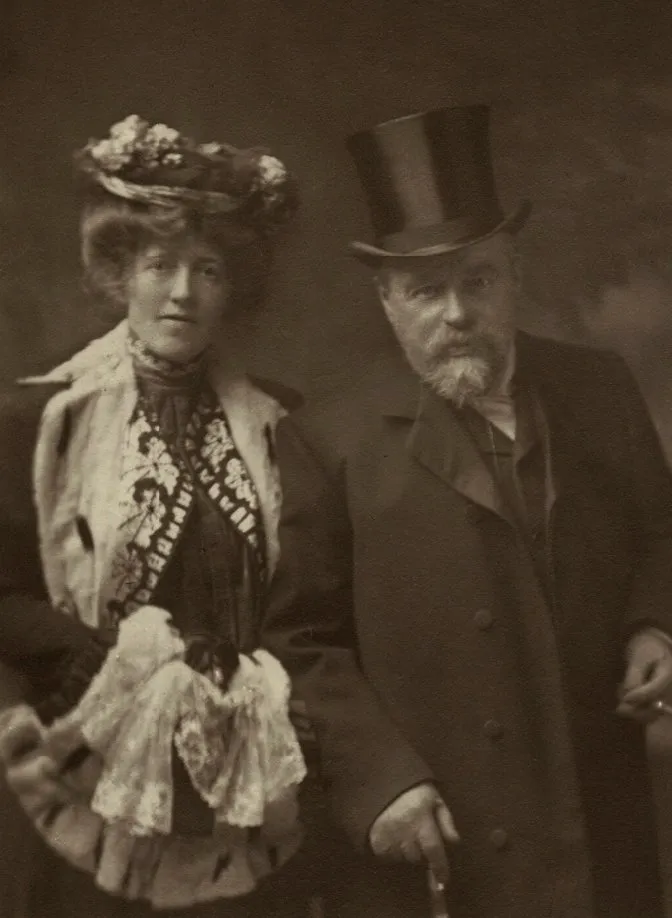
Enter the Studio.
Discover the private collection of Lady Alma-Tadema’s intimate works in our curated digital gallery.
Open Lady Alma-Tadema’s StudioRemembering Laura
Today, history is finally giving Laura Alma Tadema her due.
We are looking past the famous last name. We are seeing the woman who mastered the brush. We are seeing the stepmother who raised two brilliant daughters. We are seeing the partner who made the great Sir Lawrence possible.
She was the heart of the house. She was the quiet genius in the corner.
And in her own paintings, Laura Alma Tadema left us a piece of her soul—gentle, detailed, and filled with a light that never goes out.
Leave a Visiting Card
Consulting the visiting cards...